







VS Code

GitScrum for VS Code, Google Antigravity, Cursor and Windsurf!

GitScrum logo
Solution

Client Expectations 2026 | Real-Time Project Boards

Scope creep kills client relationships. GitScrum: client-visible boards, documented scope, sprint demos align expectations continuously. Free trial.

Client Expectations 2026 | Real-Time Project Boards

Client projects fail more often from expectation misalignment than technical failure.

Client has one vision, developer understands another. Scope is 'agreed' verbally but never documented clearly.

'Small changes' accumulate into massive scope creep. Client doesn't see progress until final delivery—then discovers it's not what they expected.

The agency/freelancer relationship suffers because surprises erode trust. Managing expectations requires continuous visibility: client sees progress as it happens, scope is documented and changes tracked, delivery is incremental so misalignments surface early.

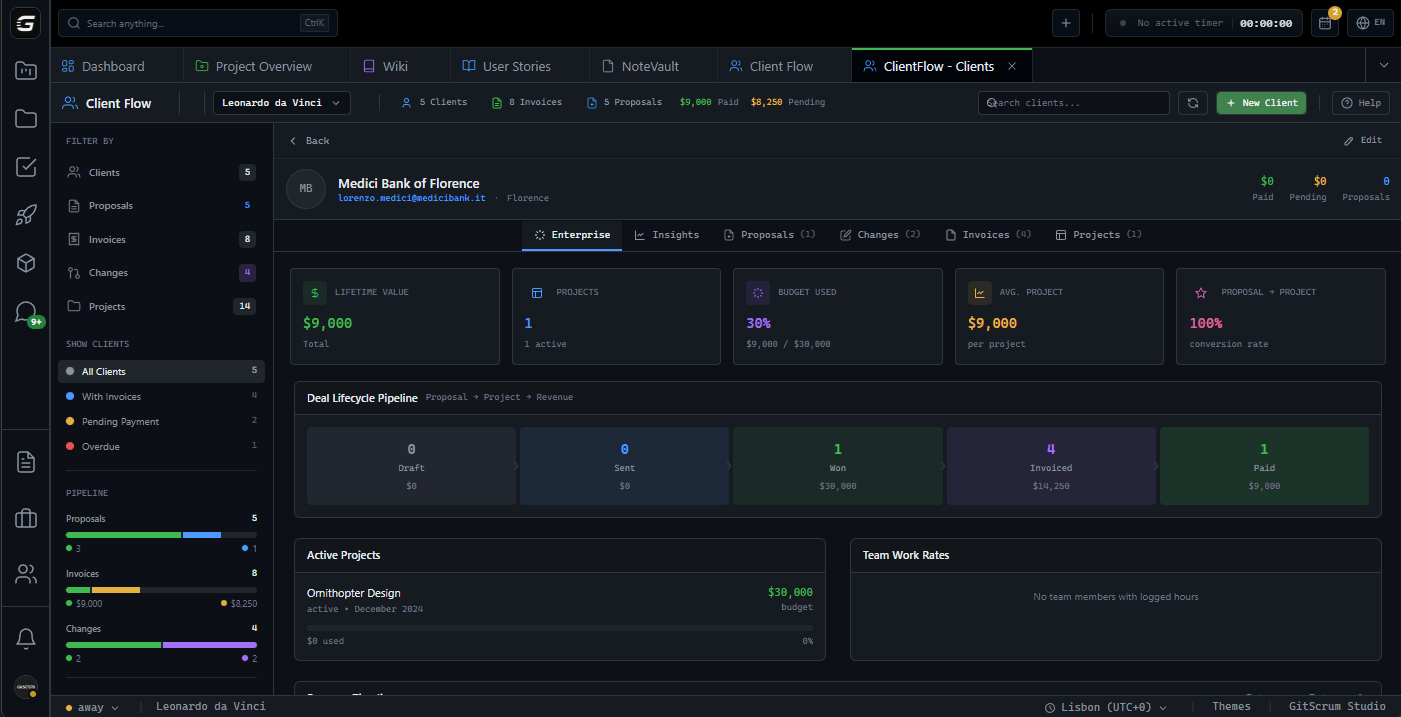
GitScrum enables this: share project board with client (read-only access), document scope in User Stories with acceptance criteria, show completed work each sprint. Clients stay informed, expectations stay aligned, relationships stay healthy.

The GitScrum Advantage

One unified platform to eliminate context switching and recover productive hours.

01

problem.identify()

The Problem

Client has different vision than what developers understand

Scope agreed verbally but not documented—disputes later

No visibility into progress until final delivery

'Small changes' accumulate into undocumented scope creep

Surprises at delivery damage client relationships and profitability

02

solution.implement()

The Solution

Client-visible board shows progress in real-time (read-only access)

User Stories with acceptance criteria document scope explicitly

Incremental delivery reveals misalignments early, not at final delivery

Change requests tracked visibly—client sees scope additions

Sprint demos give clients regular touchpoints with working software

03

How It Works

1

Share Project Visibility

Invite client to GitScrum with view-only access. They see: what's in progress, what's completed, what's upcoming. No more weekly status emails—the board is live. Client checks anytime. Progress is self-evident. Questions reduce because information is accessible.

2

Document Scope as User Stories

Every feature is a User Story with clear acceptance criteria. Client reviews and approves criteria before development starts. 'Login system' becomes 'Users can sign in with email/password, receive password reset emails, see error messages for invalid credentials.' Explicit scope prevents 'but I assumed it would include...'.

3

Deliver Incrementally

Every sprint (1-2 weeks), deliver working functionality. Client sees actual software, not promises. Misalignments surface immediately: 'This isn't what I meant.' Better to discover this in week 2 than week 12. Early course corrections are cheap; late ones are expensive.

4

Track Changes Visibly

When client requests changes, create new User Stories. Tag them: 'Change Request' or 'Out of Scope.' Client sees: original scope (agreed), additions (their requests). For fixed-price projects, changes have implications. Visibility prevents 'I thought this was included' disputes.

5

Run Sprint Demos

End of each sprint, show client what was built. Walk through completed stories. Get feedback immediately. Client feels involved, not left in the dark. Issues surface before they compound. Sprint demos build trust through transparency—client sees exactly where their investment goes.

04

Why GitScrum

GitScrum addresses Managing Client Expectations in Development Projects through Kanban boards with WIP limits, sprint planning, and workflow visualization

Problem resolution based on Kanban Method (David Anderson) for flow optimization and Scrum Guide (Schwaber and Sutherland) for iterative improvement

Capabilities

  • Kanban boards with WIP limits to prevent overload
  • Sprint planning with burndown charts for predictable delivery
  • Workload views for capacity management
  • Wiki for process documentation
  • Discussions for async collaboration
  • Reports for bottleneck identification

Industry Practices

Kanban MethodScrum FrameworkFlow OptimizationContinuous Improvement

Frequently Asked Questions

Still have questions? Contact us at customer.service@gitscrum.com

Should we give all clients board access?

Yes, with appropriate permissions. View-only access lets them see progress without modifying anything. Some clients check daily, others never—both are fine. Having access builds trust even if they don't use it. Filter what they see: completed and in-progress items, not internal discussions or estimates.

How do we handle 'small changes' that are really scope creep?

Document everything as a task or User Story. When client asks for something new, create a story, tag it 'Change Request.' Explain: 'This wasn't in original scope. We can add it—here's the impact on timeline/budget.' Visible tracking makes scope discussions objective. Clients accept change implications when they see the process.

What if the client doesn't want to use project management tools?

They don't have to actively use it. Send weekly summary emails with board screenshots. Give access for when they want to check. Many clients appreciate having the option even if they rarely use it. For reluctant clients, sprint demos with screen-sharing work well—you drive, they watch.

How do we get client sign-off on acceptance criteria?

Make it part of the process. Before sprint starts, review upcoming stories with client: 'Here's what we'll build, here's how we'll know it's done.' Get verbal or written confirmation. Document approval in GitScrum comments. If requirements unclear, clarify before coding—not after. Upfront alignment prevents rework.

How do we handle fixed-price projects with agile?

Fixed price works with agile—but scope must flex. Document original scope as backlog. As change requests come, client sees: additions vs. original. If they want more than budget covers, options: increase budget, trade out other features, or defer to later phase. Transparency in scope management makes fixed-price sustainable.

Ready to solve this?

Start free, no credit card required. Cancel anytime.

Works with your favorite tools

Connect GitScrum with the tools your team already uses. Native integrations with Git providers and communication platforms.

GitHubGitHub
GitLabGitLab
BitbucketBitbucket
SlackSlack
Microsoft TeamsTeams
DiscordDiscord
ZapierZapier
PabblyPabbly

Connect with 3,000+ apps via Zapier & Pabbly