VS Code

GitScrum for VS Code, Google Antigravity, Cursor and Windsurf!

GitScrum logo
Solution

Product Roadmap Visibility 2026 | Stakeholder View

Static roadmaps get outdated in days. GitScrum keeps it live via prioritized backlog. Stakeholders self-serve status via sprint views and milestone tags. Free trial.

Product Roadmap Visibility 2026 | Stakeholder View

Every stakeholder meeting includes the question: 'So what's the roadmap?

Or worse, the roadmap exists only in the PM's head, different from what was communicated to sales, different from what engineering understands. A living roadmap needs to be connected to actual work.

Not a static document that gets forgotten. GitScrum's approach: the roadmap IS the prioritized backlog and sprint plans.

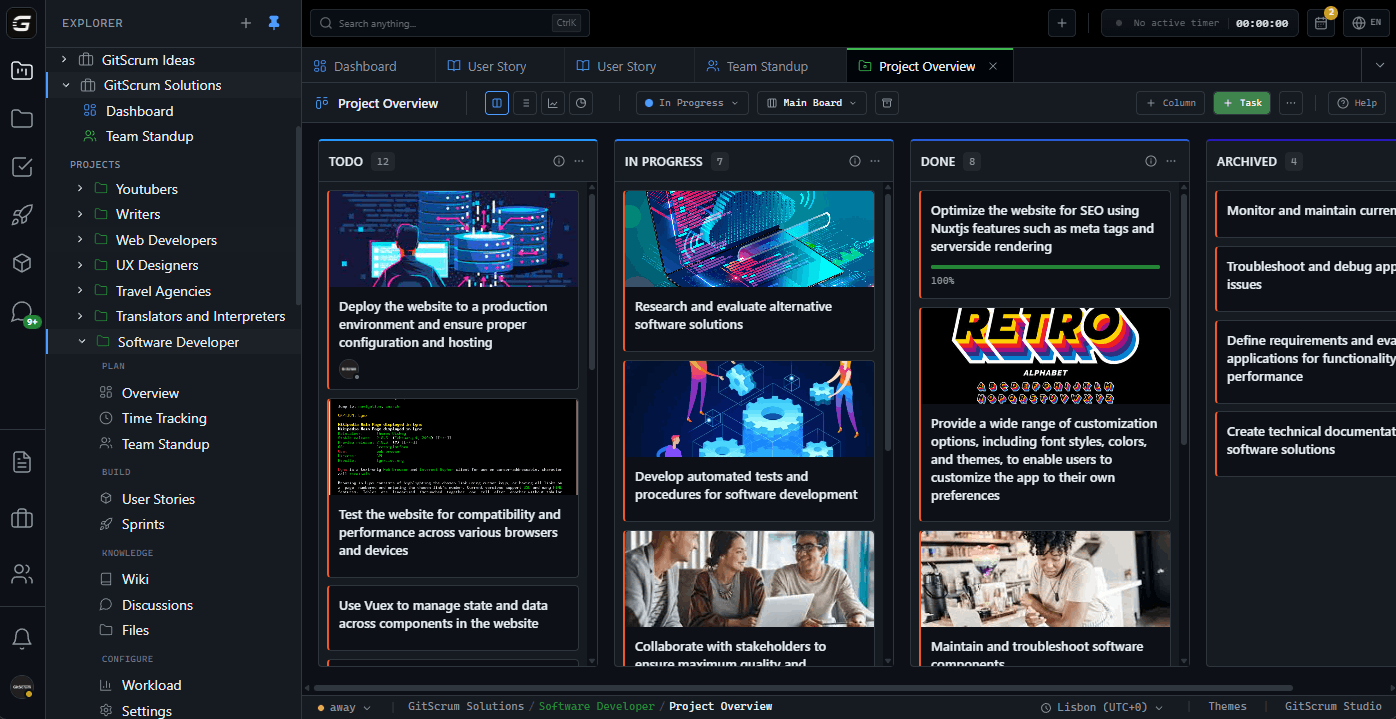
What's in the current sprint? That's happening now.

What's in the top of the backlog? That's next.

What's tagged for Q2? That's the quarter plan.

Stakeholders can look at the board anytime and see exactly where things stand—no meetings required.

The GitScrum Advantage

One unified platform to eliminate context switching and recover productive hours.

01

problem.identify()

The Problem

Roadmap exists in static slides or PM's head—gets outdated immediately

Stakeholders constantly ask 'what's the status?' because they can't see it themselves

Different versions of roadmap communicated to different stakeholders

No connection between roadmap and actual sprint work—disconnected documents

Can't easily show what shipped vs what's planned vs what's being considered

02

solution.implement()

The Solution

Living roadmap through prioritized backlog—always current, always visible

Sprint view shows what's being worked on right now with completion status

Milestone labels tag features for Q1, Q2, etc. without separate documents

Stakeholder view access lets them check status without asking PM

Done items show delivered features with dates for communication clarity

03

How It Works

1

Organize Backlog as Roadmap

Structure the backlog to represent roadmap: top items are current sprint, next section is next sprint, then 'Near-term' (this quarter), 'Future' (next quarter). Priority order IS the roadmap. Update the backlog, update the roadmap—they're the same thing.

2

Tag Features with Milestones

Create labels for time horizons: 'Q1-2024', 'Q2-2024', 'H2-2024'. Tag features with target milestones. Filter by milestone to show quarterly roadmap. When priorities shift, move the label. No separate slides to update.

3

Give Stakeholders View Access

Invite stakeholders as viewers. They can see the board, backlog, and sprint progress but not edit. When they ask 'what's the roadmap?', answer: 'Check the board. Current sprint is what's shipping now. Backlog shows what's next.' Self-service visibility.

4

Show Progress in Real-Time

Sprint board shows work moving through columns. Burndown shows completion trajectory. Stakeholders don't need status meetings—they see feature moving from In Progress to Done. Progress is visible, not reported.

5

Maintain Shipped History

Completed sprints show what was delivered and when. 'What shipped in Q1?' Filter Done items by date. The record is complete and accurate. For external communication, export completed items list—no separate tracking needed.

04

Why GitScrum

GitScrum addresses Managing Product Roadmap Visibility through Kanban boards with WIP limits, sprint planning, and workflow visualization

Problem resolution based on Kanban Method (David Anderson) for flow optimization and Scrum Guide (Schwaber and Sutherland) for iterative improvement

Capabilities

  • Kanban boards with WIP limits to prevent overload
  • Sprint planning with burndown charts for predictable delivery
  • Workload views for capacity management
  • Wiki for process documentation
  • Discussions for async collaboration
  • Reports for bottleneck identification

Industry Practices

Kanban MethodScrum FrameworkFlow OptimizationContinuous Improvement

Frequently Asked Questions

Still have questions? Contact us at customer.service@gitscrum.com

How do we keep the roadmap up to date without extra work?

The roadmap IS your backlog and sprint plans. When you prioritize backlog or plan a sprint, the roadmap updates automatically. No separate document to maintain. When priorities change, reorder the backlog—stakeholders see it immediately. Living roadmap, not static slides.

Should we share exact delivery dates on the roadmap?

Be careful with dates. 'Q2 2024' is safer than 'April 15.' Use sprint-based delivery: 'Next sprint' or 'Sprint 24.' Internal roadmap can be more specific than external roadmap. Uncertainty exists—communicate it. 'Targeted for May, depends on X completing first.'

How much detail should stakeholders see?

They should see feature-level items with status, not task-level details. 'Payment system redesign - In Progress' is useful. '47 tasks about payment system refactoring' is noise. Create a stakeholder-friendly view that rolls up to features. Hide implementation details.

What if stakeholders don't like using the tool?

Export summary views for them. Weekly: 'Here's what's shipping this sprint, what's next.' But point them to the live board for real-time updates. Over time, most prefer self-service to waiting for PM updates. The tool reduces meetings, which stakeholders appreciate.

How do we show long-term roadmap (6-12 months)?

Use milestone labels: 'Q1', 'Q2', 'H2', 'Future'. Long-term items stay in backlog but lower priority. Filter by milestone to show quarterly views. Long-term is inherently less certain—communicate that. 'H2 items are directional, subject to change based on Q1 learnings.'

Ready to solve this?

Start free, no credit card required. Cancel anytime.

Works with your favorite tools

Connect GitScrum with the tools your team already uses. Native integrations with Git providers and communication platforms.

GitHubGitHub
GitLabGitLab
BitbucketBitbucket
SlackSlack
Microsoft TeamsTeams
DiscordDiscord
ZapierZapier
PabblyPabbly

Connect with 3,000+ apps via Zapier & Pabbly