GitScrum PRO Annual — 2,500+ SaaS apps via MCP

GitScrum logo
Solution

Multi-Team WIP Constraints 2026 | Flow Balance

One WIP policy doesn't fit all teams. GitScrum provides per-project limits, cross-team workload views, and organizational flow metrics. Balance capacity. Free trial.

Multi-Team WIP Constraints 2026 | Flow Balance

WIP limits are typically discussed at the team level: 'Our team should have max 5 tasks in progress.

A backend team of 3 developers can't absorb the same throughput as a frontend team of 8. Shared services teams (platform, DevOps, QA) become bottlenecks when every product team dumps work simultaneously.

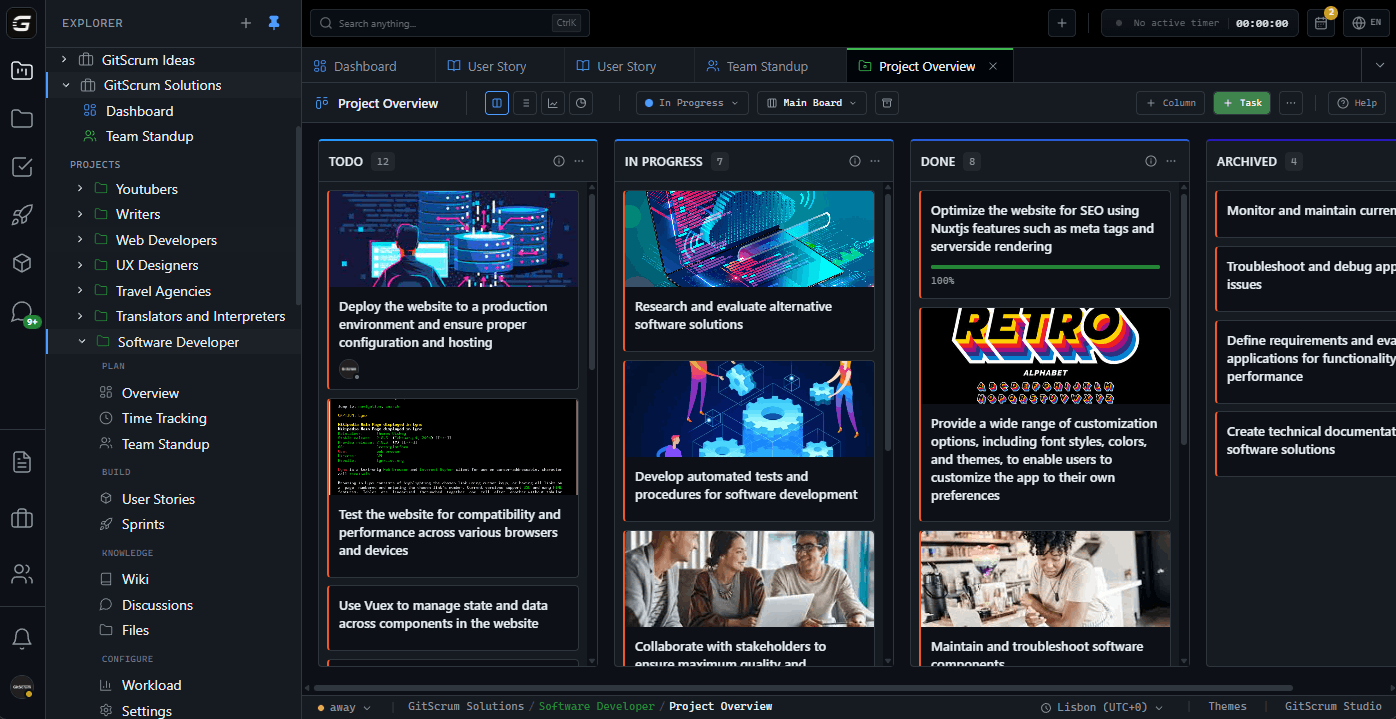
GitScrum addresses multi-team WIP through project-level controls and organizational visibility. Each project can have its own board with independent WIP limits calibrated to that team's capacity.

Workload views aggregate across projects so leadership can see which teams are overloaded and which have capacity. When dependencies exist, shared columns or cross-project visibility reveals when upstream bottlenecks are starving downstream teams.

The cumulative flow diagram works at the workspace level, showing organizational throughput. When one team's WIP skyrockets while another's flatlines, you can rebalance before deadlines are missed.

The GitScrum Advantage

One unified platform to eliminate context switching and recover productive hours.

01

problem.identify()

The Problem

Different teams have different capacity—one WIP policy doesn't fit all

Shared services teams become bottlenecks when multiple teams dump work simultaneously

No cross-project visibility to see which teams are overloaded vs have capacity

Dependencies between teams create invisible queues that bypass local WIP limits

Organizational throughput suffers even when individual teams follow their own WIP rules

02

solution.implement()

The Solution

Project-specific WIP limits—each team's board calibrated to their capacity

Workload views aggregate across projects for organizational visibility

Team capacity indicators show who's overloaded and who has bandwidth

Cross-project dependencies tracked to prevent invisible queue buildup

Workspace-level metrics reveal organizational flow patterns and bottlenecks

03

How It Works

1

Configure Per-Project WIP

Each project has its own Kanban board with independent WIP limits. Backend team (3 devs) might have 'In Progress' limit of 4. Frontend team (8 devs) might have limit of 10. Each calibrated to team capacity.

2

View Team Workloads

Workload views show task distribution per team member across all their projects. If a developer is assigned to both frontend and shared services, you see their total load—not just one project's view.

3

Track Cross-Project Dependencies

When tasks have blockers from other projects, dependencies create visibility. If frontend is blocked waiting for backend API, that dependency shows in both projects—preventing hidden queue buildup.

4

Monitor Organizational Flow

Sprint dashboards and reports aggregate across the workspace. See which projects are on track, which are bottlenecked, and where rebalancing might help. Leadership gets flow visibility without micromanaging.

5

Rebalance When Needed

When data shows Team A drowning while Team B has capacity, move work or people. WIP data provides objective evidence for resource decisions rather than squeaky-wheel politics.

04

Why GitScrum

GitScrum addresses Managing WIP Constraints Across Multiple Teams through Kanban boards with WIP limits, sprint planning, and workflow visualization

Problem resolution based on Kanban Method (David Anderson) for flow optimization and Scrum Guide (Schwaber and Sutherland) for iterative improvement

Capabilities

  • Kanban boards with WIP limits to prevent overload
  • Sprint planning with burndown charts for predictable delivery
  • Workload views for capacity management
  • Wiki for process documentation
  • Discussions for async collaboration
  • Reports for bottleneck identification

Industry Practices

Kanban MethodScrum FrameworkFlow OptimizationContinuous Improvement

Frequently Asked Questions

Still have questions? Contact us at customer.service@gitscrum.com

Should all teams have the same WIP limits?

No. WIP limits should be proportional to team capacity. A 3-person team might have WIP limit of 4-5; an 8-person team might have 10-12. The goal is similar flow efficiency, not identical numbers.

How do we handle shared services teams?

Shared services (DevOps, QA, Platform) often become bottlenecks because everyone dumps work on them. Give them strict WIP limits and make intake visible. When their queue is full, requesting teams must wait—creating natural demand management.

Can we see WIP across all projects?

Workload views and reports can aggregate across projects. You can see total organizational WIP, identify which projects are bottlenecked, and compare team utilization rates.

What about dependencies between teams?

Track blockers and dependencies explicitly. When Team A is blocked on Team B, both teams should see that dependency. This prevents hidden queues from forming outside the visible WIP system.

How do we convince teams to lower WIP?

Show the data. Track throughput before and after WIP reduction. Most teams see improved delivery within 2-3 sprints. Numbers are more convincing than philosophy.

Ready to solve this?

Start free, no credit card required. Cancel anytime.

Works with your favorite tools

Connect GitScrum with the tools your team already uses. Native integrations with Git providers and communication platforms.

GitHubGitHub
GitLabGitLab
BitbucketBitbucket
SlackSlack
Microsoft TeamsTeams
DiscordDiscord
ZapierZapier
PabblyPabbly

Connect with 3,000+ apps via Zapier & Pabbly