







VS Code

GitScrum for VS Code, Google Antigravity, Cursor and Windsurf!

GitScrum logo
Solution

Async vs Meetings 2026 | Eliminate Unnecessary Sync

35-50% of knowledge workers' time wasted in meetings. Async-first workflows replace status syncs with written updates. Teams save 5+ hours weekly. Free trial.

Async vs Meetings 2026 | Eliminate Unnecessary Sync

The standup meeting was supposed to be 15 minutes.

It's now 45. Eight people attend, but only two need to hear what the others are saying.

Everyone else is mentally checked out, thinking about the work they're not doing while sitting in this meeting. Then there's the weekly sync meeting.

An hour long. Twenty people on the call.

Most of them muted, doing other work, occasionally unmuting to give a 30-second update that could have been a Slack message. The 'all-hands' meeting where leadership reads slides aloud that could have been sent as a document.

The 'quick sync' that blocks three hours of combined engineer time to share information that was already in the project management tool. Research consistently shows that most knowledge workers spend 35-50% of their time in meetings.

A significant portion of those meetings are information sharing that doesn't require synchronous time. Every unnecessary meeting isn't just the meeting time—it's the context switch cost, the fragmented schedule, the death of deep work.

The GitScrum Advantage

One unified platform to eliminate context switching and recover productive hours.

01

problem.identify()

The Problem

Meetings exist by inertia, not necessity

Status updates don't need real-time discussion

Calendar fragmentation kills deep work

Most attendees don't need to be there

Meeting time plus context switching cost

02

solution.implement()

The Solution

Async status updates instead of standup meetings

Written updates consumed at each person's convenience

Meetings reserved for actual discussion and decisions

Protected focus time without calendar fragmentation

Clear criteria for what needs a meeting vs async

03

How It Works

1

Async Standups

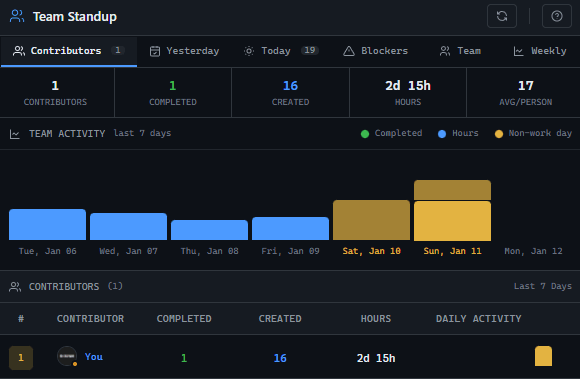
Daily status updates written in GitScrum instead of spoken in meetings. Each person takes 2 minutes to write; readers consume in 30 seconds. No scheduling required.

2

Meeting Necessity Test

Before scheduling a meeting, ask: 'Does this require real-time discussion or just information sharing?' If it's information sharing, write it. Save meetings for actual collaboration.

3

Protected Focus Blocks

Team establishes meeting-free focus time. No meetings Tuesday and Thursday afternoons, for example. Deep work requires uninterrupted time.

4

Smaller, Purpose-Driven Meetings

When meetings are necessary, invite only those who need to be there. Have a clear agenda and outcome. End when the objective is achieved, not when the calendar says.

04

Why GitScrum

GitScrum addresses Meetings That Could Have Been Async Updates through Kanban boards with WIP limits, sprint planning, and workflow visualization

Problem resolution based on Kanban Method (David Anderson) for flow optimization and Scrum Guide (Schwaber and Sutherland) for iterative improvement

Capabilities

  • Kanban boards with WIP limits to prevent overload
  • Sprint planning with burndown charts for predictable delivery
  • Workload views for capacity management
  • Wiki for process documentation
  • Discussions for async collaboration
  • Reports for bottleneck identification

Industry Practices

Kanban MethodScrum FrameworkFlow OptimizationContinuous Improvement

Frequently Asked Questions

Still have questions? Contact us at customer.service@gitscrum.com

Don't standups help with team bonding and communication?

Sometimes—but there are better ways for bonding (social time that's explicitly social) and communication (async updates for information, sync time for discussion). Forcing bonding into a status meeting makes both worse.

How do we ensure async updates are actually read?

The updates need to be valuable and concise. If people skip them, either the content isn't useful (stop requiring it) or the format is too long (shorten it). Good async updates are read because they're worth reading.

What if some people prefer meetings?

Preferences matter, but so does team productivity. Those who prefer meetings can have optional sync time. The default should be async, with sync as the exception for what genuinely needs it.

How do we handle urgent issues that come up?

Urgent issues should interrupt work—that's appropriate. The problem is routine information sharing masquerading as urgent. True urgency is rare; most 'urgent meetings' could wait or be async.

Ready to solve this?

Start free, no credit card required. Cancel anytime.

Works with your favorite tools

Connect GitScrum with the tools your team already uses. Native integrations with Git providers and communication platforms.

GitHubGitHub
GitLabGitLab
BitbucketBitbucket
SlackSlack
Microsoft TeamsTeams
DiscordDiscord
ZapierZapier
PabblyPabbly

Connect with 3,000+ apps via Zapier & Pabbly