The Remote Work PM Problem Most PM tools were designed for: - Same office, same time - Synchronous communication - Daily standups in person - Whiteboard discussions - Real-time collaboration default Modern remote teams need: - Multiple timezones, async-first - Written documentation over meetings - Standups that don't require waking up at 3am - Digital-native workflows - Asynchronous collaboration default Legacy Tool Remote Failures 1.
Jira in Remote Context Problems: - Complex dashboards require explanation - Status update meetings to understand status - Configuration requires admin presence - Timezone handling is afterthought - 'Where is that field?' Slack messages constant Remote impact: - More meetings to understand tool - Admin bottleneck across timezones - Context lost in translation 2. Monday/Asana Remote Issues Problems: - Built for marketing teams in same office - Visual first = slow page loads on poor connections - Notifications don't respect timezones - Status requires opening app (no async-friendly API) Remote impact: - Off-hours notifications - Slow remote experience - Too pretty, not functional 3.
General Legacy Remote Problems Problems: - Designed before remote was mainstream - Sync features bolted on - Notification systems not timezone-aware - Documentation is external (Confluence, Notion) Remote impact: - Tool sprawl multiplied - Context scattered across apps - Time zone conflicts constant What Modern Remote PM Needs 1. Async-First Architecture Requirements: - Written context at every level - Status visible without meetings - Comments threaded and persistent - History fully searchable - Updates don't require real-time GitScrum delivers: - Task descriptions are documentation - Status updates via commits (no manual update) - Threaded discussions per task - Full activity history - Progress visible anytime 2.
Timezone Intelligence Requirements: - Notifications respect local time - Due dates show in local timezone - Activity feeds timezone-aware - Sprint ceremonies adaptable GitScrum delivers: - User-level timezone settings - Due date local display - Activity in context - Async sprint ceremonies support 3. Low-Bandwidth Resilience Requirements: - Fast on any connection - Essential features work offline - Mobile-first capability - No infinite loading states GitScrum delivers: - Lightweight pages - Progressive loading - Mobile app available - Consistent performance 4.
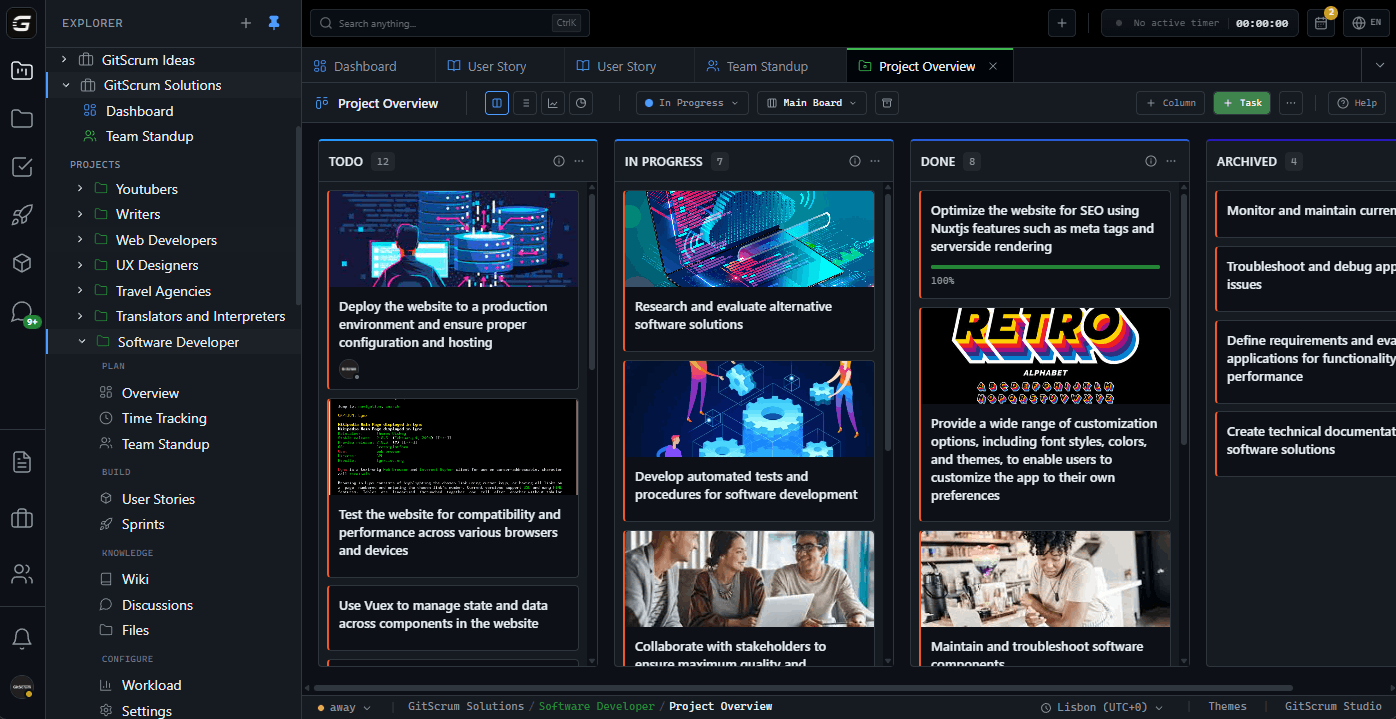
Self-Service Operations Requirements: - No admin required for daily work - Users can configure own views - Permissions don't require IT - Onboarding is self-directed GitScrum delivers: - User-customizable boards - No admin for basic config - Simple permission model - Documentation built-in Remote Team Communication Patterns 1. The Async Standup Problem Old approach: - Everyone online at same time - Video call (someone is always at 2am) - Real-time status updates - Lost if you miss the meeting Modern approach: - Async standup via task updates - No meeting required - Status visible in tool - History preserved GitScrum pattern: - Commit links to task = auto-update - Task comments = standup notes - Board view = team status - No 3am video calls 2.
The Handoff Problem Old approach: - End of day meeting with next timezone - Slack thread with context - Hope nothing got lost - Morning 'what did I miss?' ritual Modern approach: - Task state is always current - Context lives in task, not Slack - Handoff is implicit - Morning sync is self-service GitScrum pattern: - All context in task - Git commits show progress - Activity log is handoff - Self-service morning sync 3. The Documentation Gap Old approach: - PM tool for tasks - Wiki for documentation - Slack for decisions - Three places to check Modern approach: - Single source of truth - Documentation near tasks - Decisions logged in context - One tool to check GitScrum pattern: - Wiki feature included - Link wiki pages to tasks - Discussions in-tool - Reduce context switching Remote Team Metrics That Matter 1.
Meeting Hours per Developer Target: <4 hours/week of meetings Measure: Calendar hours in dev-related meetings Improve: Replace sync with async in tool 2. Context Switch Count Target: <10 app switches per hour Measure: Tool usage patterns Improve: Consolidate tools 3.
Response Time Across Timezones Target: <4 hours average response Measure: Time to first response on tasks Improve: Async-friendly tools + culture 4. Documentation Freshness Target: >80% docs updated this month Measure: Wiki/docs last modified dates Improve: Built-in docs near code Remote Team Success Patterns 1.
Async-First Culture + Tool Culture: - Default to writing - Meetings are last resort - Context in tool, not heads Tool requirements: - Rich text in tasks - Threaded discussions - Full history - Search everything GitScrum fit: - Task descriptions support formatting - Discussion threads per task - Complete activity history - Global search 2. Timezone-Distributed Sprints Pattern: - Sprint planning: async document → sync refinement - Daily standup: replaced by board + commits - Sprint review: recorded demo + async comments - Retrospective: async doc → sync discussion GitScrum support: - Sprint planning built-in - Board shows current state - Commits auto-link - Wiki for async docs 3.
The 'Follow the Sun' Model Pattern: - Americas → Europe → Asia handoff - Work continues around clock - No single timezone is 'primary' - Tool is source of truth GitScrum support: - Always-current task state - Activity log per task - No timezone-specific features - Works for any distribution GitScrum for Remote Teams Core remote features: 1. Git-Driven Status - Commits update tasks automatically - No manual status meetings - Progress is always visible - True async capability 2.
Built-In Documentation - Wiki feature included - Link docs to tasks - Single source of truth - Reduce tool sprawl 3. Time Tracking for Distributed Teams - Know who worked when - No timeclock surveillance - Project-level visibility - Trust-based tracking 4.
Client Portals for Remote Agencies - Clients see progress without calls - Async client communication - Less timezone coordination - Professional presentation 5. Notification Controls - User-configurable alerts - Respect focus time - Async-friendly defaults - No notification fatigue Remote Team Tool Stack Comparison Old Remote Stack: Jira + Confluence + Slack + Zoom + Notion + Loom 6 tools, endless context switching $40+/user/month combined Modern GitScrum Stack: GitScrum + Slack + occasional Zoom 3 tools, minimal switching $8.90/user/month for PM Tool consolidation impact: - Fewer logins - Less context scattered - Lower training burden - Better remote onboarding Remote Onboarding with GitScrum Day 1: - Sign up (30 seconds) - Accept team invite - Connect GitHub - Browse existing tasks - Explore board/sprint view Day 2-3: - Take first task - Make commits (auto-link) - Use discussions for questions - Read wiki for context Week 1: - Fully productive - No admin assistance needed - Self-service everything - Remote-ready Compare to Jira remote onboarding: 2+ weeks, admin bottleneck, timezone scheduling conflicts, training meeting recordings.
The Remote Work Future Remote work is permanent for development teams. Tools must be remote-first, not remote-capable.
Remote-first requirements: - Async by default - Self-service operations - Low bandwidth friendly - Timezone intelligent - Documentation integrated GitScrum is built for this reality. Modern Remote PM - Start Today GitScrum for remote teams: - Async-first architecture - Git-driven status (no meetings for updates) - Built-in wiki (reduce tool sprawl) - Time tracking (visibility without surveillance) - 2 users free forever - $8.90/user/month Try GitScrum: Modern PM for the remote work era.
The GitScrum Advantage
One unified platform to eliminate context switching and recover productive hours.