The Monday.
Colorful status indicators. Beautiful charts.
Animated dashboards. Marketing teams love it.
Project managers showing stakeholders love it. Executives reviewing high-level progress love it.
Programmers? The Programmer Reality Programmers don't need: - 47 colors for status columns - Animation-heavy dashboards - Drag-drop everything visual builders - 'Work OS' philosophy abstractions Programmers need: - Git commits linked to tasks - Real sprint management - Time tracking that exports for billing - Keyboard shortcuts that work - Fast load times - Minimal visual noise Where Monday Fails Developers 1.
No Native Git Integration Monday has 'developer app' integrations. Third-party.
Clunky. Not core to experience.
Commits don't naturally flow to work items. 2.
No Real Sprints You can create sprint-like views. But it's not agile-native.
No velocity. No burndown.
No story points as first-class citizens. 3.
Visual Over Functional Every feature prioritizes how it looks. Programmers care how it works.
Pretty charts don't ship code. 4.
Expensive at Scale $10-16/user/month for useful features. Dev teams of 10+ feel it.
Add apps for more functionality? More cost.
5. Slow Interface All those animations and visual effects cost performance.
Developers work fast. Monday feels sluggish.
6. Generic Work OS Monday tries to be everything for everyone.
Marketing campaigns. Sales pipelines.
HR onboarding. Dev projects.
Jack of all trades, master of none. The 'Looks Good in Demo' Problem Monday demos beautifully.
Sales call: Wow, these dashboards! Stakeholder meeting: Impressive charts!
Daily developer use: 'Why is this loading animation still going?' 'Where do I see my commits?' 'How do I run a real sprint?' 'Why do I need 5 clicks for this?' Form impressed management. Function fails developers.
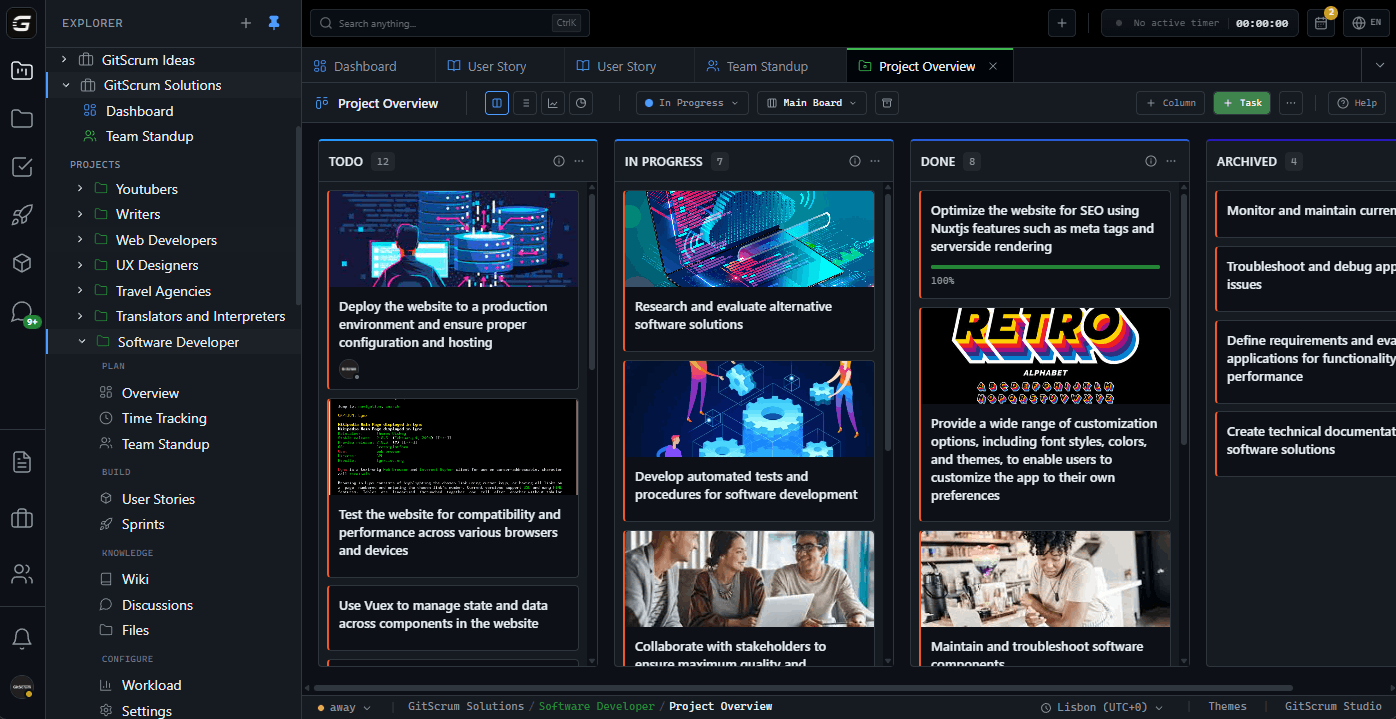
GitScrum: Function First We didn't start with 'what looks impressive?' We started with 'what do developers actually need?' Built for Developers: 1. Native Git Integration - GitHub, GitLab, Bitbucket built-in - Commits appear on tasks automatically - PRs linked and visible - Branch information accessible 2.
Real Sprint Management - Sprint planning with velocity tracking - Burndown charts that mean something - Story points first-class - Backlog grooming native 3. Time Tracking That Works - Timer on every task - Export for client billing - Utilization reports - No 'app' required 4.
Speed - Minimal animations - Fast load times - Keyboard-first navigation - Dark mode native 5. Developer-Focused UX - Information density over whitespace - Keyboard shortcuts everywhere - Terminal-friendly aesthetics Visual vs Functional Comparison Monday: 'Look at this beautiful Gantt chart!' GitScrum: 'Your sprint velocity increased 15% over last 3 sprints.' Monday: 'These color-coded statuses are gorgeous!' GitScrum: 'Commit abc123 linked to task.
PR merged. Task complete.' Monday: 'Executives will love these dashboards!' GitScrum: 'Time tracked.
Report generated. Client invoiced.' Different priorities.
Different tools. The Audience Question Who's your primary user?
If: Marketing teams, executives, visual-first managers Then: Monday.com is designed for them. If: Programmers, development teams, agencies billing hours Then: GitScrum is designed for them.
Monday optimizes for executive buy-in. GitScrum optimizes for developer productivity.
Pricing Reality Monday: - Basic: $9/seat/month (limited) - Standard: $12/seat/month (starts being useful) - Pro: $19/seat/month (full features) - Enterprise: Custom (expensive) GitScrum: - 2 users FREE forever (all features) - $8.90/user/month for larger teams Full functionality from day one. No tier-restricted features.
The GitScrum Advantage
One unified platform to eliminate context switching and recover productive hours.