VS Code

GitScrum for VS Code, Google Antigravity, Cursor and Windsurf!

GitScrum logo
Solution

Unified Project Dashboard 2026 | Full Health Visibility

Project health scattered across 6+ tools? Manual aggregation takes hours and is outdated instantly. One platform shows full status in real time. Free trial.

Unified Project Dashboard 2026 | Full Health Visibility

Project health is multidimensional.

Are tasks being completed on schedule? Is the team maintaining velocity?

Are bugs accumulating or being resolved? Is customer satisfaction improving?

Is code quality stable? Each dimension typically lives in a different tool.

Task data in Jira. Time data in Toggl or Harvest.

Bug data in GitHub or Linear. Customer feedback in Zendesk or Intercom.

Code quality in SonarQube or CodeClimate. No single tool sees the complete picture.

To understand overall project health, someone must visit each tool, extract relevant metrics, combine them in a spreadsheet, and synthesize insights. This process takes hours and happens infrequently because it is so labor-intensive.

By the time the unified view exists, it is already outdated. The data has changed while the aggregation was happening.

The result is that decision makers operate with incomplete information. They see Jira looking healthy while bugs are accumulating in GitHub.

They celebrate sprint velocity while time tracking shows the team is burning out. They focus on new features while customer satisfaction is declining.

The fragmented view creates blind spots that lead to poor decisions. A unified platform provides instant complete visibility.

Task progress, time tracking, and team metrics exist in the same system. The dashboard updates in real time.

Decision makers see the full picture, not fragments. They can spot correlations between metrics that would be invisible in siloed tools.

The GitScrum Advantage

One unified platform to eliminate context switching and recover productive hours.

01

problem.identify()

The Problem

Project health metrics scattered across multiple tools

No single view of complete project status

Manual aggregation required for unified visibility

Unified reports outdated by time they are created

Decision makers operate with incomplete information

Blind spots lead to poor strategic decisions

02

solution.implement()

The Solution

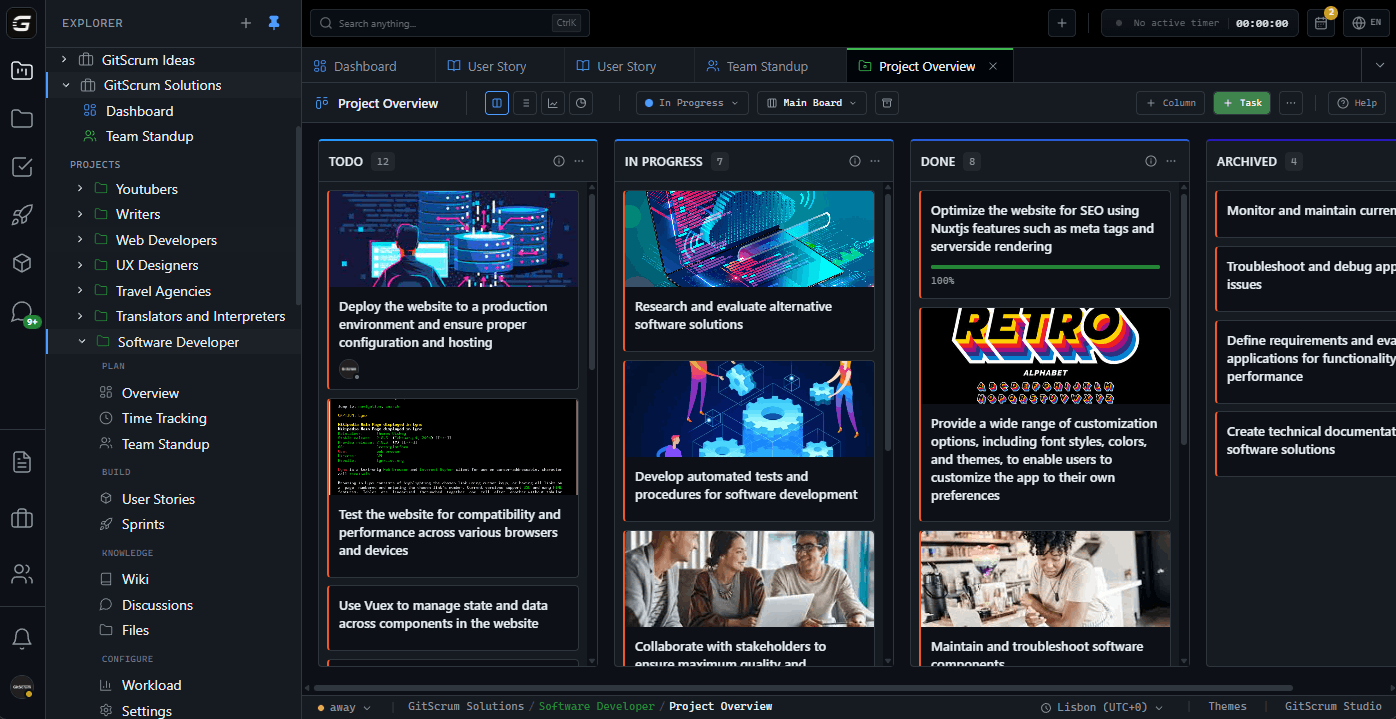
All project metrics in single unified dashboard

Complete visibility without manual aggregation

Real-time updates reflect current project state

Decision makers see full picture instantly

Correlations between metrics visible

Informed strategic decisions based on complete data

03

How It Works

1

Unified Data

All project information stored in single platform

2

Integrated Dashboard

Comprehensive view of all project dimensions

3

Real-Time Updates

Dashboard reflects current state automatically

4

Informed Decisions

Complete visibility enables better strategic choices

04

Why GitScrum

GitScrum addresses No Single Dashboard Showing Complete Project Health Across All Tools through Kanban boards with WIP limits, sprint planning, and workflow visualization

Problem resolution based on Kanban Method (David Anderson) for flow optimization and Scrum Guide (Schwaber and Sutherland) for iterative improvement

Capabilities

  • Kanban boards with WIP limits to prevent overload
  • Sprint planning with burndown charts for predictable delivery
  • Workload views for capacity management
  • Wiki for process documentation
  • Discussions for async collaboration
  • Reports for bottleneck identification

Industry Practices

Kanban MethodScrum FrameworkFlow OptimizationContinuous Improvement

Frequently Asked Questions

Still have questions? Contact us at customer.service@gitscrum.com

Why can not leaders get a complete view of project health?

Project health metrics are scattered across multiple tools. Task completion in Jira, time data in Toggl, bugs in GitHub, customer feedback in Zendesk. Each tool shows one dimension but no tool shows the complete picture. Creating a unified view requires manual aggregation that takes hours and is outdated by the time it is finished.

What are the consequences of fragmented project visibility?

Decision makers operate with incomplete information. They might see Jira looking healthy while bugs accumulate in GitHub. They celebrate velocity while the team burns out. They focus on features while customer satisfaction declines. These blind spots lead to poor strategic decisions that could have been avoided with complete visibility.

How does a unified platform provide complete project visibility?

When task management, time tracking, and team metrics exist in the same platform, the dashboard naturally shows complete project health. No manual aggregation needed. Updates happen in real time. Decision makers see correlations between metrics—like velocity trends alongside time logged—that would be invisible in separate tools.

Ready to solve this?

Start free, no credit card required. Cancel anytime.

Works with your favorite tools

Connect GitScrum with the tools your team already uses. Native integrations with Git providers and communication platforms.

GitHubGitHub
GitLabGitLab
BitbucketBitbucket
SlackSlack
Microsoft TeamsTeams
DiscordDiscord
ZapierZapier
PabblyPabbly

Connect with 3,000+ apps via Zapier & Pabbly