What Notion Excels At Notion is genuinely amazing for: - Documentation - Knowledge bases - Company wikis - Meeting notes - Personal organization - Flexible databases Notion's flexibility is its superpower.
Build anything. Configure anything.
Connect anything. But that flexibility has limits.
The PM Gap Notion can create project management workflows. Databases.
Formulas. But 'can create' is different from 'built for'.
1. No Native Git Integration Notion: Paste commit links manually.
Or use Zapier. Reality: Development work and task management stay disconnected.
2. No Real Sprints Notion: Create a 'Sprint' property.
Filter database views. Reality: No velocity tracking.
No burndown charts. No sprint planning ceremony support.
3. No Time Tracking Notion: Add a 'Time' property.
Update manually. Reality: No timer.
No automatic tracking. No billing export.
4. No Client Portals Notion: Share pages with clients?
Reality: They see your messy workspace structure. Or you maintain duplicate pages.
5. Performance at Scale Notion: Gets slow with large databases.
Reality: Active development projects with thousands of tasks strain the system. 6.
Everything Is Custom Notion: Build your own PM system from scratch. Reality: Weeks of setup.
Ongoing maintenance. Things break with updates.
The DIY PM Problem Teams build Notion PM systems. Spend 40+ hours on setup.
Create complex relation systems. Build formula-based automations.
Then: - Template breaks with Notion update - New team member can't understand structure - Performance degrades over time - Nobody remembers why things were set up that way You're maintaining a custom PM tool instead of using one. The Right Tool for Each Job Notion is the best wiki tool.
It's not the best PM tool. Just like: - VS Code is great for coding, not for design - Figma is great for design, not for coding - Notion is great for docs, not for PM Using Notion for PM is like using Excel for accounting.
It can work. But proper accounting software exists for a reason.
GitScrum: Purpose-Built PM We didn't try to be everything. We focused on one job: Project management for development teams.
Native, Not Custom: 1. Git Integration - GitHub, GitLab, Bitbucket built-in - Commits appear on tasks automatically - PRs linked and tracked - No Zapier.
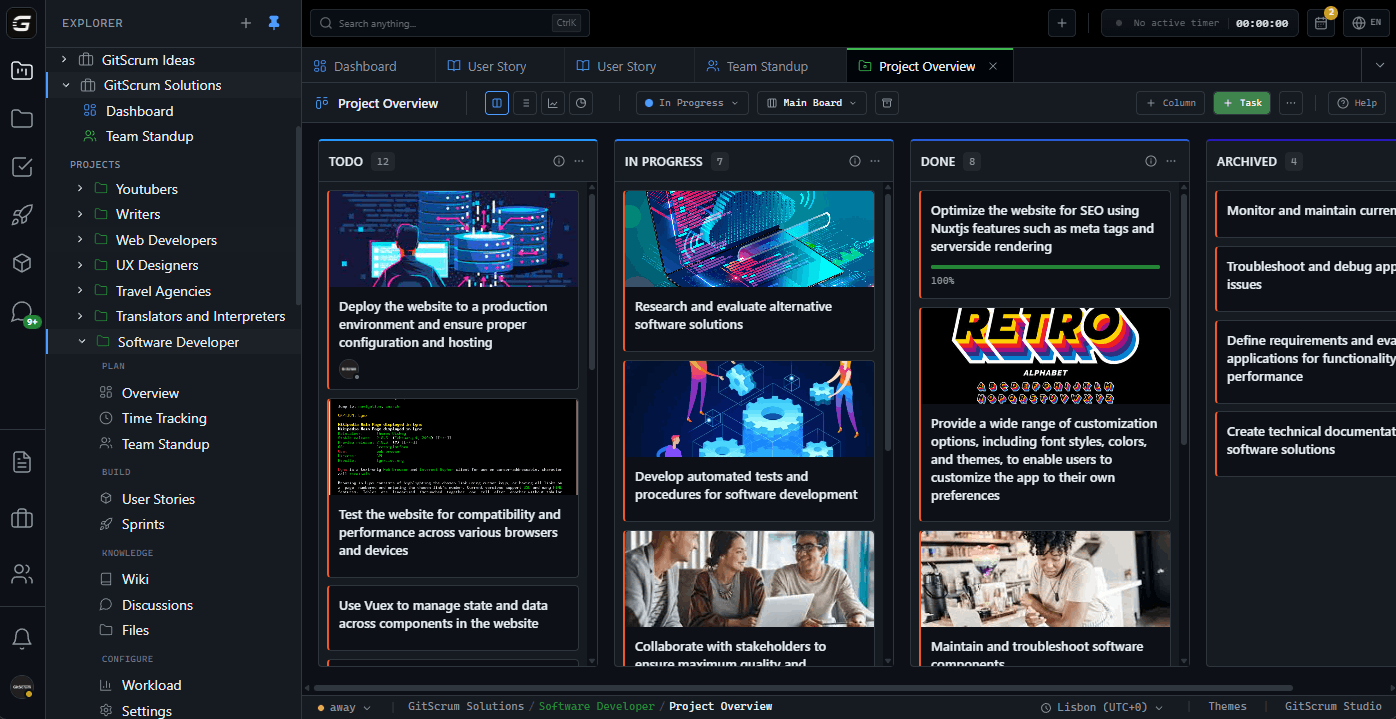
Sprint Management - Real sprints with ceremony support - Velocity tracking across sprints - Burndown charts auto-generated - Backlog prioritization built-in 3. Time Tracking - Timer on every task - One-click start/stop - Export for billing - Utilization reports 4.
Client Flow - Client portals purpose-built - Show what you want shown - Professional interface - Clients always free 5. Performance - Built for scale - Fast with large projects - No database limitations Notion + GitScrum: The Combo Best setup: - Notion: Company wiki, docs, knowledge base - GitScrum: Project management, sprints, time tracking Don't force Notion to be a PM tool.
Don't force GitScrum to be a wiki. Use each for what they're built for.
Migration Path From Notion PM databases: 1. Export task data 2.
Import to GitScrum 3. Set up sprints properly 4.
Connect Git repositories 5. Keep Notion for docs Your wiki stays.
Your PM becomes purpose-built. Pricing Notion: - Free: Limited blocks - Plus: $10/user/month - Business: $18/user/month GitScrum: - 2 users FREE forever (full features) - $8.90/user/month for larger teams - Clients always free Use both.
Notion free for docs. GitScrum free for PM.
Upgrade when scale demands.
The GitScrum Advantage
One unified platform to eliminate context switching and recover productive hours.