GitScrum PRO Annual — 2,500+ SaaS apps via MCP

GitScrum logo
Solution

Notion vs ClickUp vs GitScrum 2026 | Dev Teams

Notion: docs tool forcing PM. ClickUp: 80% unused features. GitScrum: purpose-built for dev with native Git, sprints, time tracking. $8.90/user/month. Free trial.

Notion vs ClickUp vs GitScrum 2026 | Dev Teams

Three popular tools, three different philosophies: Notion: Started as a note-taking and documentation tool.

Added databases, then project views on top. Beautiful for wikis, specs, and knowledge bases.

But sprint planning feels bolted-on. No native time tracking.

GitHub integration is basic. It's a great docs tool that can do project management—not a great PM tool that can do docs.

ClickUp: Started as a Jira alternative, then expanded to compete with everything. Has features for marketing, sales, HR, operations.

Powerful but overwhelming. Your development team doesn't need CRM views, whiteboards, or goals tracking.

You're paying for (and navigating around) features you'll never use. GitScrum: Started for software development and stayed focused.

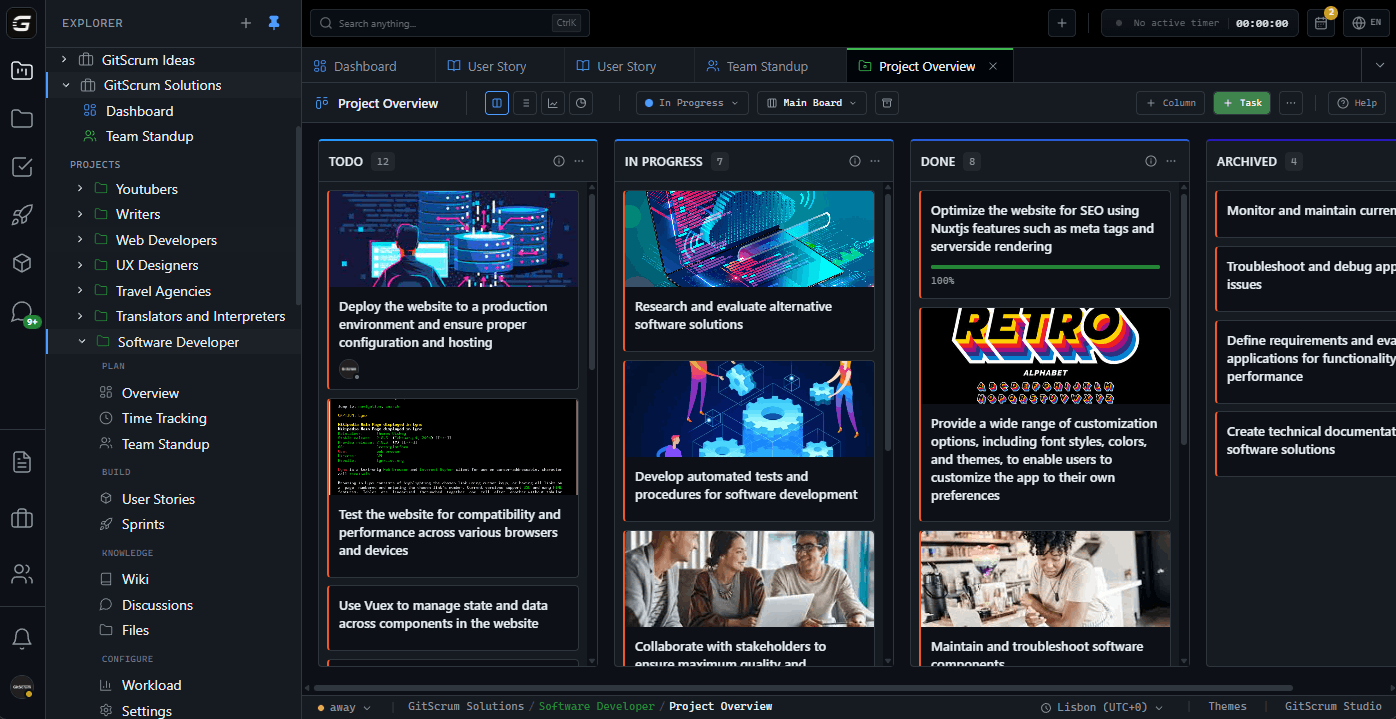
Every feature—sprint planning, time tracking, burndown charts, GitHub integration, client portals—serves development workflows. No feature bloat.

No context-switching between PM tool identities. The question isn't which tool has more features.

It's which tool has the right features for how your development team actually works.

The GitScrum Advantage

One unified platform to eliminate context switching and recover productive hours.

01

problem.identify()

The Problem

Notion: sprint planning feels bolted-on to docs tool

Notion: no native time tracking for development work

Notion: GitHub integration is basic, not deep

ClickUp: overwhelming feature set for development teams

ClickUp: navigating around marketing/sales/HR features

ClickUp: paying for functionality you'll never use

Both: learning curve for features you don't need

Both: not built specifically for software development

02

solution.implement()

The Solution

Purpose-built for software development from day one

Sprint planning as core feature, not addon

Time tracking built-in for client billing and estimates

Deep GitHub integration: PRs, commits, branches sync automatically

No marketing/sales/HR feature bloat to navigate around

Pay only for development-focused functionality

Minimal learning curve—if you know Scrum, you know GitScrum

Every feature serves development workflow

03

How It Works

1

Evaluate Your Actual Needs

List what your development team actually does daily: sprint planning, task tracking, time logging, code review coordination, client updates. Then check which tool serves those specific needs without bloat.

2

Try GitScrum's Focused Approach

Sign up. Connect GitHub. Create a project. Start a sprint. The workflow is immediate—no tutorial needed for basic operations. Everything serves development. Nothing to skip or hide.

3

Compare Daily Experience

After one sprint in GitScrum, compare: how much time navigating vs doing? How many features do you use vs ignore? How quickly can you find what you need? Development-focused tools win on daily experience.

4

Keep Specialized Tools Specialized

Use Notion for documentation—it's excellent there. Use GitScrum for project management—it's excellent there. Trying to make one tool do everything means everything is mediocre.

04

Why GitScrum

GitScrum addresses Notion vs ClickUp vs GitScrum for Development Teams through Kanban boards with WIP limits, sprint planning, and workflow visualization

Problem resolution based on Kanban Method (David Anderson) for flow optimization and Scrum Guide (Schwaber and Sutherland) for iterative improvement

Capabilities

  • Kanban boards with WIP limits to prevent overload
  • Sprint planning with burndown charts for predictable delivery
  • Workload views for capacity management
  • Wiki for process documentation
  • Discussions for async collaboration
  • Reports for bottleneck identification

Industry Practices

Kanban MethodScrum FrameworkFlow OptimizationContinuous Improvement

Frequently Asked Questions

Still have questions? Contact us at customer.service@gitscrum.com

We love Notion for docs—do we need to replace it?

No! Use Notion for what it's best at: documentation, specs, wikis, knowledge bases. Use GitScrum for what it's best at: sprint planning, task tracking, time management, GitHub coordination. Best-in-class tools for each job.

ClickUp has everything in one place—isn't that more efficient?

Only if you use everything. Development teams use maybe 20% of ClickUp's features. The other 80% creates noise: cluttered menus, confusing options, longer learning curve. Focused tools mean less navigation, faster workflows.

Can GitScrum handle documentation too?

Basic task descriptions and comments, yes. Full documentation system like Notion? No, and intentionally so. GitScrum stays focused on project management. Link to your Notion docs from GitScrum tasks—best of both worlds.

What about teams that do more than development?

If your team genuinely needs marketing, sales, and development tools in one place, ClickUp might fit. If development is your core work and other functions are secondary, GitScrum's focus will serve you better.

Ready to solve this?

Start free, no credit card required. Cancel anytime.

Works with your favorite tools

Connect GitScrum with the tools your team already uses. Native integrations with Git providers and communication platforms.

GitHubGitHub
GitLabGitLab
BitbucketBitbucket
SlackSlack
Microsoft TeamsTeams
DiscordDiscord
ZapierZapier
PabblyPabbly

Connect with 3,000+ apps via Zapier & Pabbly