GitScrum PRO Annual — 2,500+ SaaS apps via MCP

GitScrum logo
Solution

Developer Coding Time 2026 | Only 4.2 Hours Daily

Developers code only 4.2h of 8h workday. 3.8h lost to tool switching and meetings. Unified platform recovers 2+ hours for productive development. Free trial.

Developer Coding Time 2026 | Only 4.2 Hours Daily

The Stack Overflow Developer Survey, GitHub Octoverse, and multiple industry studies converge on a sobering finding: developers spend only about half their workday actually writing or reviewing code.

The precise figures vary by study—4.2 hours in some, 4.5 in others—but the pattern is consistent. The remaining time divides among meetings, status updates, tool navigation, information hunting, and the cognitive cost of context switching.

For organizations, this represents a massive hidden cost. A developer earning $150K salary effectively costs $37.50/hour.

If 3.8 hours daily are lost to non-coding overhead, that's $142/day or $35,000+ annually per developer in unproductive time. GitScrum addresses the tool-related portion of this overhead.

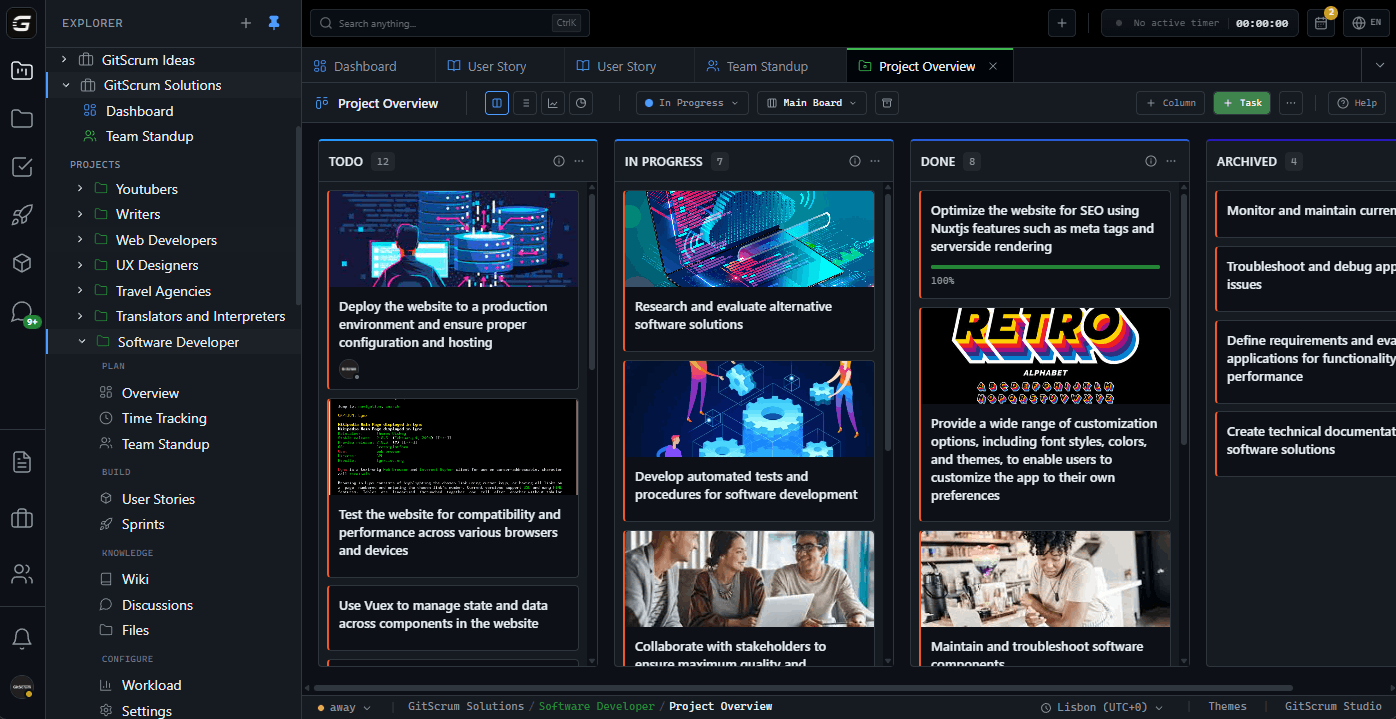
By consolidating task management, time tracking, team communication, and Git integration, developers eliminate much of the navigation and context-switching that consumes their non-coding hours. The goal: push actual coding time from 4.2 hours toward 6+ hours by eliminating fragmented tool management.

The GitScrum Advantage

One unified platform to eliminate context switching and recover productive hours.

01

problem.identify()

The Problem

Only 4.2 hours of 8-hour workday spent on actual coding

3.8 hours daily lost to overhead activities

Tool navigation consuming significant developer time

Context switching between platforms destroying focus

High salary cost wasted on non-productive activities

Developers frustrated by inability to focus on coding

02

solution.implement()

The Solution

Increase actual coding time from 4.2 to 6+ hours daily

Consolidate tools to eliminate navigation overhead

Unified platform reduces context switching

Recover 2+ hours daily for productive development

Developer satisfaction increases with more coding time

Return significant salary investment to productive work

03

How It Works

1

Baseline Current Coding Time

Use Time Tracking to measure actual hours developers spend coding versus in overhead activities

2

Consolidate Overhead Tools

Migrate task management, time tracking, and team communication into GitScrum to eliminate tool-switching overhead

3

Streamline Non-Coding Tasks

Configure automations and integrations to minimize manual status updates and information hunting

4

Measure Coding Time Gains

Track improvement in actual coding hours using Time Tracking Analytics and developer self-reporting

04

Why GitScrum

GitScrum addresses Only 4.2 Hours Actual Coding Time Due to Tool Switching through Kanban boards with WIP limits, sprint planning, and workflow visualization

Problem resolution based on Kanban Method (David Anderson) for flow optimization and Scrum Guide (Schwaber and Sutherland) for iterative improvement

Capabilities

  • Kanban boards with WIP limits to prevent overload
  • Sprint planning with burndown charts for predictable delivery
  • Workload views for capacity management
  • Wiki for process documentation
  • Discussions for async collaboration
  • Reports for bottleneck identification

Industry Practices

Kanban MethodScrum FrameworkFlow OptimizationContinuous Improvement

Frequently Asked Questions

Still have questions? Contact us at customer.service@gitscrum.com

Where does the 4.2 hours figure come from?

Multiple developer surveys including Stack Overflow, GitHub Octoverse, and industry productivity studies consistently find developers spend 4-5 hours per 8-hour day on code-related activities. The 4.2-hour figure represents a composite of these findings.

Can tool consolidation really add 2+ hours of coding time?

Tool navigation and context switching account for a significant portion of non-coding overhead. Teams consolidating into a unified platform typically report 2-3 hours daily recovered from eliminated tool switching, which can be redirected to coding.

What about meetings—doesn't that consume the other hours?

Yes, meetings are a significant factor, though GitScrum cannot directly eliminate meeting overhead. However, better project visibility and async communication features can reduce the need for status update meetings, recovering some of that time as well.

Ready to solve this?

Start free, no credit card required. Cancel anytime.

Works with your favorite tools

Connect GitScrum with the tools your team already uses. Native integrations with Git providers and communication platforms.

GitHubGitHub
GitLabGitLab
BitbucketBitbucket
SlackSlack
Microsoft TeamsTeams
DiscordDiscord
ZapierZapier
PabblyPabbly

Connect with 3,000+ apps via Zapier & Pabbly