GitScrum PRO Annual — 2,500+ SaaS apps via MCP

GitScrum logo
Solution

Missed Deadlines Prevention 2026 | See It Coming

Deadlines slip without warning. Sprint goals missed repeatedly. Due dates, burndown tracking, and early warning systems prevent deadline surprises. Free trial.

Missed Deadlines Prevention 2026 | See It Coming

Another missed deadline.

The sprint ends and half the committed work isn't done. The release slips by two weeks—again.

Stakeholders lose trust, teams feel demoralized, and everyone wonders why this keeps happening. Deadlines get missed when there's no visibility into progress.

Work is 'in progress' until the day it's due, then suddenly 'we need more time.' No one saw it coming because no one was tracking. GitScrum makes deadline risk visible before it becomes a crisis.

Due dates on tasks show what's coming up. Burndown charts reveal if the sprint is on track or falling behind.

Overdue tasks are flagged so they don't hide in the backlog. Sprint velocity trends show realistic expectations for future commitments.

When you can see problems forming, you can act before they become missed deadlines.

The GitScrum Advantage

One unified platform to eliminate context switching and recover productive hours.

01

problem.identify()

The Problem

No visibility into whether work is on track until the deadline arrives

Sprint commitments are based on gut feeling, not data—leading to overcommitment

Overdue tasks hide in the backlog with no flagging or escalation

Blockers aren't surfaced early, causing last-minute scrambles

No historical velocity data to make realistic future estimates

02

solution.implement()

The Solution

Due dates on tasks with visual indicators for upcoming and overdue work

Burndown charts show sprint progress in real-time—falling behind is visible immediately

Velocity tracking provides data-driven sprint capacity for realistic commitments

Blocker flags and escalation workflows surface problems before they cause delays

Sprint review compares committed vs delivered to improve future planning accuracy

03

How It Works

1

Set Due Dates on Tasks

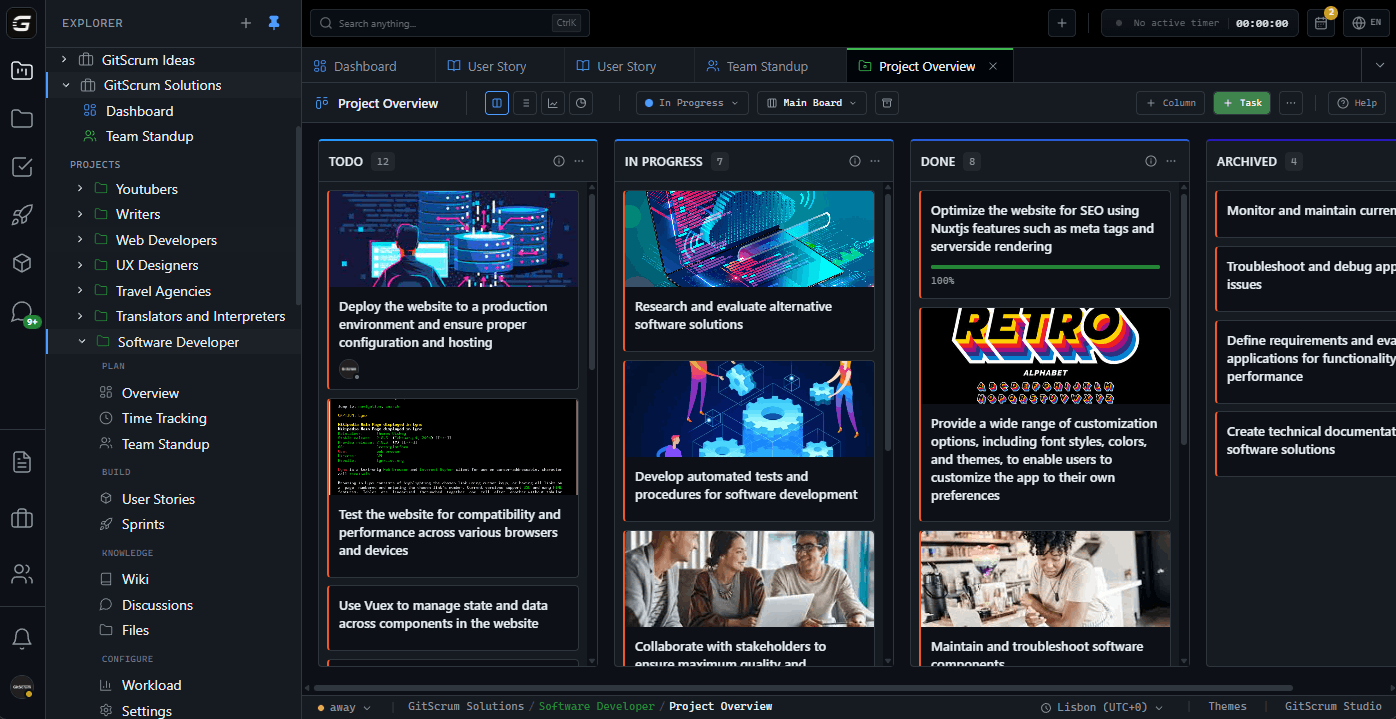
Every task with a deadline gets a due date. GitScrum shows due dates on cards and highlights upcoming (yellow) and overdue (red) tasks. Visual urgency keeps deadlines top of mind. Sort and filter by due date to focus on what's urgent.

2

Track Sprint Burndown Daily

Burndown chart shows work remaining vs time remaining. Ideal line shows expected progress; actual line shows reality. If actual is above ideal, you're behind. Check daily—don't wait until sprint end to discover problems. React while there's still time.

3

Use Velocity for Planning

Track how many points/tasks the team completes per sprint. Historical velocity is your planning data. If you averaged 30 points last 3 sprints, committing to 50 this sprint is unrealistic. Data-driven commitments prevent overpromising.

4

Flag Blockers Immediately

When something is blocked, mark it immediately. Blocked tasks are visible on the board. Daily standups review blockers. The earlier a blocker is surfaced, the more time to resolve it before it impacts deadlines.

5

Sprint Retrospective Analysis

After each sprint, review: What did we commit to? What did we deliver? Why the gap? Improve estimation, identify recurring blockers, adjust processes. Each sprint teaches you to plan the next one more accurately.

04

Why GitScrum

GitScrum addresses Preventing Missed Deadlines in Software Development through Kanban boards with WIP limits, sprint planning, and workflow visualization

Problem resolution based on Kanban Method (David Anderson) for flow optimization and Scrum Guide (Schwaber and Sutherland) for iterative improvement

Capabilities

  • Kanban boards with WIP limits to prevent overload
  • Sprint planning with burndown charts for predictable delivery
  • Workload views for capacity management
  • Wiki for process documentation
  • Discussions for async collaboration
  • Reports for bottleneck identification

Industry Practices

Kanban MethodScrum FrameworkFlow OptimizationContinuous Improvement

Frequently Asked Questions

Still have questions? Contact us at customer.service@gitscrum.com

How do burndown charts help prevent missed deadlines?

Burndown charts provide daily visibility into sprint progress. The chart shows work remaining (vertical) vs time remaining (horizontal). If the actual line is above the ideal line, you're behind schedule. This early warning—days or weeks before the deadline—gives time to adjust: reduce scope, add resources, or extend the timeline with stakeholder alignment.

What's the role of velocity in preventing missed deadlines?

Velocity is your team's proven capacity—how much work they actually complete per sprint. If historical velocity is 30 points, committing to 50 is setting up for failure. Use velocity for planning: commit to what you can realistically deliver based on data, not optimism. Accurate commitment = achievable deadlines.

How should we handle tasks that are clearly going to miss their deadline?

Surface early, decide explicitly. As soon as you see a task will miss its deadline, raise it. Options: reduce scope to meet the date, extend the deadline with stakeholder agreement, or add resources if realistic. The worst approach is hoping it'll somehow work out—it won't. Early transparency preserves trust even when news is bad.

How do we improve estimation accuracy over time?

Sprint retrospectives. After each sprint, compare estimates to actuals. Which tasks took longer than expected? Why? Were there hidden complexities, scope creep, or external dependencies? Track patterns. If API integrations consistently take 2x the estimate, adjust future estimates accordingly. Estimation improves with feedback loops.

How do we set realistic deadlines with stakeholders?

Show the data. Present velocity trends: 'We've averaged 25 points per sprint over the last quarter.' Show the work breakdown: 'This feature is estimated at 40 points—realistically two sprints.' When deadlines are based on demonstrated capacity rather than wishes, stakeholders can make informed tradeoff decisions.

Ready to solve this?

Start free, no credit card required. Cancel anytime.

Works with your favorite tools

Connect GitScrum with the tools your team already uses. Native integrations with Git providers and communication platforms.

GitHubGitHub
GitLabGitLab
BitbucketBitbucket
SlackSlack
Microsoft TeamsTeams
DiscordDiscord
ZapierZapier
PabblyPabbly

Connect with 3,000+ apps via Zapier & Pabbly