Distributed Team Reality Typical distributed setup: ├─ US West Coast (PST/PDT) ├─ US East Coast (EST/EDT) ├─ Europe (CET/CEST) ├─ India (IST) ├─ Singapore/Australia (SGT/AEST) Timezone math: ├─ SF → London: 8 hours ├─ SF → Singapore: 15 hours ├─ London → Singapore: 7 hours ├─ All-hands call?
Someone's at 3 AM Meetings don't scale globally. Async must be the default.
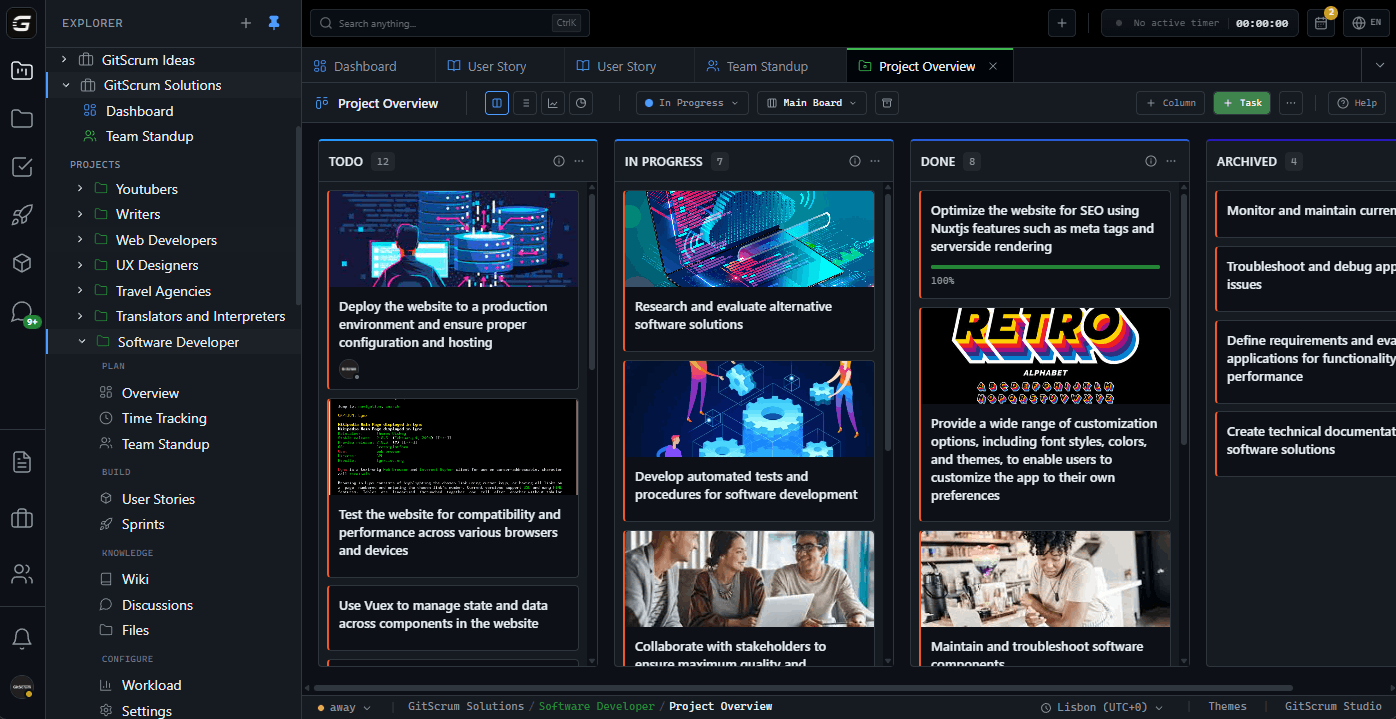
Why Traditional PM Fails Distributed Sync-first assumptions: ├─ 'Daily standup' ├─ 'Quick sync call' ├─ 'Let me share my screen' ├─ 'Can everyone join this meeting?' Distributed reality: ├─ No overlapping hours some days ├─ Slack messages lost in scroll ├─ 'I'll update Jira when I wake up' ├─ Context lost between handoffs ├─ Waiting 24 hours for answers GitScrum for Distributed Teams Async-first design: ├─ Board = single source of truth ├─ Task = complete context ├─ Git commits = automatic updates ├─ Wiki = persistent documentation ├─ No meeting required for status 'What's the status?' Look at the board. 24/7, any timezone.
The Board as Source of Truth Distributed board usage: ├─ Morning: Check board ├─ What's in progress? ├─ What's blocked?
├─ What's waiting for me? ├─ Pick task, start working ├─ Evening: Update board ├─ Next timezone sees updates Follow-the-sun workflow: ├─ SF finishes → Board updated ├─ Europe starts → Sees SF work ├─ Europe finishes → Board updated ├─ Asia starts → Sees Europe work ├─ Continuous progress Task Context is Everything Async task requirements: ├─ Full description (no verbal context) ├─ Acceptance criteria clear ├─ Dependencies noted ├─ Blockers visible ├─ Links to relevant resources ├─ Discussion in comments (not Slack) GitScrum approach: ├─ Rich task descriptions ├─ Checklist for requirements ├─ Comments for async discussion ├─ Wiki links for context ├─ Git commits for progress No 'I'll explain in the call'.
Git Integration for Automatic Updates Distributed Git workflow: ├─ Developer commits code ├─ Commit references task ├─ Task updated automatically ├─ No manual Jira update ├─ Progress visible immediately ├─ Next timezone sees progress No more: ├─ 'I finished but forgot to update' ├─ 'Can you update your ticket?' ├─ 'What's the real status?' Handoff Between Timezones Timezone handoff: ├─ SF developer ends day ├─ Task description: Current state ├─ Comments: What's left to do ├─ Board column: Accurate status ├─ Blockers: Clearly noted ├─ London developer starts ├─ Full context available ├─ No meeting needed 'Handoff meeting' becomes: ├─ Read task ├─ Review commits ├─ Check comments ├─ Continue work Async Decision Making Distributed decisions: ├─ Post proposal in task/wiki ├─ All timezones review ├─ Comments with feedback ├─ 24-48 hours for input ├─ Decision documented ├─ No 3 AM meeting required GitScrum wiki: ├─ Decision logs ├─ Architecture decisions ├─ Process documentation ├─ Accessible anytime Reducing Meeting Load Distributed meeting math: ├─ 10-person team, 5 timezones ├─ 1 all-hands = 5 people inconvenienced ├─ Weekly = 20 lost sleep sessions/month ├─ Plus: Travel for in-person Async-first approach: ├─ Board replaces daily standup ├─ Wiki replaces 'overview meeting' ├─ Task comments replace 'quick sync' ├─ Meetings: Rare, for relationships Time Tracking Across Timezones Distributed time tracking: ├─ Who worked on what? ├─ When?
├─ How long? ├─ Billing for clients?
├─ Utilization reporting? GitScrum time tracking: ├─ Built-in, per task ├─ Timezone-aware ├─ Reports when needed ├─ Not another tool Notifications That Work Async notifications: ├─ Task mentioned?
Notification ├─ Comment on your task? Notification ├─ Blocked task resolved?
Notification ├─ Digest of daily changes Not: ├─ 100 Slack messages ├─ Lost in channel scroll ├─ Urgent vs noise unclear Documentation for Context Distributed documentation: ├─ Onboarding (no 'shadow someone') ├─ Architecture (no 'ask James') ├─ Processes (no tribal knowledge) ├─ Decisions (no 'we discussed') GitScrum wiki: ├─ All docs in one place ├─ Searchable ├─ Linked from tasks ├─ Always up-to-date ├─ Not lost in Notion/Drive Pricing for Global Teams 10-person distributed team: $71.20/month ├─ 3 in US ($26.70) ├─ 3 in Europe (included) ├─ 4 in Asia (included) ├─ Same features everywhere ├─ No regional pricing tricks $8.90/user/month. 2 users free forever.
Same price in SF and Singapore. Compared to Other Tools Jira for distributed: ├─ Heavy, slow to load globally ├─ Git integration = plugin overhead ├─ Pricing: $17.50/user (Premium) Trello: ├─ Simple but no Git integration ├─ No sprints ├─ Gets messy at scale Linear: ├─ Good UX but $10/user ├─ No built-in wiki ├─ Limited time tracking GitScrum: ├─ Lightweight (fast globally) ├─ Native Git integration ├─ Wiki included ├─ $8.90/user Real Distributed Experience 'Our team spans San Francisco, Berlin, and Bangalore.
Before GitScrum, we had 3 status meetings per day to cover timezones. Now the board IS the status meeting.
Berlin updates before leaving, Bangalore picks up in their morning. SF reviews before bed.
Three time zones, zero meetings for coordination. We meet monthly for team bonding, not status.' - Engineering Manager, Remote-First Company Daily Async Workflow Any timezone morning: ├─ Open board (30 seconds) ├─ Check: What changed overnight?
├─ Check: What's assigned to me? ├─ Check: Any blockers resolved?
├─ Pick task, start working ├─ Commits link automatically ├─ Comments for async questions Any timezone evening: ├─ Update task status ├─ Leave context in comments ├─ Note blockers clearly ├─ 2 minutes, done ├─ Next timezone sees everything Sprint Planning Async Distributed sprint planning: ├─ PM creates proposed sprint ├─ Tasks in 'Proposed' column ├─ Team reviews async ├─ Comments with questions/concerns ├─ 48 hours to finalize ├─ Sprint starts Monday ├─ No 2-hour planning poker Retro async: ├─ Wiki page for retro items ├─ Team adds throughout sprint ├─ Review async ├─ Discussion in comments ├─ Actions become tasks ├─ Optional: 30 min video call Building Trust Remotely Distributed trust: ├─ Work visibility builds trust ├─ Board shows who's doing what ├─ Git shows actual commits ├─ No 'are they really working?' ├─ Output is visible, always GitScrum provides: ├─ Transparency by default ├─ Work speaks for itself ├─ No micromanagement needed ├─ Trust through visibility Start Free Today 1. Sign up (30 seconds) 2.
Invite global team 3. Connect repos 4.
Board = source of truth Async-first project management. For teams that span the globe.
The GitScrum Advantage
One unified platform to eliminate context switching and recover productive hours.