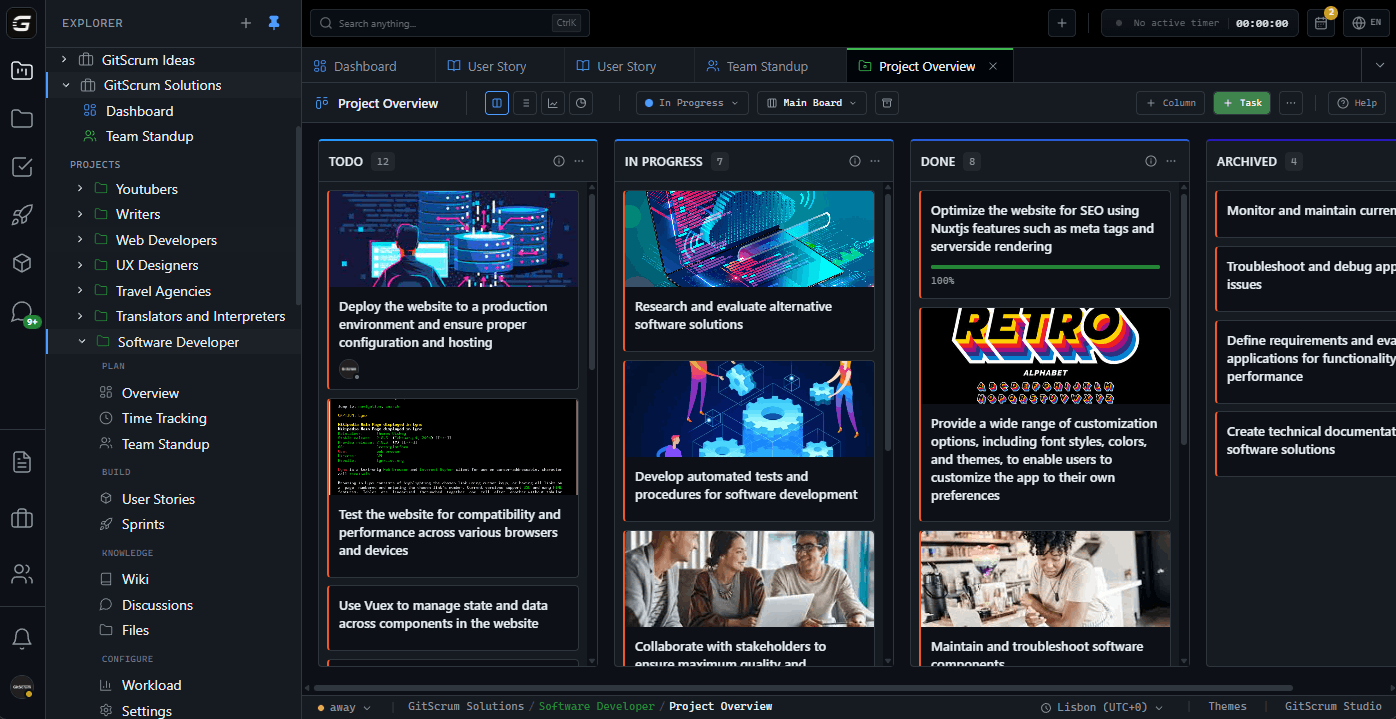
GitScrum GitHub Integration Overview: --- WHY DEVELOPERS NEED THIS The Problem: - Context switching between GitHub and project management tools - Manual status updates when code is pushed - No visibility into development progress for managers - Commit history disconnected from task history - PRs approved but tasks still show 'In Progress' The Solution: - Single source of truth for code and tasks - Automatic status updates based on Git activity - Real-time sync between commits, PRs, and tasks - Development metrics visible in project dashboards --- CORE INTEGRATION FEATURES 1.
Commit-to-Task Linking How it works: - Reference task ID in commit message: git commit -m "Add login validation [GS-123]" - Commit automatically links to task GS-123 - Commit appears in task activity feed - Click-through from task to GitHub commit Benefits: - Full audit trail of code changes per task - Easy code review context - Historical record of implementation 2. Branch Tracking How it works: - Create branch from task: feature/GS-123-login-validation - GitScrum tracks branch automatically - Branch status visible on task card - See all branches linked to a task Benefits: - Know which branches address which features - Identify orphan branches - Track work in progress 3.
Pull Request Sync How it works: - PR references task: Fixes GS-123 - PR status syncs to task (Open/Reviewing/Merged) - Reviewers visible on task - PR comments linked to task discussion Benefits: - Tasks auto-update when PRs are merged - Review status visible in project board - No manual status updates needed 4. Automatic Task Progression Configurable automation rules: - Commit pushed → Task moves to 'In Progress' - PR opened → Task moves to 'Code Review' - PR approved → Task moves to 'Ready for QA' - PR merged to main → Task moves to 'Done' Customization: - Define your own rules - Different rules per project - Override manual when needed --- SETUP GUIDE Step 1: Connect GitHub Account - Go to Settings → Integrations → GitHub - Click 'Connect GitHub' - Authorize GitScrum OAuth app - Select repositories to sync Step 2: Configure Repository Mapping - Map GitHub repos to GitScrum projects - Set default branch (main/master) - Enable webhook notifications Step 3: Set Up Automation Rules - Define commit triggers - Set PR status mappings - Configure branch naming convention - Test with sample commit Step 4: Team Adoption - Share commit message conventions - Document branch naming patterns - Set up commit hooks (optional) Total setup time: ~15 minutes --- COMMIT MESSAGE CONVENTION Basic format: <type>: <description> [GS-<task-id>] Examples: feat: Add user registration flow [GS-456] fix: Resolve login timeout issue [GS-789] refactor: Simplify payment processing [GS-234] docs: Update API documentation [GS-567] Multiple tasks: feat: Implement dashboard widgets [GS-123, GS-124, GS-125] --- GITHUB ACTIONS INTEGRATION GitScrum can receive GitHub Actions webhooks: yaml .github/workflows/notify-gitscrum.yml name: Notify GitScrum on: push: branches: [main] pullrequest: types: [opened, closed, merged] jobs: notify: runs-on: ubuntu-latest steps: - name: Notify GitScrum run: | curl -X POST ${{ secrets.GITSCRUMWEBHOOKURL }} \ -H 'Content-Type: application/json' \ -d '{"event": "${{ github.eventname }}", "ref": "${{ github.ref }}"}' Use cases: - Build status on task cards - Deploy notifications - Test results linked to tasks --- COMPARISON: GITSCRUM VS JIRA GITHUB | Feature | GitScrum | Jira + GitHub | |---------|----------|---------------| | Setup time | 15 min | 1-2 hours | | Commit linking | Native | Via marketplace app | | PR status sync | Real-time | Polling (delayed) | | Auto task progression | ✓ (configurable) | Limited | | Branch tracking | Built-in | Requires add-on | | Price | Included | $2-5/user extra | --- DEVELOPER EXPERIENCE Without GitScrum: 1.
Write code 2. Commit to GitHub 3.
Open browser, go to Jira 4. Find task 5.
Update status manually 6. Add comment about commit 7.
Go back to coding With GitScrum: 1. Write code 2.
Commit with task ID: git commit -m "Fix bug [GS-123]" 3. Everything updates automatically 4.
Keep coding Time saved: 5-10 minutes per commit × 20 commits/day = 1.5-3 hours/day/developer
The GitScrum Advantage
One unified platform to eliminate context switching and recover productive hours.