The time tracking integration problem is more expensive than most teams realize.
The Hidden Costs of Separate Time Tracking: 1. Double Data Entry Every time entry requires: - Opening time tracking app - Finding or creating the project/task - Entering time manually - Adding description (often duplicating task name) If your team logs 50 time entries per day, that's 50 context switches and 50 opportunities for error.
2. Reconciliation Overhead At sprint end, someone needs to answer: 'How many hours did we spend on feature X?' With separate systems, this means: - Exporting time data from Toggl/Harvest - Exporting task data from Jira/Asana - Matching time entries to tasks manually - Building spreadsheet formulas - Discovering mismatched entries - Chasing team for corrections This reconciliation takes 2-4 hours per sprint for most project managers.
3. Billing Accuracy Agencies and consultancies bill by hours.
Separate systems create billing risk: - Time logged but not linked to project - Time linked to wrong project - Billable/non-billable confusion - Missing time entries discovered after invoice sent 4. Estimation Improvement (Impossible) 'How long do authentication features actually take?' With separate systems, answering this requires manual analysis across both platforms.
Nobody does it. Estimation never improves.
5. Team Accountability Gaps Where did 40 hours go this week?
With separate systems: - Time tool shows total hours - Task tool shows completed tasks - No correlation between them - Trust-based system without verification What Integrated Time Tracking Looks Like: 1. One-Click Timer Start - Open task - Click 'Start Timer' - Work - Timer auto-stops when you start another task No separate app.
No manual entry. No forgetting to log.
2. Time Visible on Tasks - Each task shows time logged - Timer runs visibly on task card - Multiple sessions accumulate - History preserved 3.
Sprint Time Analytics - Total hours per sprint (automatic) - Hours by team member (automatic) - Hours by task type (automatic) - Actual vs estimated (automatic) 4. Project Billing Reports - Billable hours by project - By client, by team member - Exportable for invoicing - No reconciliation needed 5.
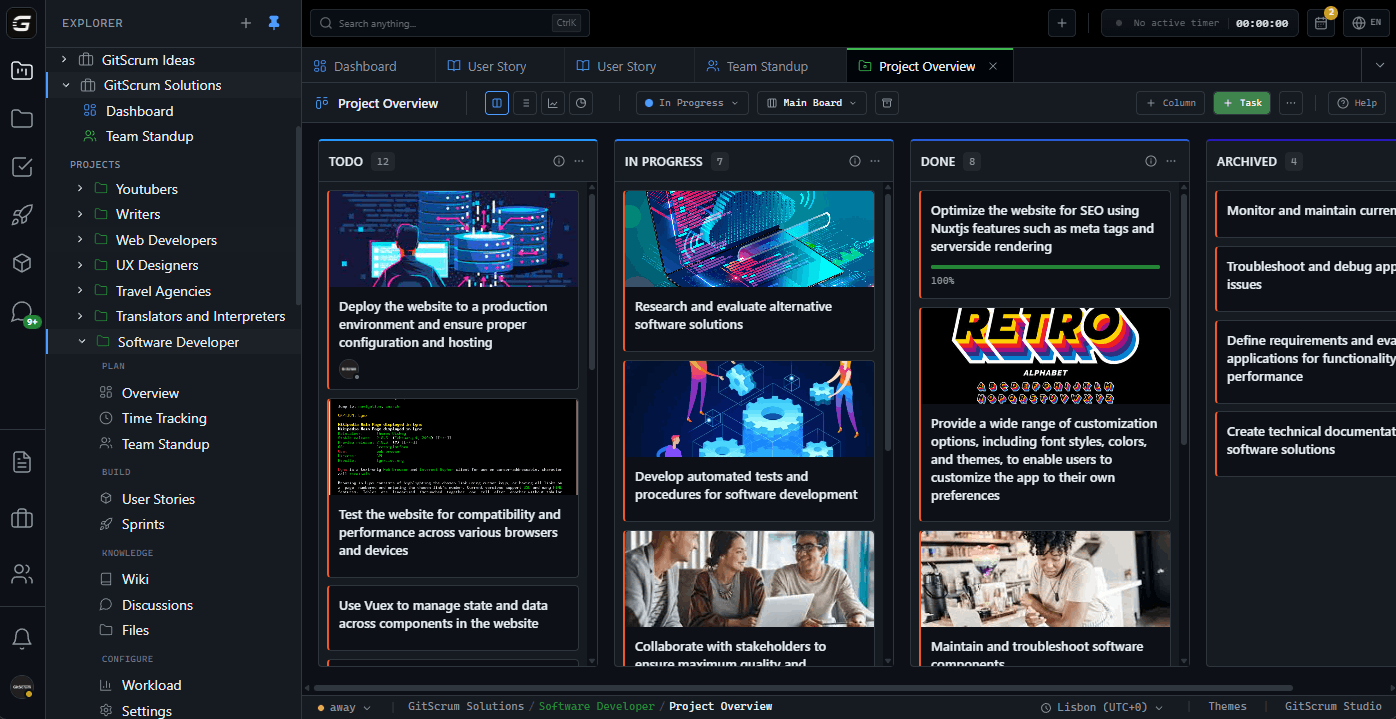
Estimation Calibration - Historical data: 'Auth features average 12 hours' - Estimation accuracy tracking - Team velocity in hours and story points The Math of Integration: Separate Systems (10-person team): - Toggl Team: $90/month - Jira: $77.50/month - Reconciliation: 4 hours/sprint × $50/hour = $400/month - Error correction: 2 hours/month × $50/hour = $100/month - Total: ~$670/month GitScrum Integrated (10-person team): - 2 free + 8 × $8.90 = $71.20/month - Reconciliation: $0 (automatic) - Error correction: minimal (single source of truth) - Total: ~$75/month Time Tracking Features in GitScrum: 1. Task-Level Timers - Start/stop from task view - Active timer visible across interface - Auto-pause on idle detection - Manual entry for retroactive logging 2.
Time Entry Management - Edit/delete time entries - Add notes to time entries - Billable/non-billable flag - Bulk time entry for catch-up 3. Reporting Suite - By project, sprint, task, person - Date range filtering - Export to CSV/PDF - Client-friendly formats 4.
Integrations - Calendar sync for time context - Invoice tool export - Payroll system export 5. Team Visibility - Who's working on what now?
- Team timesheet view - Individual time summaries - Manager oversight without micromanagement For Agencies and Consultancies: Integrated time tracking is especially valuable for billable work: - Client projects tracked accurately - Profitability visible per project - Invoice data ready without assembly - Client transparency through shared reports For Product Teams: Integrated time tracking helps internal optimization: - Feature cost understanding - Sprint planning accuracy - Velocity measurement in hours and points - Technical debt time tracking $8.90/user/month for project management with integrated time tracking. 2 users free forever.
One tool for tasks and time.
The GitScrum Advantage
One unified platform to eliminate context switching and recover productive hours.