Why Teams Are Replacing Jira Right Now The momentum shift: - 2020-2022: Jira was 'the standard' - 2023: Teams started questioning - 2024: Migration to alternatives accelerated - 2025: Replacing Jira is normal What changed: 1.
Better alternatives emerged - Linear proved you can have speed AND features - GitScrum proved you can have GitHub-native AND affordable - Height proved AI can be useful in PM 2. Remote work exposed Jira's weaknesses - Configuration requires synchronous communication - Learning curve worse without in-person training - Admin bottleneck across timezones 3.
Cost scrutiny increased - Per-user costs add up at scale - Feature gatekeeping frustrates teams - Atlassian price increases 4. Developer experience matters more - War for talent means tools matter - 'We use Jira' is becoming a yellow flag - Teams want tools developers actually like The Jira Replacement Decision Framework Before migrating, confirm you're solving the right problem: Symptom Is it Jira?
Could be configuration? ------- ----------- ---------------------- Slow page loads Yes No Complex setup Yes Partially High admin burden Yes Partially Poor GitHub integration Yes Partially High cost per user Yes No Developers avoiding tool Probably Maybe Too many status meetings Probably Maybe Manual status updates Yes No If 4+ items are 'Yes' or 'Probably', migration is warranted.
Choosing Your Jira Replacement Primary Options: 1. GitScrum Best for: GitHub-centric teams wanting complete solution Strength: Time tracking, client portals, 2 free users Migration: Import from Jira available Price: $8.90/user/month 2.
Linear Best for: Speed-obsessed teams with budget Strength: Fastest PM tool available Migration: Import available Price: $8/user/month (no free tier) 3. Shortcut Best for: API-heavy automation teams Strength: Mature, well-balanced Migration: Good import tools Price: Free tier + $8.50/user 4.
Asana Best for: Mixed dev/non-dev teams Strength: Mature, wide adoption Migration: Import tools exist Price: Higher, complex tiers 5. Monday Best for: Visual-first teams Strength: Pretty, customizable Migration: Import available Price: Higher, feature gatekeeping Recommendation for dev teams: - GitScrum if time tracking and GitHub matter - Linear if speed is everything - Shortcut if API automation is priority The Migration Timeline Week -2: Preparation Day 1-3: Assessment - Audit current Jira usage - Which projects are active?
- What custom fields exist? - Which integrations are used?
- Who are the admins? Day 4-7: Data export - Export active project data - Export custom field definitions - Document current workflows - Screenshot key configurations Day 8-14: Tool setup - Create accounts in new tool - Configure basic structure - Test import with one project - Fix import issues Week 0: Migration Day 1: Communication - Announce migration date - Share training resources - Set Jira to read-only mode - Support channel established Day 2-3: Data migration - Import remaining projects - Verify data integrity - Configure integrations (GitHub) - Set up notifications Day 4-5: Team onboarding - Quick training sessions - Distribute quick-start guide - Answer questions - First sprint in new tool Week 1-2: Stabilization - Monitor for issues - Collect feedback - Adjust configurations - Handle edge cases Week 3-4: Optimization - Remove unused features - Improve workflows - Measure velocity - Document learnings Data Migration Strategy What to migrate: Priority Data Type Reason -------- --------- ------ High Active tasks Currently being worked on High Current sprint In progress work Medium Recent history Context for active work Medium Backlog items Future work planned Low Old sprints Historical reference Skip Closed 6+ months Rarely needed, archive Migration approach: Option A: Fresh Start (Recommended for <20 active tasks) - Don't import old data - Create tasks manually - Clean slate, clean start - Fastest approach Option B: Active + Backlog (Recommended for 20-200 tasks) - Import active sprint - Import backlog - Don't import closed items - Balanced approach Option C: Full Migration (Only if legally required) - Import everything - Takes longest - Usually unnecessary - Creates clutter GitScrum Jira Import: - Export from Jira (CSV/JSON) - Map fields to GitScrum - Import with tool - Verify and clean up Team Transition Management Anticipate reactions: Developer Type Likely Reaction How to Handle -------------- -------------- -------------- Jira-frustrated Excited Channel enthusiasm Change-resistant Skeptical Show clear benefits Admin/Power user Territorial Involve in setup New team members Neutral Quick training Transition tactics: 1.
Find your champion - Identify developer who's excited - Have them help others - Peer support > manager mandate 2. Quick wins first - Show speed difference immediately - Demo GitHub integration working - 'Look, no admin overhead' 3.
Address concerns directly - 'Where did my custom filter go?' - 'How do I see velocity?' - Prepare answers to common questions 4. Two-week commitment - Ask for genuine 2-week try - Then honest assessment - Data-driven decision GitScrum-Specific Migration Guide Step 1: Sign up and explore (Day 1) - Create GitScrum account (free) - Explore with 2 free users - Get familiar with interface - Connect GitHub immediately Step 2: Configure structure (Day 1-2) - Create project structure - Set up sprint configuration - Configure board columns - Map to Jira workflow Jira Status GitScrum Status ----------- --------------- To Do To Do In Progress In Progress In Review Review Done Done Step 3: Import data (Day 2-3) - Export active items from Jira - Use GitScrum import - Map custom fields - Verify imported data Step 4: Connect integrations (Day 3) - Connect GitHub/GitLab/Bitbucket - Set up commit linking - Configure notifications - Test PR workflow Step 5: Train team (Day 4-5) - 30-min walkthrough session - Focus on daily workflows - Distribute cheat sheet - Answer questions Step 6: Go live (Day 5) - Set Jira read-only - All new work in GitScrum - Support channel active - Monitor closely Common Migration Mistakes 1.
Migrating everything Mistake: Import 5 years of Jira history Reality: You'll never look at it Fix: Import only active + backlog 2. Replicating Jira complexity Mistake: Try to recreate every Jira field Reality: You had too many fields anyway Fix: Start simple, add as needed 3.
No training Mistake: 'They'll figure it out' Reality: Frustration builds, tool blamed Fix: 30-min training + cheat sheet 4. Big bang migration Mistake: Switch everything at once Reality: Too much change, chaos Fix: Pilot with one team first 5.
Keeping Jira 'just in case' Mistake: Both tools active indefinitely Reality: Nobody commits to new tool Fix: Hard deadline, read-only, then archive 6. Ignoring feedback Mistake: 'Just use it' Reality: Valid concerns go unaddressed Fix: Week 1-2 feedback sessions Measuring Migration Success Week 2 metrics: - Tool adoption rate (target: >90%) - Help requests (target: <3/day) - Data integrity (target: 100%) - GitHub integration working (target: 100%) Week 4 metrics: - Sprint velocity (target: equal or better) - Status meeting time (target: reduced) - Manual updates (target: near zero) - Team satisfaction (target: higher than Jira) Week 8 metrics: - Return to Jira (target: 0%) - Feature requests for new tool (sign of engagement) - New team onboarding time (target: <1 day) - Admin overhead (target: minimal) Rollback Plan (Hopefully Unused) If migration fails: Week 1 issues: - Likely causes: Data migration gaps, training gaps - Action: Fix issues, extend timeline - Don't: Immediately roll back Week 2 issues: - Likely causes: Workflow mismatch, integration problems - Action: Adjust configuration, more training - Don't: Panic Week 3+ issues: - Likely causes: Wrong tool choice, insufficient buy-in - Action: Honest assessment - Consider: Partial rollback or alternative tool True rollback (rare): - Keep Jira data intact during migration - If necessary, restore Jira access - Document what went wrong - Try different tool next time GitScrum migrations have high success rates because: - Simple to learn (low training burden) - GitHub integration works immediately - Free tier lets you validate before committing Post-Migration Optimization Month 1: - Collect feedback weekly - Adjust board configuration - Add/remove features as needed - Document new processes Month 2: - Review velocity metrics - Compare to Jira baseline - Optimize notifications - Train new team members Month 3: - Full retrospective - Celebrate wins - Document learnings - Archive old Jira data Ongoing: - Stay current with new features - Regular process reviews - Continuous improvement - Enjoy not being in Jira Ready to Replace Jira?
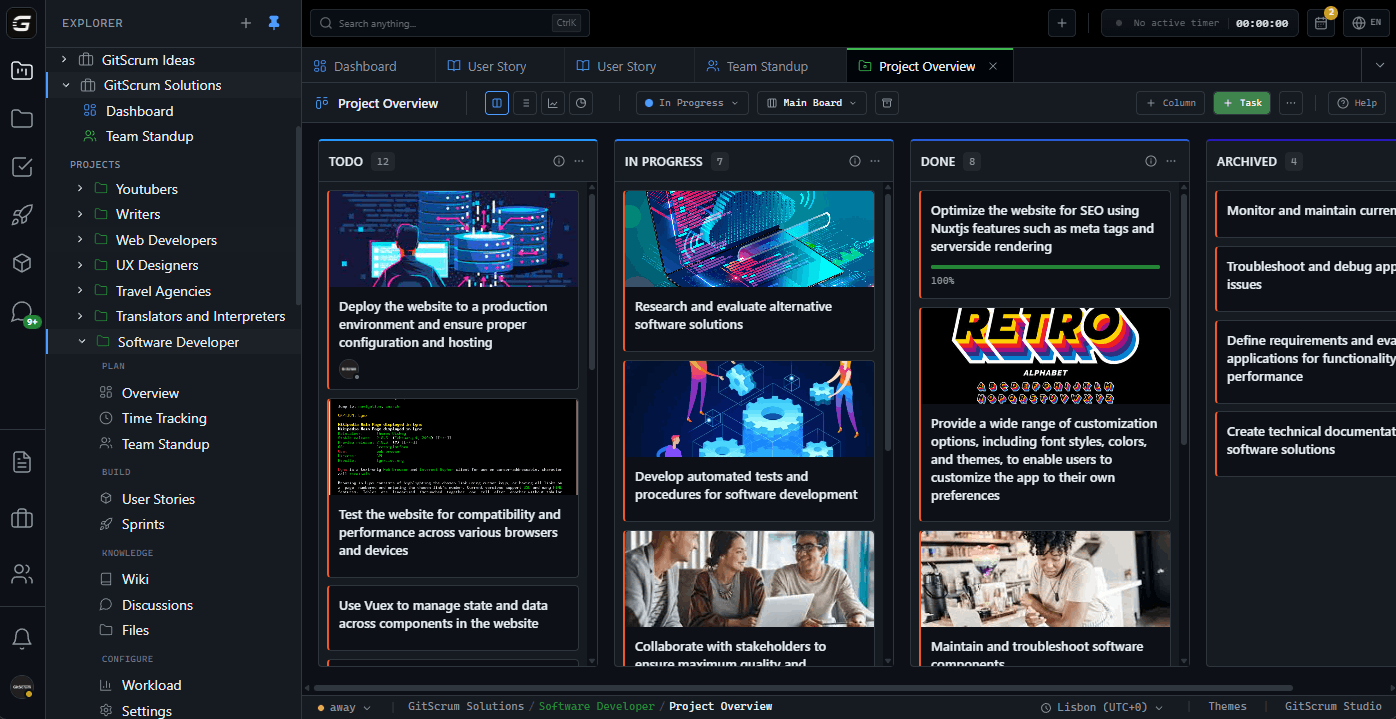
GitScrum makes the switch easy: - Clean, fast interface (no Jira sluggishness) - GitHub-native integration (real, not webhooks) - 2 users free forever (validate before committing) - $8.90/user/month (no enterprise gatekeeping) - Time tracking included (no addon fees) - Client portals (if you need them) - Wiki built-in (no Confluence needed) Most teams complete migration in 1-2 weeks. Velocity typically matches or improves within first sprint.
No PhD in administration required. Try GitScrum: Your Jira replacement awaits.
The GitScrum Advantage
One unified platform to eliminate context switching and recover productive hours.