VS Code

GitScrum for VS Code, Google Antigravity, Cursor and Windsurf!

GitScrum logo
Solution

WIP Limits for Dev Focus 2026 | 30-50% Throughput

Devs juggle 5-7 tasks—context switch costs 23-min each. WIP limits enforce focus. Reduce WIP from 5 to 2 per dev, see 30-50% throughput gain. Free trial.

WIP Limits for Dev Focus 2026 | 30-50% Throughput

Research shows developers need 23 minutes to regain focus after an interruption.

When a developer has 5 tasks 'in progress,' they're not working on 5 things—they're being interrupted 4 times per task. Mental gear-shifting consumes 20-40% of cognitive capacity.

The solution isn't trying harder to focus—it's having less work in flight. GitScrum's WIP tracking reveals the true cost of multitasking.

Sprint KPIs show current WIP count. The focus score metric measures completion vs parallelism.

Column WIP limits enforce boundaries: if 'In Progress' limit is 3, a developer literally cannot start a 4th task until one completes. This isn't punishment—it's protection.

When WIP is low, developers enter flow state. They complete tasks faster because they're not constantly reloading mental context.

Paradoxically, doing less in parallel means finishing more in total. The data proves it: teams that reduce average WIP from 5 to 2 per developer typically see 30-50% throughput improvement.

The GitScrum Advantage

One unified platform to eliminate context switching and recover productive hours.

01

problem.identify()

The Problem

Developers have 5-7 tasks 'in progress' simultaneously—none getting full attention

Context switching between tasks consumes 20-40% of productive cognitive capacity

23 minutes needed to regain focus after each interruption or task switch

Flow state is impossible when constantly switching between PRs, bugs, and features

High WIP looks productive (everyone is 'busy') but destroys actual throughput

02

solution.implement()

The Solution

WIP count metric shows concurrent tasks per sprint in real-time

Focus score measures completion rate vs parallelism—higher focus = more finishing, less juggling

Per-column WIP limits prevent developers from overloading their personal queue

Visual indicators when columns approach capacity create natural pause points

Sprint KPIs track WIP trends over time to measure improvement

03

How It Works

1

Measure Current WIP

Start by understanding your baseline. Sprint KPIs show 'Work In Progress' count—tasks in active workflow states. If your team of 5 has 25 tasks in progress, that's 5 per developer. Too high.

2

Check Focus Score

The focus metric in Sprint Health measures how much the team is completing vs how much is in flight. Low focus score means lots of juggling. Target: more completing than starting.

3

Set WIP Limits

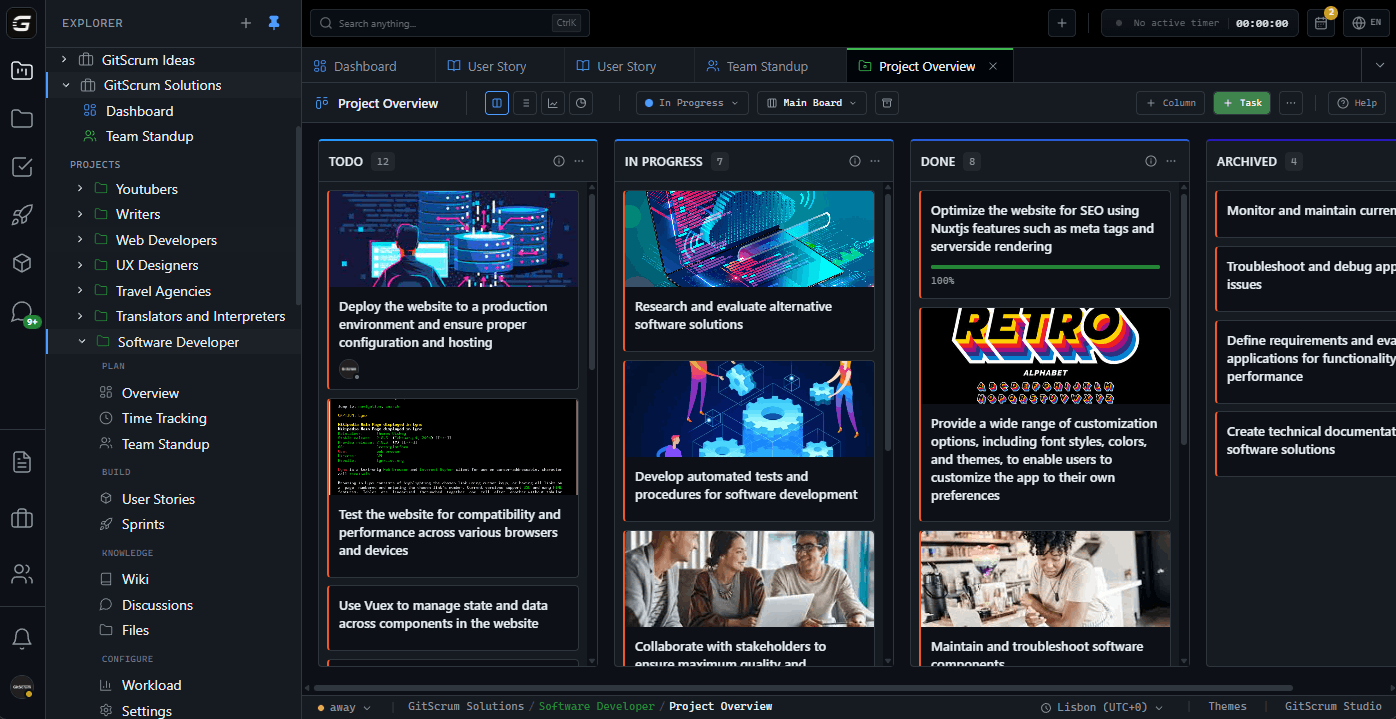
Configure column WIP limits to enforce lower parallelism. For a 5-person team, try WIP limit of 6-8 for 'In Progress.' The system blocks new work until existing work moves forward.

4

Monitor the Shift

Watch sprint metrics over 2-3 sprints. WIP should decrease while throughput (completed tasks) increases. The data proves that doing less in parallel = finishing more in total.

5

Protect Focus Time

Lower WIP creates natural focus blocks. When a developer has only 1-2 active tasks, they can work for hours without mental context switching. Flow state becomes possible.

04

Why GitScrum

GitScrum addresses Reducing Work in Progress to Improve Focus Time through Kanban boards with WIP limits, sprint planning, and workflow visualization

Problem resolution based on Kanban Method (David Anderson) for flow optimization and Scrum Guide (Schwaber and Sutherland) for iterative improvement

Capabilities

  • Kanban boards with WIP limits to prevent overload
  • Sprint planning with burndown charts for predictable delivery
  • Workload views for capacity management
  • Wiki for process documentation
  • Discussions for async collaboration
  • Reports for bottleneck identification

Industry Practices

Kanban MethodScrum FrameworkFlow OptimizationContinuous Improvement

Frequently Asked Questions

Still have questions? Contact us at customer.service@gitscrum.com

What's an ideal WIP per developer?

Research suggests 1-3 tasks per developer. One primary task with 1-2 secondary (blocked or awaiting review) allows focus while preventing idleness. 5+ tasks per developer typically indicates problematic multitasking.

Won't reducing WIP make developers idle?

The opposite typically happens. With lower WIP, tasks complete faster (no context switching overhead). The total throughput increases even though fewer tasks are active at any moment.

How does focus score work?

Focus score measures the ratio of completed work to in-progress work. High focus = team is finishing things faster than starting new things. Low focus = lots of work started, little getting done.

What if urgent work comes in?

WIP limits force real prioritization. If something urgent must start, something else must pause. This prevents the common pattern where everything is 'urgent' and nothing gets done.

How long before we see improvement?

Most teams see measurable throughput improvement within 2-3 sprints of reducing WIP. The first sprint feels uncomfortable ('I should be doing more!'), but data shows completion rates rising.

Ready to solve this?

Start free, no credit card required. Cancel anytime.

Works with your favorite tools

Connect GitScrum with the tools your team already uses. Native integrations with Git providers and communication platforms.

GitHubGitHub
GitLabGitLab
BitbucketBitbucket
SlackSlack
Microsoft TeamsTeams
DiscordDiscord
ZapierZapier
PabblyPabbly

Connect with 3,000+ apps via Zapier & Pabbly