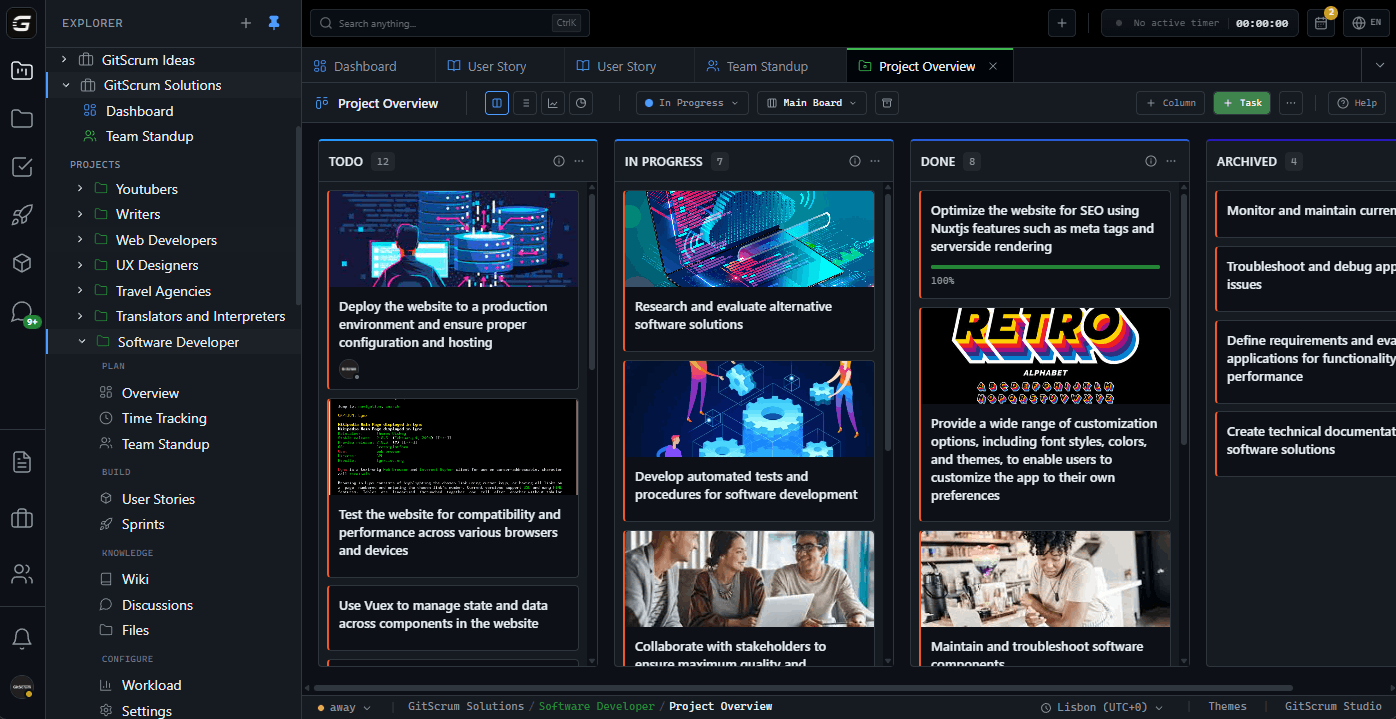
VS Code

GitScrum for VS Code, Google Antigravity, Cursor and Windsurf!

GitScrum logo
Solution

Release Deployment Coordination 2026 | What's Shipping

'What's in this release?' 'QA signed off?' 'Who deploys when?' Sprints define scope. Done column shows ready. Checklists ensure steps followed. Free trial.

Release Deployment Coordination 2026 | What's Shipping

Release day arrives.

'What's going into this release?' Someone scrolls through commits. 'Did QA sign off on the payment feature?' Nobody's sure.

'When are we deploying?' The deployment time was decided in Slack two weeks ago, buried in a thread. Someone deploys too early, breaks staging.

The release goes out late with last-minute panic fixes. Sound familiar?

Release management requires visibility: what's ready, what's tested, what's the plan. GitScrum provides structure: sprints define release scope, Done column shows what's complete, checklists ensure pre-deployment steps are followed, and deployment coordination happens in a visible place—not scattered across Slack threads.

Releases become predictable events, not firefighting exercises.

The GitScrum Advantage

One unified platform to eliminate context switching and recover productive hours.

01

problem.identify()

The Problem

Unclear what's included in release—scrolling through commits to figure it out

QA sign-off status unknown—did everything get tested before release?

Deployment timing decided in chat—buried and forgotten

Pre-deployment steps missed—checklists exist nowhere or aren't followed

Post-deployment verification ad hoc—nobody knows if release is healthy

02

solution.implement()

The Solution

Sprint completion defines release scope—Done column shows what's shipping

QA status visible on each task—passed, failed, or pending QA sign-off

Deployment tasks with scheduled dates and assignees for coordination

Pre-deployment checklists ensure steps are completed and verified

Post-deployment checklist items for verification and rollback readiness

03

How It Works

1

Define Release Scope via Sprint

Sprint represents release. All tasks in Done column at sprint end are release candidates. Filter by sprint to see exactly what's ready to ship. No guessing, no scrolling commits—the board shows release content.

2

Track QA Status Per Task

Tasks move through status columns: In Progress → Code Review → QA → Done. Each task shows its status. Before release, filter for QA status—anything not in Done hasn't passed QA. Don't release untested work.

3

Create Deployment Task

Create a 'Sprint 23 Deployment' task. Add deployment date, assign to deployer, and create checklist: database migrations run, environment variables set, monitoring configured, rollback plan documented. The deployment has a home.

4

Execute Pre-Deployment Checklist

Before deploying, go through the checklist. Each item checked is visible progress. 'Staging tested ✓, Performance check ✓, Security scan ✓, Documentation updated ✓.' Nothing forgotten, nothing assumed.

5

Post-Deployment Verification

After deployment, checklist continues: smoke tests passed, error rates normal, key user flows verified, team notified. If issues appear, rollback steps are documented in the same task. Release management is systematic, not heroic.

04

Why GitScrum

GitScrum addresses Release Management and Deployment Coordination through Kanban boards with WIP limits, sprint planning, and workflow visualization

Problem resolution based on Kanban Method (David Anderson) for flow optimization and Scrum Guide (Schwaber and Sutherland) for iterative improvement

Capabilities

  • Kanban boards with WIP limits to prevent overload
  • Sprint planning with burndown charts for predictable delivery
  • Workload views for capacity management
  • Wiki for process documentation
  • Discussions for async collaboration
  • Reports for bottleneck identification

Industry Practices

Kanban MethodScrum FrameworkFlow OptimizationContinuous Improvement

Frequently Asked Questions

Still have questions? Contact us at customer.service@gitscrum.com

How do we define what's in a release?

Sprint = release. Everything in Done column at sprint end is release content. This creates natural release cadence: every 2-week sprint is a release. If you need to release mid-sprint, filter tasks by 'Done before date' or tag release-specific items. The board is the source of truth for release content.

How do we ensure everything is QA tested before release?

Use status columns that require QA. Task flow: In Progress → Code Review → QA → Done. Nothing reaches Done without passing QA. Before release, filter for any items in QA or earlier—those aren't release-ready. If they must go out, QA them first or explicitly decide to ship untested (and document the risk).

Should deployment tasks be separate from feature tasks?

Yes. Create a 'Sprint X Deployment' task that exists alongside feature work. It holds deployment date, deployer assignment, and deployment checklist. This task represents the release event itself, not the features in it. When someone asks 'when are we deploying?', point to this task.

How detailed should deployment checklists be?

Detailed enough that someone unfamiliar could follow them. Include: pre-deployment (migrations ready, env vars set, rollback plan), deployment steps (command or pipeline to run, expected duration), post-deployment (smoke tests, monitoring check, stakeholder notification). Review and update after each release.

How do we handle hotfixes outside normal release cycle?

Hotfixes are mini-releases. Create a hotfix task, link to the issue being fixed, and follow abbreviated checklist: fix developed, code reviewed, tested in staging, deployed with monitoring. Document what was deployed and when. Hotfix tasks are flagged separately from sprint work for tracking.

Ready to solve this?

Start free, no credit card required. Cancel anytime.

Works with your favorite tools

Connect GitScrum with the tools your team already uses. Native integrations with Git providers and communication platforms.

GitHubGitHub
GitLabGitLab
BitbucketBitbucket
SlackSlack
Microsoft TeamsTeams
DiscordDiscord
ZapierZapier
PabblyPabbly

Connect with 3,000+ apps via Zapier & Pabbly