
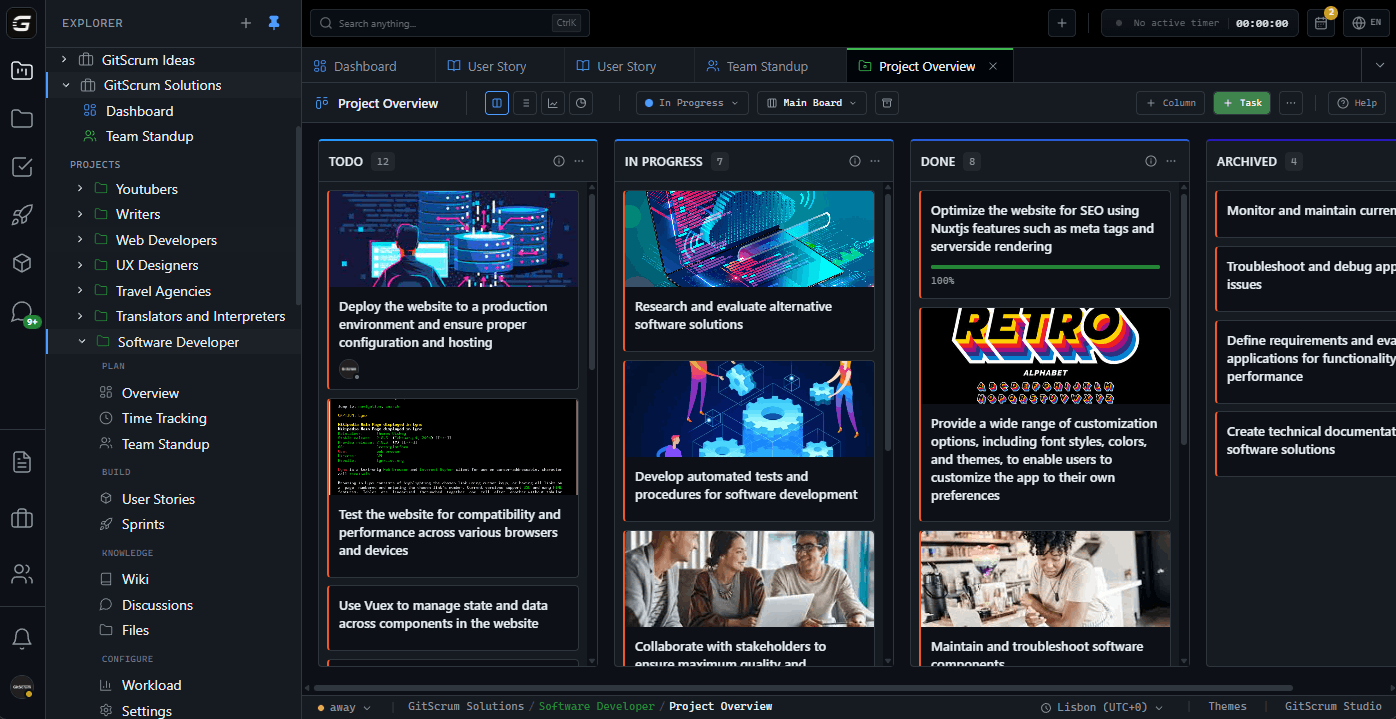
The Release Planning Problem Release planning meeting: 'So, what's ready for release this week?
let me check.' opens Jira, sees In Progress 'Oh wait, the PR is merged. Jira wasn't updated.' 'Mike, what about the dashboard?' 'Code complete, but needs review.' 'When will it be reviewed?' 'I don't know, I assigned Lisa, but...' Lisa not in meeting Result: - 45 minutes wasted - Release scope unclear - Ship date at risk - Nobody confident in the plan This happens because: - PM tool status is out of date - No connection to actual code state - Release readiness requires manual checking - Communication gaps between dev and PM What Release Planning Needs 1.
Real-Time Status Not 'what did someone say yesterday.' What's the code status RIGHT NOW? For each feature: - Code started?
(branch exists) - Code done? (PR opened) - Code reviewed?
(PR approved) - Code merged? (in main branch) - Code deployed?
(in environment) This is objective. No asking, no guessing.
2. Release Scope Definition Which features are in this release?
- Version number - Target date - Features/bugs included - Dependencies 3. Release Progress Tracking How close are we?
- Total items in release - Items complete - Items in progress - Items blocked - Percent complete 4. Risk Identification What might delay us?
- Features with no code activity - PRs waiting too long for review - Blocked items - Scope creep (items added late) 5. Release Notes Generation What's included?
- Feature list - Bug fixes - Breaking changes - Migration notes GitScrum Release Planning Release Dashboard: Release: v2.4.0 Target: Jan 15, 2025 Status: 72% Complete Features (6 total) ───────────────── ✅ Login redesign Done - Merged Jan 8 ✅ Dashboard widgets Done - Merged Jan 10 🔄 Report export In Review - PR 234 🔄 User preferences In Progress - 3 commits ⚪ Email notifications Not Started 🔴 API rate limiting Blocked - Waiting on infra Bugs (4 total) ───────────── ✅ Fix mobile nav Merged Jan 9 ✅ Fix date picker Merged Jan 10 🔄 Fix search filters In Review ⚪ Fix pagination Not Started Release Health ───────────── Complete: 5 / 10 (50%) In Progress: 3 / 10 (30%) Not Started: 2 / 10 (20%) Blocked: 1 item Risks ───── ⚠️ API rate limiting blocked - needs infrastructure team ⚠️ Email notifications not started - at risk for release ⚠️ 5 days until target date This view updates automatically from Git activity. Creating a Release 1.
Create Release - Name: v2.4.0 - Target Date: Jan 15, 2025 - Description: 'Q1 feature release' 2. Add Items to Release - Drag from backlog - Or tag existing items - Or auto-add by epic/label 3.
Track Progress - Dashboard updates as code ships - Git activity reflected immediately - No manual status updates needed 4. Ship - Mark release as shipped - Release notes auto-generated - Historical record preserved Release Item States Git-driven states: ⚪ Not Started - No branch created - No commits - Work hasn't begun 🔄 In Progress - Branch created OR - Commits exist - Work is happening 👀 In Review - PR opened - Awaiting code review ✅ Ready to Merge - PR approved - Ready for final merge ✓ Complete - PR merged to main - Code is in release branch 🚀 Deployed - Code deployed to production - (requires deployment tracking setup) 🔴 Blocked - Manually marked blocked - Requires resolution Each state determined by Git events, not self-reporting.
Release Timeline View Week 1 Week 2 Week 3 ──────────── ──────────── ──────────── Login [████████████████] ✅ Complete Dashboard [███████████████] ✅ Complete Reports [████████] 🔄 In Review Prefs [█████████████] 🔄 In Progress Email [] ⚠️ Not Started API [█████━━━━━━━━━━━━━━] 🔴 Blocked Visualize: - When work started - How long each item took - What's on track vs behind - Where blockers appeared Release Metrics 1. Release Velocity - Items completed per week - Trend over release cycle - Predicts completion date 2.
Scope Stability - Items added after release start - Scope creep percentage - Impact on timeline 3. Time in Review - Average PR review time - Items stuck in review - Bottleneck identification 4.
Block Duration - How long items stay blocked - Common blockers - Resolution time Release Notes Generation Auto-generate release notes from completed items: Release v2.4.0 - January 15, 2025 ═════════════════════════════════ New Features ──────────── - Login redesign with SSO support (123) - Dashboard widgets with drag-and-drop (145) - Report export to CSV and PDF (167) Bug Fixes ───────── - Fixed mobile navigation on iOS Safari (201) - Fixed date picker timezone issues (205) Customize: - Include/exclude items - Edit descriptions - Add manual notes - Export to Markdown, HTML, or plain text Multi-Release Planning See multiple releases: v2.4.0 - Jan 15 [████████████████] 72% v2.5.0 - Feb 15 [████████░░░░░░░░] 40% v3.0.0 - Mar 30 [███░░░░░░░░░░░░░] 15% Plan across releases: - Move items between releases - Balance scope - Manage dependencies - Coordinate team capacity Version Numbering Supports semantic versioning: Major.Minor.Patch - Major: Breaking changes - Minor: New features, backwards compatible - Patch: Bug fixes Or custom versioning: - Sprint numbers (Sprint 23) - Dates (2025.01.15) - Code names (Project Phoenix) Release Branches For teams using release branches: 1. Create release branch in Git 2.
Associate with GitScrum release 3. Track what's merged to release branch 4.
Cherry-pick tracking Differentiate: - Merged to main - Merged to release branch - Deployed to staging - Deployed to production Stakeholder Communication Share release status: - Read-only link for stakeholders - Automatic email updates - Slack integration - No login required for viewing Stakeholders see progress without asking. Release Retrospective After release: - What shipped vs planned - What slipped - Why things slipped - Time in each state - Lessons learned Historical data for improving future releases.
Vs Jira Release Management Jira: ✓ Version/release tracking ✓ Release hub ✗ Manual status updates ✗ Git integration requires plugins ✗ Complex configuration ✗ Expensive with required add-ons GitScrum: ✓ Release tracking ✓ Release dashboard ✓ Auto status from Git ✓ Native Git integration ✓ Simple configuration ✓ $8.90/user all-inclusive Vs Productboard/Aha! Productboard/Aha!: ✓ Roadmap focused ✓ Customer feedback ✗ Less dev execution focus ✗ No Git integration ✗ Higher price point ✗ Marketing/PM focused GitScrum: ✓ Release execution ✓ Dev workflow focus ✓ Git integration ✓ Lower price ✓ Engineering-centric Vs Spreadsheets Spreadsheets: ✓ Free ✓ Flexible ✗ Manual updates ✗ No Git connection ✗ Always out of date ✗ No collaboration GitScrum: ✓ Auto-updating ✓ Git connected ✓ Always current ✓ Team collaboration ✓ $8.90/user (2 free) Pricing 2 users: $0/month (free forever) 5 users: $26.70/month 10 users: $71.20/month 25 users: $178/month Includes: - Unlimited releases - Release dashboard - Release notes generation - Git integration - Stakeholder sharing - Metrics and reports - Mobile apps - API access No premium tier for release features.
Everything included. Getting Started 1.
Sign up (30 seconds) 2. Create project 3.
Connect Git repository 4. Create release with target date 5.
Add features/bugs to release 6. Watch status update from Git 7.
Ship with confidence $8.90/user/month. 2 users free forever.
Release planning with real-time code visibility.
The GitScrum Advantage
One unified platform to eliminate context switching and recover productive hours.