VS Code

GitScrum for VS Code, Google Antigravity, Cursor and Windsurf!

GitScrum logo
Solution

Remote Team Dev Collaboration 2026 | Async-First Boards

Distributed teams lack visibility. Timezone gaps break comms. Questions wait hours. Team Standup captures updates async. Boards show status 24/7. Free trial.

Remote Team Dev Collaboration 2026 | Async-First Boards

Remote work killed the hallway conversation, the tap on the shoulder, the quick desk visit.

What replaced it? A flood of Slack messages, endless video calls, and the anxiety of not knowing what teammates are doing.

Developers in different timezones work in isolation—by the time one person wakes up, another has gone to sleep. Questions wait hours for answers.

Work gets duplicated because nobody knew someone else was already on it. Context lives in synchronous meetings that exclude whoever couldn't attend.

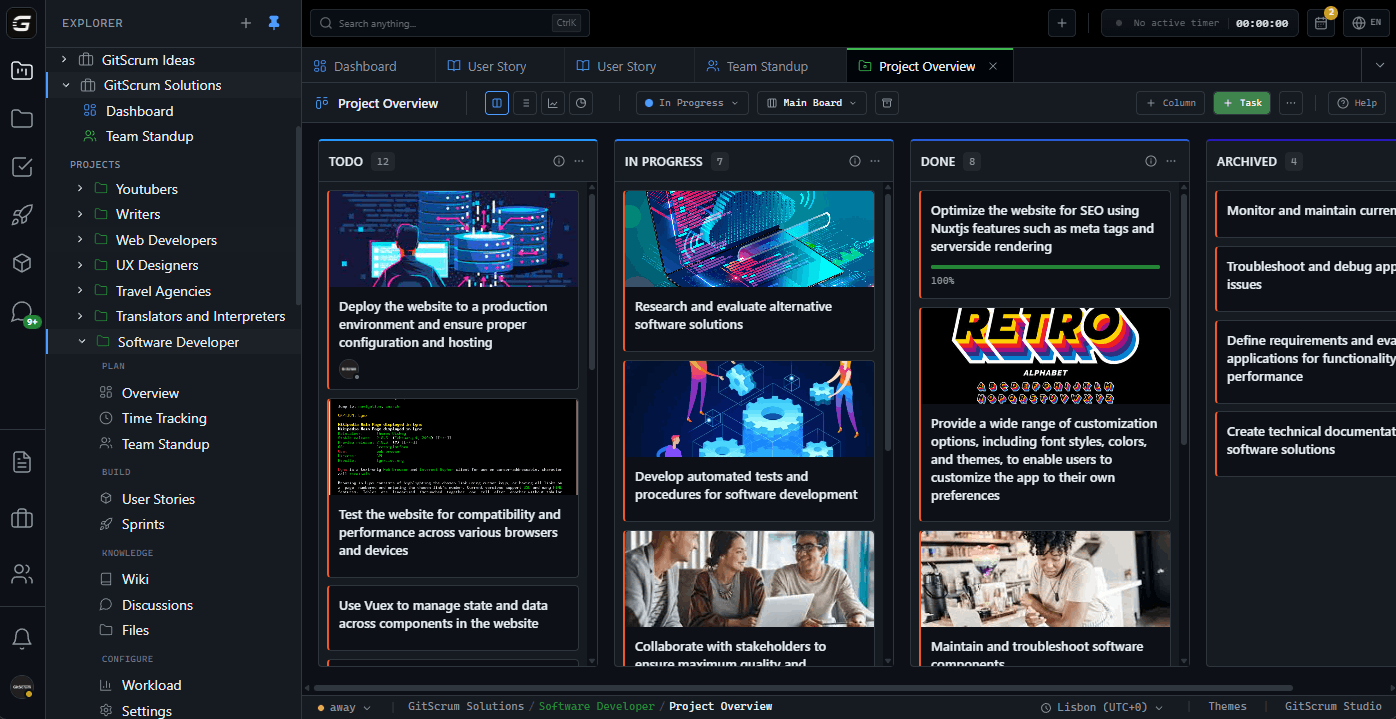
Remote teams need async-first collaboration: status updates that don't require real-time presence, persistent discussions where decisions are documented, visual boards everyone can check anytime. GitScrum provides this: Team Standup captures daily updates across timezones, boards show who's working on what, discussion threads preserve context for whoever reads them later.

The GitScrum Advantage

One unified platform to eliminate context switching and recover productive hours.

01

problem.identify()

The Problem

No visibility into what remote teammates are working on

Timezone differences create communication gaps—questions wait hours

Synchronous meetings exclude developers in different timezones

Context and decisions lost in ephemeral chat messages

Work duplication because coordination requires real-time communication

02

solution.implement()

The Solution

Team Standup captures async status updates—read anytime, any timezone

Visual boards show real-time task status without asking anyone

Discussion threads persist decisions and context for async consumption

Task assignments and ownership clear at a glance

Activity feeds show what happened while you were offline

03

How It Works

1

Establish Async Standup

Replace daily sync meetings with GitScrum's Team Standup. Each team member posts: what they did yesterday, what they're doing today, any blockers. Posts happen when convenient for each timezone. Everyone reads updates at their start of day. Full visibility without meeting overhead.

2

Use Boards as Source of Truth

The board shows reality: what's in progress, what's blocked, what's done. Update task status as you work. Teammates check the board, not Slack, for status. Board updates in real-time—no stale information. Everyone sees the same picture regardless of timezone.

3

Document Decisions in Discussions

Use Discussion Channels and task comments for technical decisions. Not Slack—messages there disappear. Document: 'We decided to use approach X because Y.' Anyone onboarding or catching up finds the rationale. Decisions persist and are searchable.

4

Minimize Synchronous Dependencies

Design work to minimize handoffs requiring real-time coordination. Break tasks into independent chunks. Use task descriptions with full context—enough for someone to start without asking questions. When questions arise, they go in task comments, answered when the right person is online.

5

Review Activity Before Starting

Start each day by scanning: activity feed (what changed overnight), standup updates (what teammates are doing), board changes (new blockers, completed work). Get context in 10 minutes without scheduling a meeting. Work begins informed, not isolated.

04

Why GitScrum

GitScrum addresses Remote Team Collaboration for Developers through Kanban boards with WIP limits, sprint planning, and workflow visualization

Problem resolution based on Kanban Method (David Anderson) for flow optimization and Scrum Guide (Schwaber and Sutherland) for iterative improvement

Capabilities

  • Kanban boards with WIP limits to prevent overload
  • Sprint planning with burndown charts for predictable delivery
  • Workload views for capacity management
  • Wiki for process documentation
  • Discussions for async collaboration
  • Reports for bottleneck identification

Industry Practices

Kanban MethodScrum FrameworkFlow OptimizationContinuous Improvement

Frequently Asked Questions

Still have questions? Contact us at customer.service@gitscrum.com

How do Team Standups work across timezones?

Each person posts when they start their workday. If you're in Tokyo, you post at your 9 AM. Someone in London reads it at their 9 AM—8 hours later. There's no 'meeting time' to find. Posts are timestamped. Most teams set an expectation: post before noon your local time. Updates are always there when you need them.

How do we handle urgent issues across timezones?

Define what's actually urgent: production down, customer blocked. For true emergencies, use phone/text—that's what oncall rotations are for. Everything else can wait for async response. Most 'urgent' things aren't. If you're relying on real-time communication for routine work, the process is broken.

Won't async communication slow us down?

It changes rhythm, not speed. Yes, a question might wait 4 hours for an answer. But you're not blocked—work on something else meanwhile. Total throughput often increases: no time lost to meetings, no interruptions, deeper focus. Async is slower per-item but faster overall.

How do we maintain team culture remotely?

Intentionality. Create space for non-work conversation—virtual coffee chats, dedicated Slack channels for random topics. Celebrate wins publicly in team channels. Video calls when they matter (retrospectives, planning). But don't force 'culture'—people bond through working together effectively, not mandatory fun.

How do we onboard new team members remotely?

Documentation and async mentorship. Use Discussion Channels to document how things work. Assign 'starter' tasks with detailed context. Pair new hires with buddies for questions—answered async in task comments. Record important meetings for later viewing. Good remote onboarding is actually better documented than chaotic in-office osmosis.

Ready to solve this?

Start free, no credit card required. Cancel anytime.

Works with your favorite tools

Connect GitScrum with the tools your team already uses. Native integrations with Git providers and communication platforms.

GitHubGitHub
GitLabGitLab
BitbucketBitbucket
SlackSlack
Microsoft TeamsTeams
DiscordDiscord
ZapierZapier
PabblyPabbly

Connect with 3,000+ apps via Zapier & Pabbly