PRO Annual — 50 users, $106.80/year

GitScrum logo
Solution

Resource Allocation No Utilization Visibility 2026

Allocate Team Alpha without knowing workload. Already at 110%. Problem shows too late. See real utilization before allocating. Data-driven decisions. Free trial.

Resource Allocation No Utilization Visibility 2026
PRO Annual
$106.80/year · 50 users · no per-seat
Get PRO Annual

Resource allocation in most organizations happens with surprisingly limited data.

Leadership knows headcount and organizational structure, but actual utilization—what people are working on, how much capacity they have, where they are blocked—lives in operational tools that leadership does not access. Decisions are made based on assumptions that may not match reality.

The typical allocation process works like this: A new initiative needs staffing. Leadership looks at the org chart and identifies teams with relevant skills.

They reach out to team leads asking for availability. Team leads give estimates based on their understanding, which may not accurately reflect actual utilization.

Resources are allocated on paper. Only when work begins does reality emerge.

Common failure modes include: allocating people who are already at 110% utilization, spreading key experts across too many initiatives, pulling people from work that was more critical, and creating dependencies that were not visible from the allocation perspective. Each of these failures stems from the same root cause: allocation decisions made without visibility into actual work and utilization.

The information exists—it lives in Jira tickets, time tracking systems, and sprint boards—but it does not reach the people making allocation decisions. By the time the allocation creates problems, significant effort has been invested in the wrong direction.

A unified platform solves this by making utilization visible at every level. Before making allocation decisions, leadership can see actual workload distribution.

They can identify who has capacity, what would be displaced by reallocation, and where skills actually exist. Allocation becomes a data-driven decision rather than an assumption-based gamble.

The GitScrum Advantage

One unified platform to eliminate context switching and recover productive hours.

01

problem.identify()

The Problem

Allocation decisions based on headcount not actual utilization

No visibility into what teams are actually working on

Capacity assumptions that do not match reality

Over-allocation discovered only after work begins

Key experts spread too thin across initiatives

Displaced work not visible during allocation

02

solution.implement()

The Solution

Real utilization data visible at allocation time

See actual workload before making decisions

Identify true capacity versus committed work

Impact of allocation visible before commitment

Data-driven resource allocation

Prevent over-allocation before it happens

03

How It Works

1

Utilization Visibility

See real workload and capacity for all teams

2

Impact Analysis

Understand what work would be displaced by reallocation

3

Informed Decision

Make allocation based on actual data

4

Balanced Workload

Teams receive appropriate work for their capacity

04

Why GitScrum

GitScrum addresses Resource Allocation Decisions Made Without Visibility Into Actual Utilization through Kanban boards with WIP limits, sprint planning, and workflow visualization

Problem resolution based on Kanban Method (David Anderson) for flow optimization and Scrum Guide (Schwaber and Sutherland) for iterative improvement

Capabilities

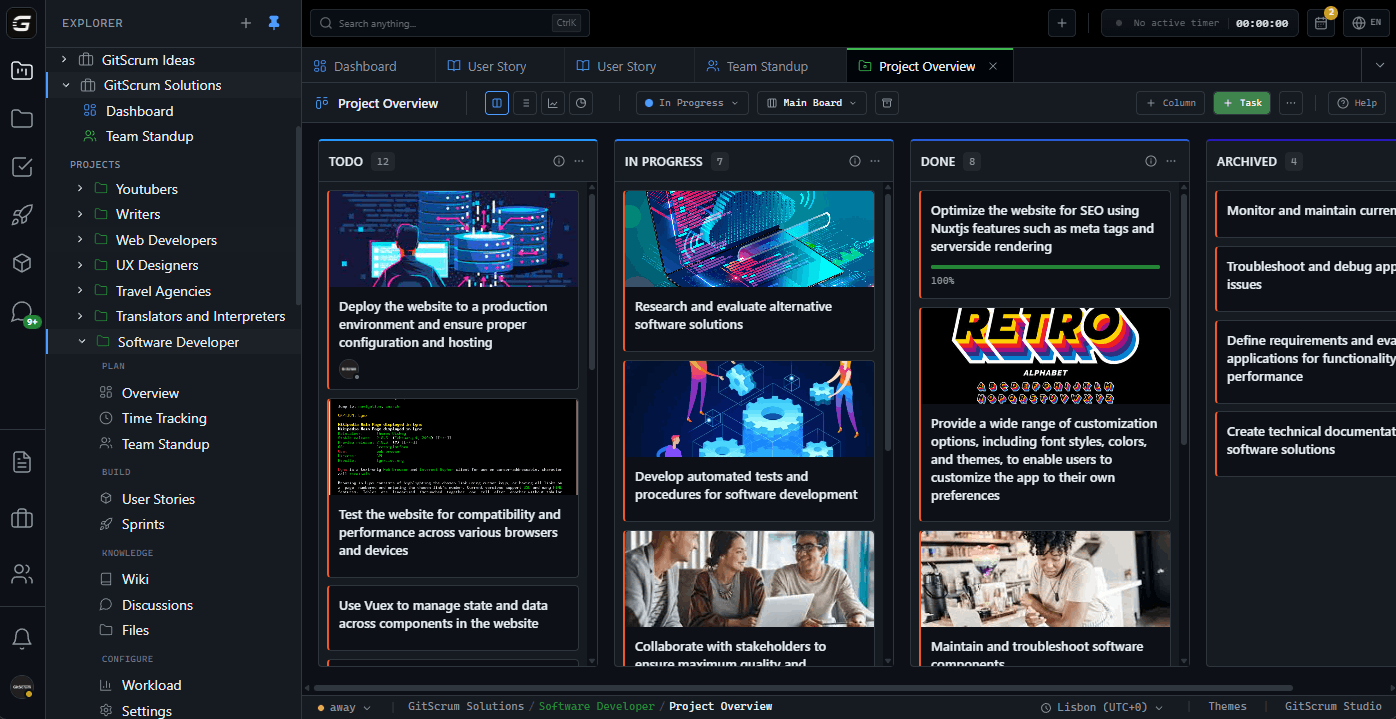
  • Kanban boards with WIP limits to prevent overload
  • Sprint planning with burndown charts for predictable delivery
  • Workload views for capacity management
  • Wiki for process documentation
  • Discussions for async collaboration
  • Reports for bottleneck identification

Industry Practices

Kanban MethodScrum FrameworkFlow OptimizationContinuous Improvement

Frequently Asked Questions

Still have questions? Contact us at customer.service@gitscrum.com

Why do organizations make allocation decisions without utilization data?

Utilization data typically lives in operational tools that leadership does not access or understand. Jira shows what tasks engineers are working on, but extracting utilization metrics requires technical knowledge and time. Leadership defaults to what they can easily see—org charts, headcount, skill matrices—none of which reveal actual workload. The data exists but does not flow to decision makers in usable form.

What is the cost of blind resource allocation?

Blind allocation creates cascading costs. Over-allocated teams burn out and quality suffers. Displaced work creates deadline failures elsewhere. Key experts spread across initiatives cannot give any single initiative the attention it needs. Organizations estimate that 20-30% of resource allocation decisions would change if made with accurate utilization data. The cost shows up in missed deadlines, team turnover, and initiative failures.

How much lead time is needed for good allocation decisions?

Good allocation requires seeing utilization data 4-8 weeks ahead. This allows identifying genuine capacity, giving displaced work time to be properly handed off, and ramping people up before they are needed. Real-time utilization visibility combined with sprint-level forecasting provides this lead time. Without it, allocation decisions are reactive rather than strategic.

Ready to solve this?

Start free, no credit card required. Cancel anytime.

Works with your favorite tools

Connect GitScrum with the tools your team already uses. Native integrations with Git providers and communication platforms.

GitHubGitHub
GitLabGitLab
BitbucketBitbucket
SlackSlack
Microsoft TeamsTeams
DiscordDiscord
ZapierZapier
PabblyPabbly

Connect with 3,000+ apps via Zapier & Pabbly