VS Code

GitScrum for VS Code, Google Antigravity, Cursor and Windsurf!

GitScrum logo
Solution

Simplify Dev Workflow Tools 2026 | One Platform 5 Functions

Every 'productivity' tool your team adopted added complexity instead of removing it. Task boards. Sprint planners. Time trackers. Documentation wikis. Client portals. GitHub connectors. Each solved one problem while creating three new ones: more logins, more interfaces, more context switches. Workflow simplification isn't about doing less. It's about doing everything in fewer places. One platform where tasks, code, time, docs, and clients connect natively. GitScrum simplifies dev team workflows by consolidating scattered tools into one GitHub-native platform. Not feature reduction—complexity reduction. $8.90/user/month. 2 users free forever.

Simplify Dev Workflow Tools 2026 | One Platform 5 Functions

Simplicity is hard.

Every team starts simple—maybe a GitHub project board and a spreadsheet. Then requirements grow: - Need sprint planning → add Jira - Need documentation → add Confluence - Need time tracking → add Toggl - Need client visibility → add Monday - Need better GitHub sync → add ZenHub Five years later, you have seven tools that don't quite work together.

Each made sense in isolation. Together they create a complexity tax on every task.

The Simplicity Paradox: More tools ≠ more productivity. Studies show developer productivity peaks with 2-3 integrated tools, then declines as tool count increases.

The correlation is clear: every additional tool adds friction that eventually outweighs its benefit. Why?

Because software tools don't just do things. They impose mental models.

Jira thinks in epics and stories. Notion thinks in pages and blocks.

Toggl thinks in time entries and projects. Your brain has to switch between these models constantly.

Simplification Principles: Principle 1: Consolidate Functions, Not Features You don't need every feature from Jira AND every feature from Notion AND every feature from Toggl. You need task management AND documentation AND time tracking that work together.

The integration value exceeds individual feature value. Principle 2: Native > Integrated Native connections beat bolted-on integrations every time.

A platform built around GitHub syncs more reliably than a platform that connects to GitHub through an afterthought API. Native means no sync delays, no authentication gaps, no version mismatches.

Principle 3: One Mental Model The biggest simplification isn't reducing clicks. It's reducing cognitive load.

One platform means one navigation pattern, one terminology set, one workflow logic. Learn it once, use it everywhere.

Principle 4: Visible Tradeoffs Simplification involves tradeoffs. GitScrum won't have Jira's enterprise governance features or Notion's block-based flexibility.

That's intentional. The tradeoff is complexity for dev-team focus.

GitScrum's Simplification Approach: Instead of: Jira + Confluence + Toggl + Client Portal + GitHub Connector GitScrum provides: Tasks + Wiki + Time Tracking + Client Flow + Native GitHub One platform. One interface.

One mental model. The functions exist.

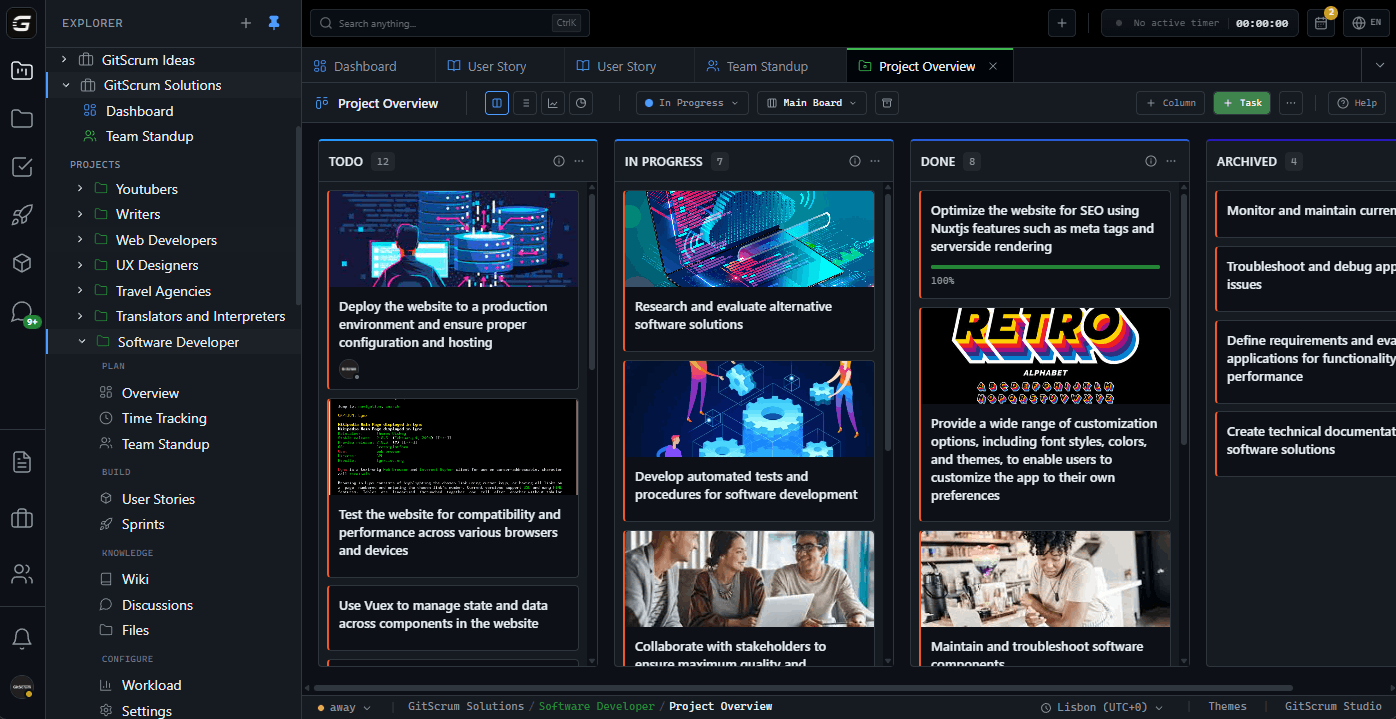
The complexity doesn't. What You Keep: - Task boards with customizable workflows - Sprint planning with velocity tracking - Time logging attached to tasks - Documentation wiki with linking - Client portals with filtered visibility - Real-time GitHub synchronization What You Lose: - Multiple logins - Multiple notification streams - Multiple search contexts - Integration maintenance - Sync reliability concerns - Scattered project knowledge $8.90/user/month for dev workflow simplification.

2 users free forever. Start simple, stay simple.

The GitScrum Advantage

One unified platform to eliminate context switching and recover productive hours.

01

problem.identify()

The Problem

Each new tool adds complexity instead of removing it

Multiple mental models required for daily workflows

Productivity peaks at 2-3 tools then declines

Integration between tools creates friction

Simple tasks require multiple platform switches

Workflow optimization blocked by tool fragmentation

02

solution.implement()

The Solution

One platform consolidates 5+ tool functions

Single mental model for all PM activities

Native GitHub integration eliminates sync friction

All project information searchable in one place

Simple tasks stay simple—no platform switching

Workflow optimization through consolidation

03

How It Works

1

Map Current Complexity

Document every tool, every workflow, every handoff point. Identify where complexity lives—usually in the gaps between tools.

2

Start With Core Functions

Migrate task management and GitHub sync first. These touch every developer daily. Immediate simplification value.

3

Layer Additional Functions

Add time tracking, documentation, client access. Each addition replaces a separate tool while maintaining a single interface.

4

Measure Simplification

Track tool count, daily context switches, time to find information. These metrics prove simplification value beyond cost savings.

04

Why GitScrum

GitScrum addresses Simplify Development Team Workflow Tools through Kanban boards with WIP limits, sprint planning, and workflow visualization

Problem resolution based on Kanban Method (David Anderson) for flow optimization and Scrum Guide (Schwaber and Sutherland) for iterative improvement

Capabilities

  • Kanban boards with WIP limits to prevent overload
  • Sprint planning with burndown charts for predictable delivery
  • Workload views for capacity management
  • Wiki for process documentation
  • Discussions for async collaboration
  • Reports for bottleneck identification

Industry Practices

Kanban MethodScrum FrameworkFlow OptimizationContinuous Improvement

Frequently Asked Questions

Still have questions? Contact us at customer.service@gitscrum.com

What makes GitScrum simpler than using specialized tools?

Specialized tools optimize for features. GitScrum optimizes for workflow. One platform means one mental model, one search context, one notification stream. The integration value exceeds individual feature value.

Will we lose functionality by consolidating?

You'll lose some edge-case features from specialized tools. You'll gain workflow coherence, reduced context switching, and eliminated integration maintenance. Most teams find the tradeoff heavily favors simplification.

How do we convince the team to simplify?

Measure current pain: count daily tool switches, time spent searching for information, integration maintenance hours. Present GitScrum as an experiment. Let the team experience simplification before committing.

What if different team members prefer different tools?

Tool preferences often reflect habit, not optimization. A unified platform creates a shared workflow that benefits everyone. Give it 2-3 sprints before evaluating—initial friction is normal.

Ready to solve this?

Start free, no credit card required. Cancel anytime.

Works with your favorite tools

Connect GitScrum with the tools your team already uses. Native integrations with Git providers and communication platforms.

GitHubGitHub
GitLabGitLab
BitbucketBitbucket
SlackSlack
Microsoft TeamsTeams
DiscordDiscord
ZapierZapier
PabblyPabbly

Connect with 3,000+ apps via Zapier & Pabbly