GitScrum PRO Annual — 2,500+ SaaS apps via MCP

GitScrum logo
Solution

Single Source Truth Project Status 2026 | One Dashboard

Ask five people about project status and get five different answers. The PM checks Jira and sees 80% complete. The designer checks Figma and sees pending reviews. The developer checks GitHub and sees open blockers. Engineering lead checks their spreadsheet and sees on-track. Each tool tells a different story because each captures partial reality. There is no single source—just contradicting fragments. GitScrum creates one authoritative view that everyone references—live, calculated from actual work, impossible to contradict.

Single Source Truth Project Status 2026 | One Dashboard

Distributed tools create distributed truth.

Each system captures what it knows, but none knows the whole picture. When PM updates task status in Jira but the code isn't merged in GitHub, which is the truth?

When design is 'approved' in Figma but the task still shows 'In Progress' in the board, which do you believe? Teams waste meeting time reconciling different tool reports, and decisions are made on partial, often stale data.

The GitScrum Advantage

One unified platform to eliminate context switching and recover productive hours.

01

problem.identify()

The Problem

Different tools report different status

No authoritative source for project truth

Meetings spent reconciling tool reports

Decisions made on partial data

Manual spreadsheets to aggregate status

02

solution.implement()

The Solution

One platform holds complete project state

Status calculated from actual work completion

Everyone sees same dashboard

Real-time accuracy without manual updates

No reconciliation needed

03

How It Works

1

Unified Project Dashboard

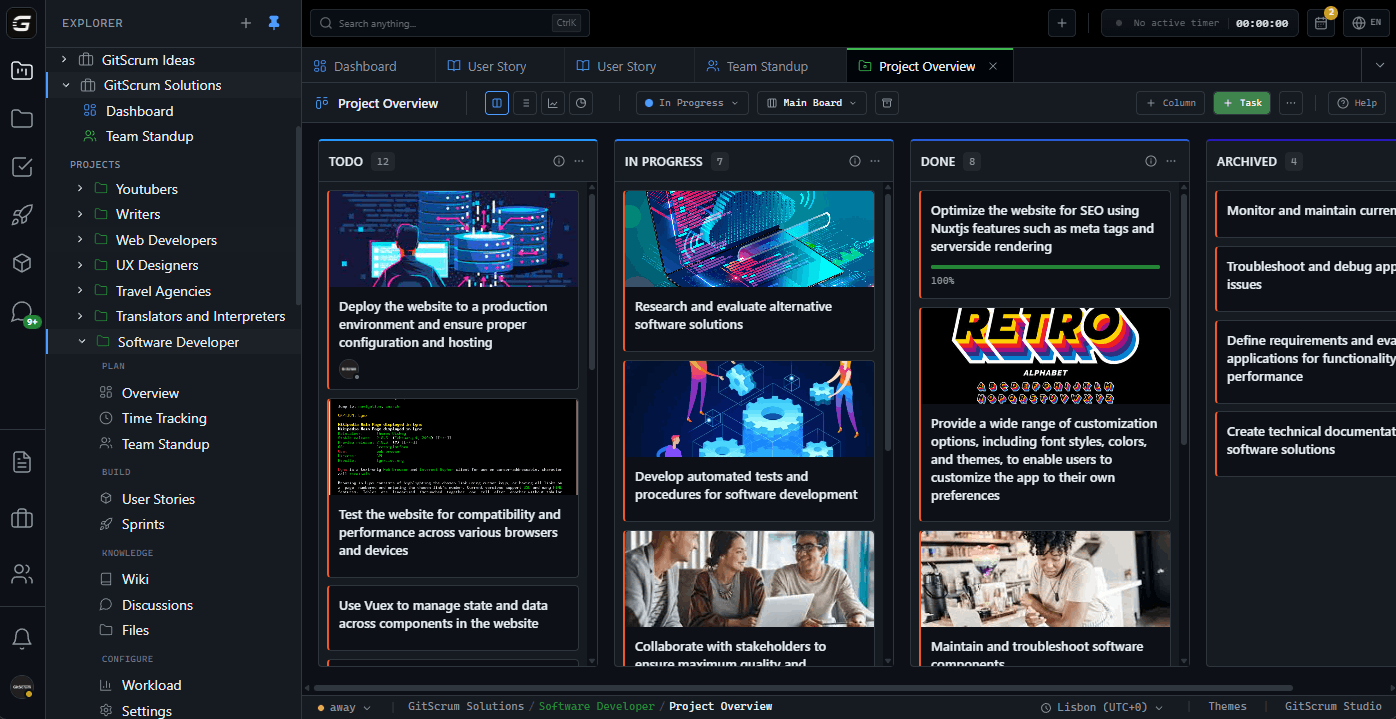
One view for everyone: 'Project X Dashboard shows: 67% complete (calculated from tasks). 12 tasks In Progress. 3 blocked (specific blockers named). Code: 84 PRs merged, 7 pending review. Next milestone: Dec 15, currently 2 days ahead. The PM, designer, developer, and executive all see this same view—no conflicting interpretations.'

2

Live Calculation

Status from reality, not opinion: 'Progress isn't what someone says—it's calculated. Task completion + Story points delivered + Code merged = actual progress. Velocity trends predict completion dates. Blockers flag automatically when PRs stall or dependencies slip. The dashboard reflects what's happening, not what was reported.'

3

Cross-Team Visibility

Same truth for all stakeholders: 'Design team sees their tasks' impact on overall progress. Engineering sees how their blockers affect the timeline. Product sees feature completion across all disciplines. Everyone works from the same picture—collaboration improves because misunderstandings decrease.'

4

Elimination of Status Meetings

Dashboard replaces reporting: 'Stand-ups become problem-solving sessions, not status recitations. Weekly status meetings become optional—anyone can check the dashboard anytime. Executive summaries auto-generate from real data. The time spent on status reconciliation becomes time spent on actual work.'

04

Why GitScrum

GitScrum addresses Single Source of Truth for Project Status Across Teams through Kanban boards with WIP limits, sprint planning, and workflow visualization

Problem resolution based on Kanban Method (David Anderson) for flow optimization and Scrum Guide (Schwaber and Sutherland) for iterative improvement

Capabilities

  • Kanban boards with WIP limits to prevent overload
  • Sprint planning with burndown charts for predictable delivery
  • Workload views for capacity management
  • Wiki for process documentation
  • Discussions for async collaboration
  • Reports for bottleneck identification

Industry Practices

Kanban MethodScrum FrameworkFlow OptimizationContinuous Improvement

Frequently Asked Questions

Still have questions? Contact us at customer.service@gitscrum.com

How do you prevent gaming the status metrics?

Status comes from actual work, not self-reporting. Task completion requires code merged, reviews passed, acceptance criteria met. Points come from configured task estimates, not developer claims. When status is calculated from artifacts, gaming becomes difficult.

What about subjective quality metrics that can't be automated?

GitScrum separates quantitative from qualitative. Progress (tasks, points, code) is automated. Quality gates (design approval, QA sign-off) still require human input but are tracked consistently. The dashboard shows both: '80% tasks complete, 2 awaiting design approval' gives full picture.

How does this work for cross-functional teams with different definitions of 'done'?

Each discipline configures their definition of done within GitScrum. Design tasks have design-specific completion criteria. Engineering tasks have code criteria. The project dashboard aggregates all—showing completion per discipline and overall. One truth, acknowledged complexity.

Can executives get a simplified view while teams see detail?

Absolutely. Same underlying data, different presentations. Executive view: high-level progress, milestones, risks. Team view: individual tasks, blockers, daily progress. Both accurate, both from same source. Drill-down connects the views without data duplication.

Ready to solve this?

Start free, no credit card required. Cancel anytime.

Works with your favorite tools

Connect GitScrum with the tools your team already uses. Native integrations with Git providers and communication platforms.

GitHubGitHub
GitLabGitLab
BitbucketBitbucket
SlackSlack
Microsoft TeamsTeams
DiscordDiscord
ZapierZapier
PabblyPabbly

Connect with 3,000+ apps via Zapier & Pabbly