VS Code

GitScrum for VS Code, Google Antigravity, Cursor and Windsurf!

GitScrum logo
Solution

Dev Tool Consolidation 2026 | Replace 7 Tools with One

7+ tools = $30K+/year, 4-6h/week lost to switching. GitScrum: boards + sprints + time + docs in one. Save $25K+ yearly. $8.90/user. 2 free forever. Free trial.

Dev Tool Consolidation 2026 | Replace 7 Tools with One

Tool consolidation in software development isn't a luxury—it's a survival strategy.

The average dev team now uses 7+ different SaaS products to manage work. Each tool seemed like a good idea when someone suggested it.

But the combined overhead—in subscription costs, context switching, and integration maintenance—now exceeds the value any single tool provides. The Case for Consolidation: Financial Impact: A typical 10-person team pays $10-15/user for Jira, $5-10/user for Confluence, $10/user for time tracking, plus various other subscriptions.

That's $2,500-$3,500/month on PM tools alone. GitScrum covers boards, sprints, time tracking, docs, and client portals for $8.90/user/month.

For 10 users: $712/year vs $30,000-$42,000/year. Productivity Impact: Context switching between tools costs 23 minutes per switch.

With 7+ tools, developers switch contexts dozens of times daily. Consolidation eliminates most of these switches.

Teams report 4-6 hours weekly productivity gains. Data Integration Impact: When data lives across 7 platforms, getting a unified view requires manual aggregation or fragile integrations.

Consolidated tools provide single-source-of-truth reporting without the maintenance overhead. Onboarding Impact: New developers must learn 7 different interfaces, terminologies, and workflows.

Consolidation reduces this to one, cutting onboarding time significantly. What Actually Consolidates: Not everything can or should consolidate.

GitHub stays—it's where code lives. Slack/Teams stays—it's where communication happens.

Design tools stay—they're specialized. But the PM layer?

That can consolidate: - Issue tracking (Jira) → GitScrum boards - Sprint management (Jira) → GitScrum sprints - Documentation (Confluence/Notion) → GitScrum wiki - Time tracking (Toggl/Harvest) → GitScrum time tracking - Client reporting (various) → GitScrum client portals Why GitScrum for Consolidation: GitHub-Native: GitScrum integrates deeply with GitHub—the tool your developers already live in. PRs link to tasks.

Commits update cards. No separate issue tracker needed.

Developer-First Design: Built for how developers work. Keyboard shortcuts.

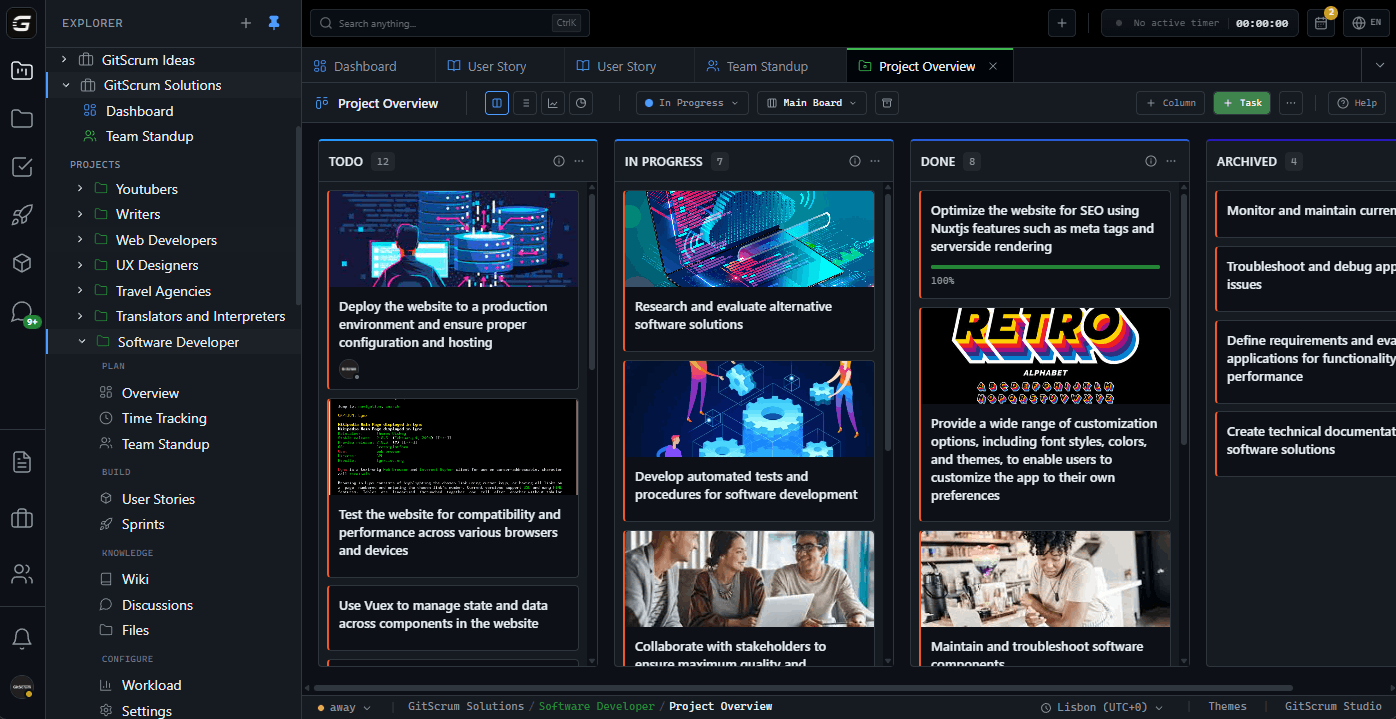
Not a generic PM tool adapted for development—a development tool that does PM. Complete Feature Set: Boards, sprints with velocity, time tracking, wiki documentation, client portals.

Everything teams typically need 4-5 subscriptions to cover. Clear Pricing: $8.90/user/month.

All features. No enterprise tax.

No premium tier required for basic functionality. 2 users free forever to start consolidating without commitment.

The GitScrum Advantage

One unified platform to eliminate context switching and recover productive hours.

01

problem.identify()

The Problem

Average dev team uses 7+ different SaaS tools with mounting overhead

Combined subscriptions cost $30,000-$42,000/year for 10-person teams

Context switching between tools costs 4-6 hours weekly productivity

Data scattered across platforms requires manual aggregation

New developers must learn 7 different interfaces and workflows

Integration maintenance becomes a job unto itself

02

solution.implement()

The Solution

One platform replaces Jira + Confluence + Toggl + client tools

$712/year for 10 users vs $30,000+ for fragmented tools

GitHub-native integration eliminates most context switches

Single source of truth for all project data

One interface to learn—dramatically faster onboarding

Built-in integrations that maintain themselves

03

How It Works

1

Identify Consolidation Targets

Map your current PM stack. GitHub stays. Communication tools stay. Everything else in the PM layer—issue tracking, sprints, time, docs, client reporting—can consolidate.

2

Start with 2 Free Users

No commitment needed. Set up GitScrum, connect GitHub, migrate one project. Validate the consolidation approach before full rollout.

3

Migrate Incrementally

Move sprints from Jira first. Then time tracking from Toggl. Then docs from Confluence. Each migration proves value before the next. Risk stays low.

4

Cancel Redundant Subscriptions

As each tool migrates successfully, cancel the subscription. Track savings. For a 10-person team, expect $25,000+ annual savings by consolidation completion.

04

Why GitScrum

GitScrum addresses Software Development Tool Consolidation through Kanban boards with WIP limits, sprint planning, and workflow visualization

Problem resolution based on Kanban Method (David Anderson) for flow optimization and Scrum Guide (Schwaber and Sutherland) for iterative improvement

Capabilities

  • Kanban boards with WIP limits to prevent overload
  • Sprint planning with burndown charts for predictable delivery
  • Workload views for capacity management
  • Wiki for process documentation
  • Discussions for async collaboration
  • Reports for bottleneck identification

Industry Practices

Kanban MethodScrum FrameworkFlow OptimizationContinuous Improvement

Frequently Asked Questions

Still have questions? Contact us at customer.service@gitscrum.com

What tools does GitScrum actually replace?

GitScrum consolidates the PM layer: Jira (boards, sprints), Confluence (wiki), Toggl/Harvest (time tracking), and client reporting tools. GitHub, Slack, and design tools remain separate—they serve different purposes.

How risky is migration?

Low risk with incremental approach. Start with one project using 2 free users. Validate the workflow works. Then migrate more projects. Cancel subscriptions only after successful migrations. You're never without a working system.

What about enterprise features we need from Jira?

Most 'enterprise features' in Jira are complexity for complexity's sake. GitScrum covers what development teams actually use: boards, sprints, velocity, time tracking. If you need Jira's advanced workflows, you're likely over-engineering your process.

How long does full consolidation take?

Typically 4-8 weeks for a 10-person team. Week 1: pilot project. Weeks 2-3: sprint migration. Week 4: time tracking migration. Weeks 5-6: documentation migration. Weeks 7-8: client portal setup and subscription cancellations.

Ready to solve this?

Start free, no credit card required. Cancel anytime.

Works with your favorite tools

Connect GitScrum with the tools your team already uses. Native integrations with Git providers and communication platforms.

GitHubGitHub
GitLabGitLab
BitbucketBitbucket
SlackSlack
Microsoft TeamsTeams
DiscordDiscord
ZapierZapier
PabblyPabbly

Connect with 3,000+ apps via Zapier & Pabbly