Sprint Planning Reality Typical sprint planning: ├─ Duration: 2-4 hours ├─ Attendees: 8 people ├─ Cost: 16-32 hours of dev time ├─ Outcome: Story points assigned ├─ Sprint result: 65-75% completion ├─ Team feeling: Exhausted before starting The ceremony problem: ├─ 'How many points is this?
70% shipped. Something is wrong.
Why Sprint Planning Fails Structural issues: ├─ Story points are fake │ └─ '5 points' means different things to different devs ├─ Velocity is misleading │ └─ 50 points/sprint assumes points mean something ├─ Commitment is theater │ └─ Team 'commits' knowing they won't finish ├─ Unknown unknowns │ └─ Bugs, blockers, meetings eat time ├─ Developer time optimism │ └─ 8-hour day ≠ 8 hours of coding The ritual continues. Results don't improve.
GitScrum Sprint Approach Simplified sprint planning: ├─ Duration: 30-45 minutes ├─ Focus: What can we actually ship? ├─ Unit: Tasks (not story points) ├─ Capacity: Hours available (realistic) ├─ Outcome: 10-15 tasks committed ├─ Tracking: Git commits prove completion Less ceremony.
More shipping. Capacity-Based Planning Realistic approach: ├─ Sprint: 2 weeks (10 work days) ├─ Team: 5 developers ├─ Total hours: 5 × 10 × 8 = 400h ├─ Realistic coding time: 60% = 240h │ └─ (Meetings, reviews, etc.
eat 40%) ├─ Buffer: 20% for unknowns = 192h ├─ Sprint capacity: 192 hours ├─ Tasks sized in hours: Fit to capacity Math, not magic. Task-Based vs Story Point Story point approach: ├─ Task: 'Implement user auth' ├─ Points: 5?
(Debate for 20 min) ├─ Velocity: 47 points/sprint ├─ This sprint: 50 points committed ├─ Result: 35 points done (70%) ├─ Learning: Nothing actionable Task-based approach: ├─ Task: 'Implement user auth' ├─ Estimate: 6 hours ├─ Capacity: 192 hours ├─ Tasks: Fit to hours ├─ Result: 85% tasks complete ├─ Learning: This took 8h, adjust next time Hours you understand. Points you debate.
Git-Verified Completion How do you know it shipped? ├─ Story points: Someone moves a card ├─ GitScrum: Commits prove it Sprint completion evidence: ├─ Task: 'Add password reset' ├─ Commits: 4 commits linked ├─ PR: Merged to main ├─ Status: Actually done ├─ Not: 'Done' because meeting ended Code doesn't lie.
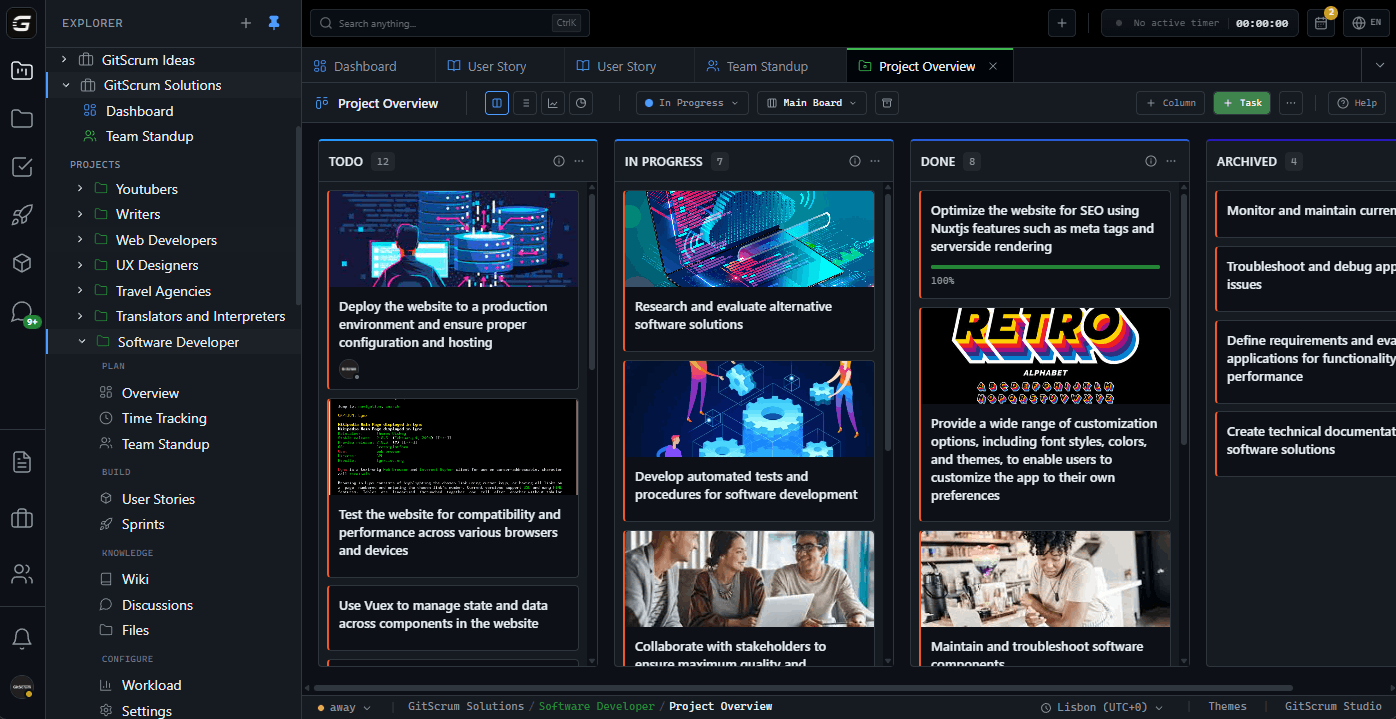
Boards can. Sprint Board Setup GitScrum sprint board: ├─ Column: Backlog │ └─ All potential work ├─ Column: This Sprint │ └─ Committed work (capacity-fit) ├─ Column: In Progress │ └─ Actively being coded ├─ Column: In Review │ └─ PR submitted ├─ Column: Done │ └─ Merged + deployed Simple.
30-Minute Sprint Planning Efficient planning meeting: ├─ 0-5 min: Review capacity │ └─ 'We have ~180 hours this sprint' ├─ 5-15 min: Priority stack │ └─ 'These are top 15 tasks' ├─ 15-25 min: Fit to capacity │ └─ 'This is 160 hours, fits' ├─ 25-30 min: Assignments │ └─ 'Alex takes auth, Jordan takes API' ├─ Done: 30 minutes ├─ Start coding Not 2 hours of point poker. Sprint Tracking During Sprint Daily reality check: ├─ Morning: Glance at board (2 min) ├─ Tasks In Progress: 3 ├─ Tasks Done: 5 ├─ Tasks Remaining: 7 ├─ Blockers: 1 (flagged) ├─ On track?
Yes/No visible ├─ No: Daily standup meeting ├─ Yes: Keep shipping Board tells the story. Sprint Retrospective Data End of sprint: ├─ Committed: 15 tasks ├─ Completed: 13 tasks (87%) ├─ Carried over: 2 tasks ├─ Why carried: Bug in task 8 blocked 9 ├─ Action: Better dependency tracking ├─ Next sprint: Account for it Data-driven improvement.
Not blame-driven discussion. Velocity That Means Something Measurable velocity: ├─ Sprint 1: 180 hours capacity → 156h done ├─ Sprint 2: 180 hours capacity → 165h done ├─ Sprint 3: 160 hours capacity → 158h done ├─ Average: ~90% of capacity shipped ├─ Next planning: Use 90% as baseline ├─ Improvement: Real and measurable Not: '47 story points.' Yes: '165 hours of actual work.' Handling Sprint Disruptions Real sprint reality: ├─ Day 3: P1 bug discovered ├─ Impact: 8 hours to fix ├─ Response: Remove equivalent task from sprint ├─ Track: Sprint scope change documented ├─ End of sprint: Realistic completion ├─ Retro: 'We had an unplanned P1' Adapt without drama.
Sprint Commitment vs Forecast Healthy approach: ├─ Don't: 'We commit to all 15 tasks' ├─ Do: 'We forecast 13-15 tasks' ├─ Buffer: Built into capacity ├─ If finish early: Pull from backlog ├─ If behind: Known by day 5, adjust ├─ No: Sprint failure shame ├─ Yes: Continuous adjustment Forecast, not promise. Team Size and Sprint Planning Scaling planning: ├─ 3-person team: │ └─ 15-minute planning │ └─ Async works fine ├─ 5-person team: │ └─ 30-minute planning │ └─ Short sync meeting ├─ 10-person team: │ └─ 45-minute planning │ └─ Split into sub-teams ├─ 20+ person team: │ └─ Sub-team planning │ └─ Cross-team sync (15 min) Planning scales with team.
Not ceremony scales. Sprint Length Options 1-week sprints: ├─ Good for: Fast iteration, uncertainty ├─ Planning: 15-20 minutes ├─ Risk: Less capacity buffer 2-week sprints: ├─ Good for: Most teams ├─ Planning: 30-45 minutes ├─ Standard cadence 3-week sprints: ├─ Good for: Larger features ├─ Planning: 45-60 minutes ├─ Longer feedback loop Choose what works.
GitScrum supports all. Backlog Grooming Integration Before sprint planning: ├─ Backlog: Prioritized ├─ Top 20 tasks: Estimated (hours) ├─ Dependencies: Identified ├─ Blockers: Known ├─ Sprint planning: Just selection Grooming is separate.
Planning is selection. Sprint Goals Goal-oriented sprints: ├─ Sprint Goal: 'Ship user authentication' ├─ Tasks support goal: │ ├─ Login page │ ├─ Password reset │ ├─ Session management │ ├─ OAuth integration ├─ Success = Goal achieved ├─ Not: All tasks done ├─ But: Goal shipped Goal clarity guides trade-offs.
Wiki for Sprint Decisions Document sprint context: ├─ Sprint 14 Goals: │ └─ Ship authentication ├─ Trade-offs made: │ └─ OAuth deferred to Sprint 15 ├─ Technical decisions: │ └─ Using Clerk for auth ├─ Capacity notes: │ └─ Alex at 60% (conference) Future sprints reference past. Real Sprint Planning Experience 'Our sprint planning was 3 hours.
Planning poker for everything. Velocity calculations.
Still only hit 65% of committed work. Switched to GitScrum approach: estimate tasks in hours, fit to realistic capacity, track via Git commits.
Planning now takes 35 minutes. Sprint completion is 85-90%.
The difference? We stopped pretending story points meant something.
Hours are honest. Git commits prove done.
Team morale improved because we stopped over-committing and under-delivering.' - Engineering Manager, 8-person team Comparing Sprint Tools Sprint planning tools: ├─ Jira: Complex, story-point focused ├─ Linear: Good but point-based ├─ Monday.com: PM-focused, not dev-native ├─ Trello: No sprint features ├─ GitScrum: Git-integrated, task-based GitScrum advantages: ├─ Git commits verify completion ├─ Hours > story points option ├─ Simple sprint board ├─ Wiki for sprint decisions ├─ $8.90/user (not enterprise pricing) Sprint Planning Anti-Patterns Avoid: ├─ 2+ hour planning meetings ├─ Story point debates > 5 minutes ├─ Committing to 100% capacity ├─ No buffer for unknowns ├─ 'Done' without code merged ├─ Velocity worship ├─ Sprint failure blame Embrace: ├─ 30-45 minute planning ├─ Hour estimates (honest) ├─ 80% capacity planning ├─ Built-in buffer ├─ Git-verified done ├─ Forecast, not commitment ├─ Continuous learning Start Better Sprint Planning 1. Sign up GitScrum ($8.90/user, 2 free) 2.
Create sprint board 3. Estimate backlog in hours 4.
Calculate realistic capacity 5. Plan sprint in 30 minutes 6.
Connect GitHub for verification 7. Ship 85%+, learn, repeat Less ceremony.
The GitScrum Advantage
One unified platform to eliminate context switching and recover productive hours.