Stakeholder communication in fragmented environments is a resource-intensive ritual.
Consider what happens before each quarterly business review, board meeting, or client presentation. Days before the meeting, someone—usually a project manager or operations lead—begins the aggregation ritual.
They pull task completion data from the project management tool. Budget burn rates from the finance system.
Time tracking summaries from another application. Risk assessments from email threads and documents.
Client feedback from the support portal. They spend hours normalizing this data into comparable formats.
Different date ranges, different naming conventions, different aggregation levels. The finance numbers show one project structure while the PM tool shows another.
Reconciliation requires manual mapping. Then visualization.
Export to Excel, create charts, paste into PowerPoint. Add narrative context explaining what the numbers mean.
Check for inconsistencies that will trigger stakeholder questions. Review, revise, polish.
By the time the report is ready—forty hours of work later—the underlying data is already stale. Task statuses changed while the report was being built.
Budget actuals updated. The report represents a historical snapshot, not current reality.
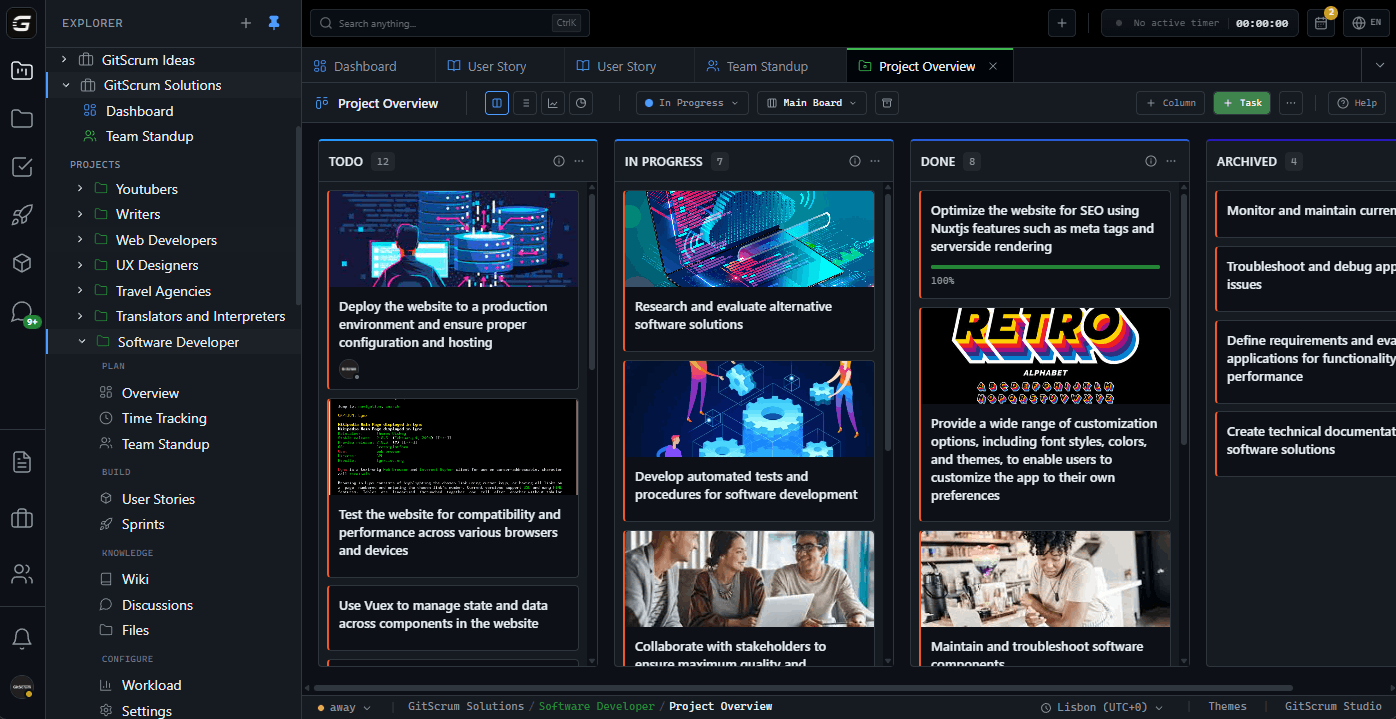
A unified platform transforms stakeholder communication. When all data lives in one system, stakeholder views generate automatically.
Real-time dashboards replace periodic reports. The forty hours of aggregation work disappears.
Communication becomes continuous rather than a quarterly burden.
The GitScrum Advantage
One unified platform to eliminate context switching and recover productive hours.