VS Code

GitScrum for VS Code, Google Antigravity, Cursor and Windsurf!

GitScrum logo
Solution

Sync Lag Outdated Decisions 2026 | Real-Time Data

Integrations sync on schedules—hourly, daily, or event-triggered. Between syncs, data drifts. The dashboard shows yesterday's numbers while today's work happens. The project tracker shows tasks assigned before this morning's reallocation. A manager makes a staffing decision based on data that is hours old. When systems operate on different synchronization schedules, every decision carries uncertainty about data freshness.

Sync Lag Outdated Decisions 2026 | Real-Time Data

Real-time data is essential for good decisions, but integrations make real-time impossible.

Even the best integrations introduce lag. Event-triggered syncs still take seconds or minutes to propagate changes.

Scheduled syncs may run hourly or daily, creating windows where data is guaranteed to be stale. The problem compounds when multiple systems sync on different schedules.

Your time tracking syncs hourly. Your project tracker syncs every 15 minutes.

Your dashboard aggregates from both, refreshing every 30 minutes. At any given moment, your dashboard could be showing time data that is 90 minutes old combined with project data that is 45 minutes old.

The business impact is subtle but real. A project manager sees the dashboard showing 80% sprint completion and approves a new feature request.

But the dashboard is behind—actual completion is 65%. The new feature request overloads an already stretched sprint.

A resource manager sees availability in the time tracking system and assigns new work. But that availability data is hours old—the team member already committed elsewhere.

Conflicts emerge that require manual resolution. Decision-makers learn to distrust the data.

They add mental buffers, ask clarifying questions, double-check in multiple systems. This overhead slows down decisions that should be instant.

Teams that could move quickly are held back by data uncertainty. GitScrum eliminates sync lag by eliminating syncs.

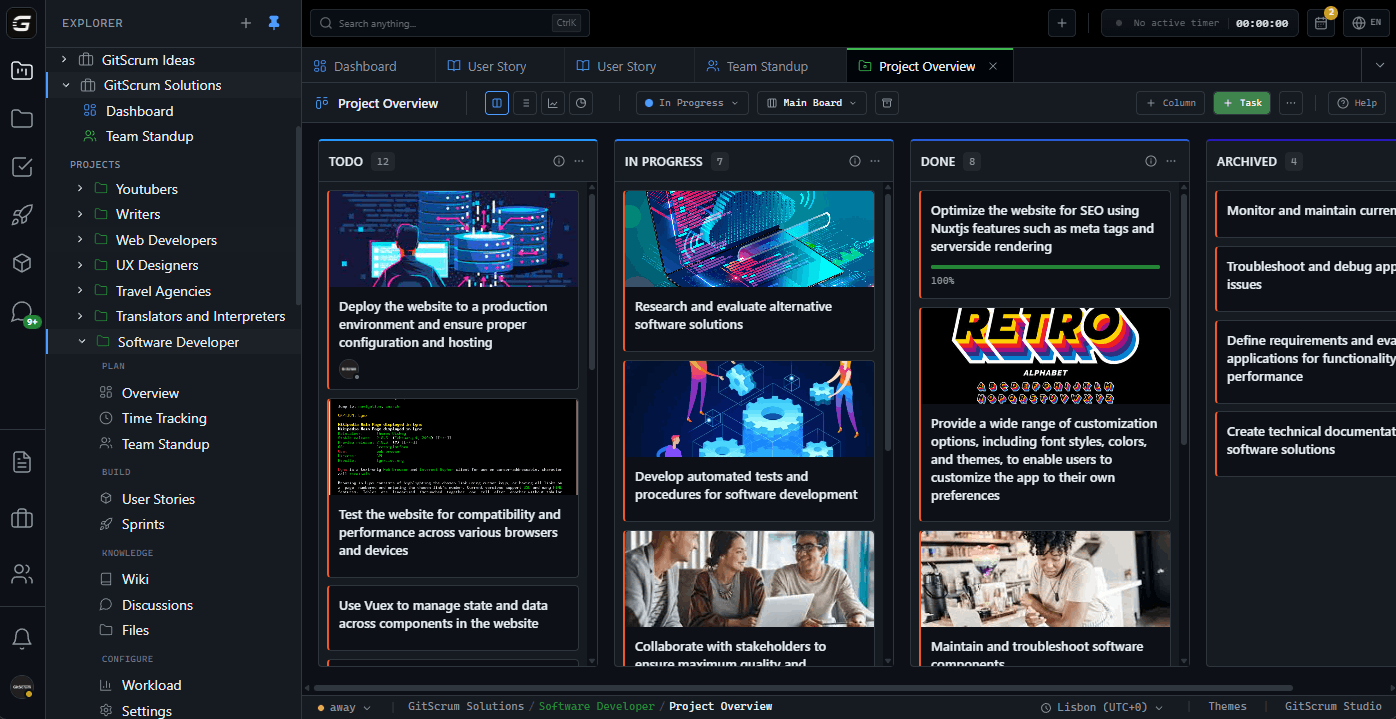
All data lives in one system and updates instantly. The dashboard reflects current reality.

Assignments show actual availability. Decisions are based on truth, not approximations.

The GitScrum Advantage

One unified platform to eliminate context switching and recover productive hours.

01

problem.identify()

The Problem

Different tools sync on different schedules

Dashboard shows aggregated data from stale sources

Decisions made on hours-old information

Resource allocation conflicts from outdated availability

Sprint planning based on delayed status updates

Trust erosion in data accuracy

02

solution.implement()

The Solution

All data in single system—no sync delays

Dashboard reflects current reality instantly

Resource availability always accurate

Sprint status updates immediately visible

Decisions based on real-time truth

Complete confidence in data freshness

03

How It Works

1

Single Data Source

All work data stored in unified platform

2

Instant Updates

Changes reflect everywhere immediately

3

Real-Time Dashboard

Dashboard shows current state, not cached aggregations

4

Confident Decisions

Make decisions knowing data is current

04

Why GitScrum

GitScrum addresses Sync Lag Causing Decisions Based on Outdated Information through Kanban boards with WIP limits, sprint planning, and workflow visualization

Problem resolution based on Kanban Method (David Anderson) for flow optimization and Scrum Guide (Schwaber and Sutherland) for iterative improvement

Capabilities

  • Kanban boards with WIP limits to prevent overload
  • Sprint planning with burndown charts for predictable delivery
  • Workload views for capacity management
  • Wiki for process documentation
  • Discussions for async collaboration
  • Reports for bottleneck identification

Industry Practices

Kanban MethodScrum FrameworkFlow OptimizationContinuous Improvement

Frequently Asked Questions

Still have questions? Contact us at customer.service@gitscrum.com

How much sync lag is typical in integrated tool stacks?

Event-triggered integrations typically have 30-second to 5-minute delays. Scheduled syncs run hourly or every few hours. Overnight batch processes mean morning data reflects yesterday's state. When data flows through multiple integration hops, each hop adds its own delay. Dashboard data aggregated from multiple sources can be 2-4 hours behind reality.

What decisions are most affected by sync lag?

Resource allocation decisions suffer most—assigning people based on stale availability data causes conflicts. Sprint capacity decisions based on delayed task completion create overcommitment. Urgent escalations based on old status information waste time. Any time-sensitive decision becomes risky when data freshness is uncertain.

How does a unified platform eliminate sync lag?

When all data lives in one platform, there is nothing to sync. A task completion in the project view is instantly visible in the dashboard, time tracking, and billing. Resource availability updates the moment work is logged. The platform maintains one source of truth that is always current—no integration delays, no stale caches, no synchronization windows.

Ready to solve this?

Start free, no credit card required. Cancel anytime.

Works with your favorite tools

Connect GitScrum with the tools your team already uses. Native integrations with Git providers and communication platforms.

GitHubGitHub
GitLabGitLab
BitbucketBitbucket
SlackSlack
Microsoft TeamsTeams
DiscordDiscord
ZapierZapier
PabblyPabbly

Connect with 3,000+ apps via Zapier & Pabbly