GitScrum PRO Annual — 2,500+ SaaS apps via MCP

GitScrum logo
Solution

Scattered Team Metrics 2026 | Compare Apples to Apples

Team A: Jira. Team B: Azure. Team C: spreadsheet. Compare? Meaningless. GitScrum: same metrics everywhere. $8.90/user. 2 free forever. Free trial.

Scattered Team Metrics 2026 | Compare Apples to Apples

Organizations cannot optimize what they cannot measure, and they cannot measure what they cannot compare.

When each team uses different tools with different metrics, performance comparison becomes meaningless. Consider story points.

Team Alpha estimates aggressively—their '5' is another team's '13'. Team Beta padding estimates conservatively—their '8' represents less work than Team Alpha's '3'.

Team Gamma does not use points at all—they track hours. Comparing these teams by 'points delivered' or 'velocity' produces nonsense.

A team delivering 50 points might be outperforming a team delivering 100 points, but the numbers suggest the opposite. Beyond estimation practices, different tools measure different things.

One team's 'cycle time' is calculated from task creation. Another's starts from first commit.

A third measures from when the task enters 'In Progress.' These are all valid measurements, but they measure different things. Comparing them creates false impressions of relative performance.

Leadership ends up making decisions based on incomparable metrics. Resource allocation, team sizing, project assignments—all influenced by numbers that cannot be meaningfully compared.

The illusion of data-driven management hides the reality of guess-driven decisions. A unified platform ensures consistent measurement across teams.

Same tools, same definitions, same calculations. When Team Alpha delivers 50 points and Team Beta delivers 40, that comparison means something because both teams measure the same way.

Leadership can actually make informed decisions.

The GitScrum Advantage

One unified platform to eliminate context switching and recover productive hours.

01

problem.identify()

The Problem

Each team uses different tools with different metrics

Story points mean different things to different teams

Cycle time calculated differently across systems

Performance comparison produces meaningless numbers

Leadership decisions based on incomparable data

Illusion of data-driven management hides guesswork

02

solution.implement()

The Solution

Consistent metrics across all teams and projects

Same definitions ensure meaningful comparisons

Standard calculation methods for all measurements

Accurate cross-team performance visibility

Data-driven decisions based on comparable numbers

True organizational performance understanding

03

How It Works

1

Unified Tooling

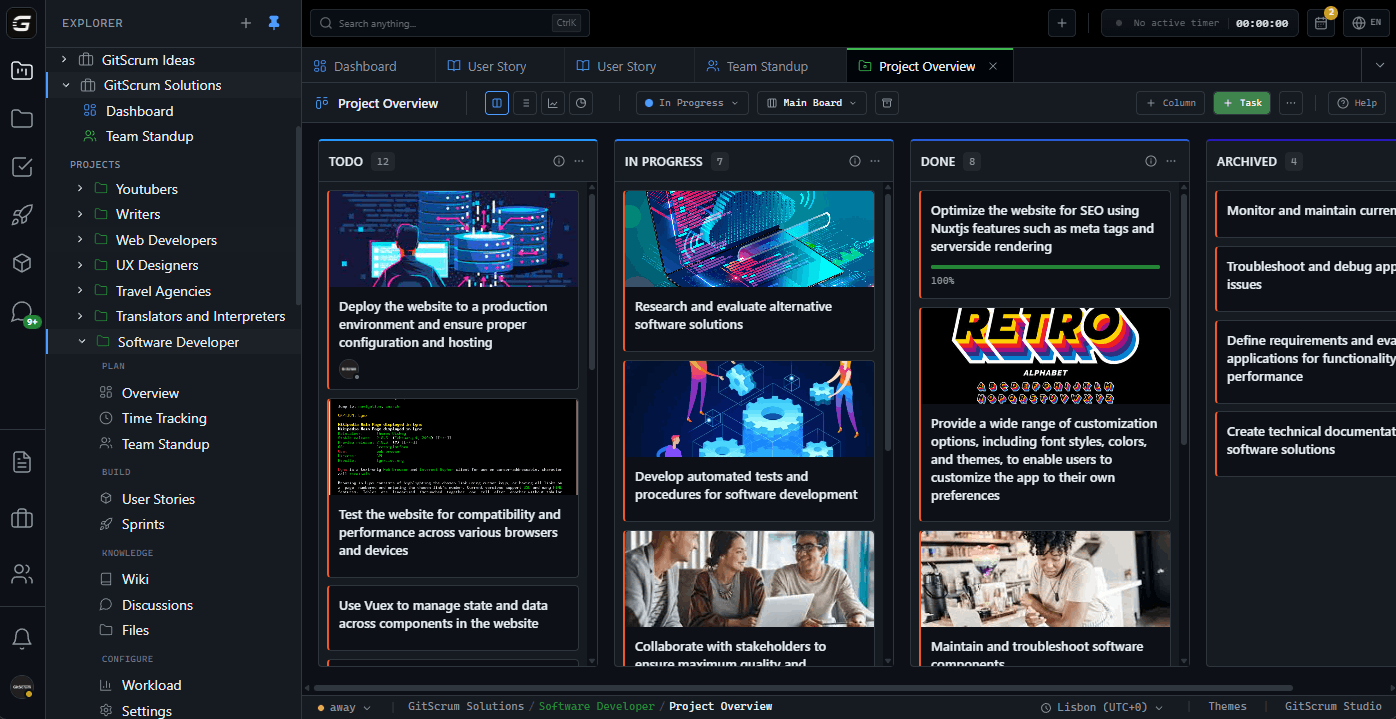
All teams use same platform with same metrics

2

Standard Definitions

Points, cycle time, velocity mean same thing everywhere

3

Comparable Dashboards

Cross-team views show meaningful comparisons

4

Informed Decisions

Leadership acts on accurate comparable data

04

Why GitScrum

GitScrum addresses Team Performance Metrics Scattered and Incomparable through Kanban boards with WIP limits, sprint planning, and workflow visualization

Problem resolution based on Kanban Method (David Anderson) for flow optimization and Scrum Guide (Schwaber and Sutherland) for iterative improvement

Capabilities

  • Kanban boards with WIP limits to prevent overload
  • Sprint planning with burndown charts for predictable delivery
  • Workload views for capacity management
  • Wiki for process documentation
  • Discussions for async collaboration
  • Reports for bottleneck identification

Industry Practices

Kanban MethodScrum FrameworkFlow OptimizationContinuous Improvement

Frequently Asked Questions

Still have questions? Contact us at customer.service@gitscrum.com

Why are team performance metrics incomparable across tools?

Different tools measure different things differently. Jira calculates velocity one way, Azure DevOps another, spreadsheets a third. Beyond tools, teams estimate differently—one team's 5-point story is another's 13-point story. Cycle time definitions vary by starting point. These inconsistencies mean that comparing '50 points delivered' across teams is meaningless—the numbers represent different amounts of work measured differently.

What decisions suffer from incomparable metrics?

Resource allocation, team sizing, project assignments, and performance reviews all suffer. If Team Alpha appears to deliver twice as much as Team Beta, but the metrics are incomparable, decisions based on that comparison are flawed. Organizations may over-invest in teams that look productive but actually are not, while under-resourcing teams that are high performers with conservative estimates.

How does unified tooling enable meaningful comparison?

When all teams use the same platform with the same definitions, metrics become comparable. A story point means the same thing across teams. Cycle time calculates the same way. Velocity uses the same formula. When Team Alpha delivers 50 points and Team Beta delivers 40, leadership knows that represents a real 25% difference, not a measurement artifact. Decisions can actually be data-driven.

Ready to solve this?

Start free, no credit card required. Cancel anytime.

Works with your favorite tools

Connect GitScrum with the tools your team already uses. Native integrations with Git providers and communication platforms.

GitHubGitHub
GitLabGitLab
BitbucketBitbucket
SlackSlack
Microsoft TeamsTeams
DiscordDiscord
ZapierZapier
PabblyPabbly

Connect with 3,000+ apps via Zapier & Pabbly