Accurate estimation is learned through feedback.
When you estimate a task at 4 hours and it takes 12, you need to know that to adjust future estimates. But in fragmented environments, estimates live in the project management tool while actual time lives in a separate time tracker.
The feedback loop is broken. Consider how estimation typically works in fragmented systems: During sprint planning, the team estimates stories in Jira using story points or hours.
Developers work on tasks, logging their time in Toggl or a similar tool. The sprint ends.
Jira shows stories as complete. Toggl shows time spent.
But no one has connected these two datasets. There is no report showing estimated-versus-actual by task.
No one sees that Feature X was estimated at 8 hours but took 32. No one notices that Developer Y consistently underestimates by 50%.
The same estimation errors repeat sprint after sprint. Teams who estimate login features at 4 hours continue doing so even though login always takes 20.
Why? Because the evidence is trapped in Toggl while the estimates are in Jira.
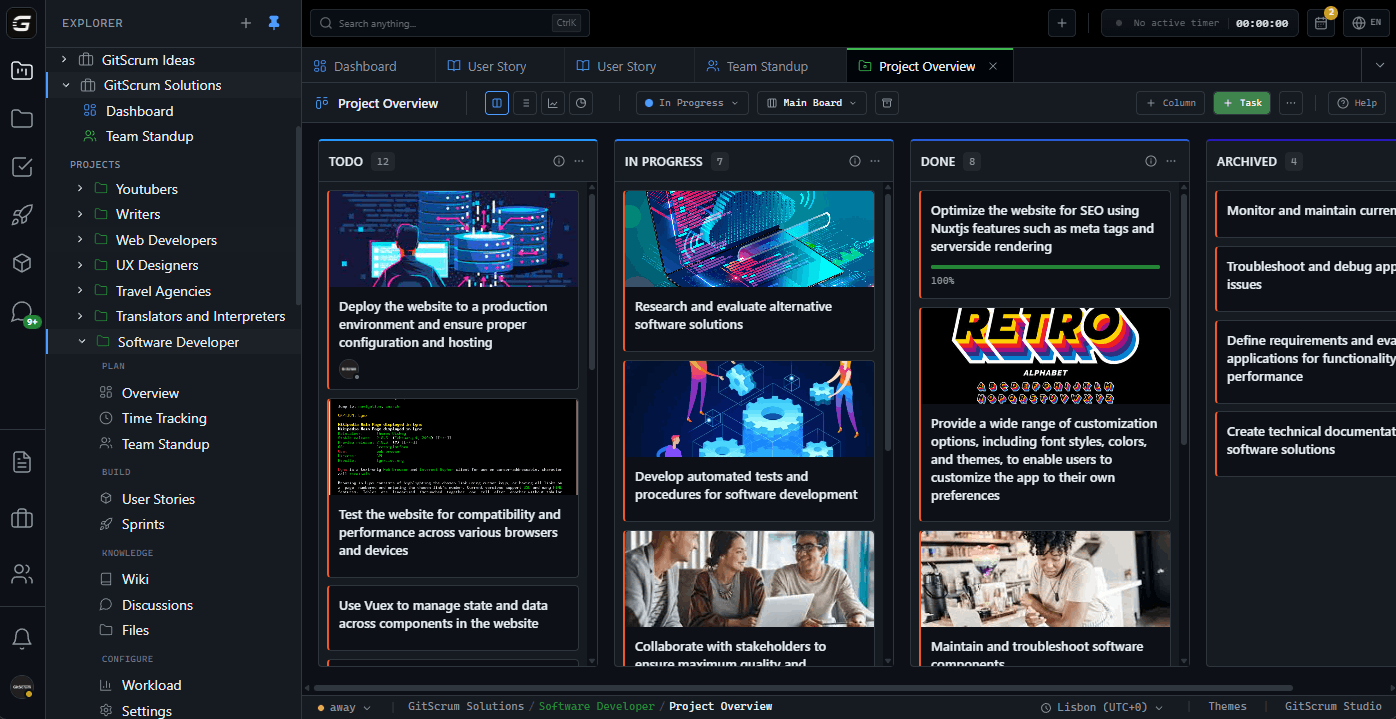
In a unified platform, estimates and actuals appear side by side. After each sprint, teams can see exactly which tasks exceeded estimates and by how much.
Patterns emerge: certain task types are consistently underestimated, certain team members are overly optimistic, certain integrations always take longer than expected. This data feeds back into future planning, improving accuracy over time.
Without it, estimation remains guesswork indefinitely.
The GitScrum Advantage
One unified platform to eliminate context switching and recover productive hours.