The Trello Love Story Developers love Trello.
Why? - Simple - Visual - Fast - Drag and drop - No learning curve - Works immediately Every dev team tries Trello at some point.
The Trello Breakup But then reality hits: 3 months in... 'We need to connect tasks to GitHub.' 'We need sprint planning.' 'We need velocity tracking.' 'We need story points.' 'We need better reporting.' Trello response: Power-ups!
(Add-ons for $$$) Trello + Power-ups: ├─ GitHub Power-up: Limited connection ├─ Story points: Third-party add-on ├─ Sprint planning: Doesn't exist ├─ Velocity: Doesn't exist ├─ Burndown: Doesn't exist └─ Result: Frankenstein of add-ons The team either: A) Lives with Trello's limitations B) Migrates to complex tool (Jira) C) Finds something better Why Trello Isn't Enough 1. Cards Are Just Cards Trello card: ├─ Title ├─ Description ├─ Comments ├─ Checklist ├─ Due date ├─ Labels └─ Attachments Dev task needs: ├─ Story points ├─ Sprint assignment ├─ Epic parent ├─ Linked branch ├─ Linked PRs ├─ Linked commits ├─ Time tracking ├─ Priority └─ Status from Git Fundamental mismatch.
2. No Git Connection Developer creates branch for card.
Trello: Doesn't know. Developer pushes 10 commits.
Trello: Doesn't know. Developer opens PR.
Trello: Doesn't know. Developer merges PR.
Trello: Doesn't know. Developer moves card to Done.
Trello: Now it knows! All the actual work = invisible to Trello.
3. No Sprint Framework Trello has boards.
Boards have lists. You can create: ├─ 'Sprint 1' list ├─ 'Sprint 2' list └─ etc.
But you don't get: ├─ Sprint goals ├─ Sprint dates ├─ Velocity calculation ├─ Burndown charts ├─ Sprint planning ├─ Sprint retrospectives ├─ Capacity planning └─ Historical sprint data Lists ≠ sprints. 4.
Power-up Fatigue To make Trello work for dev: Power-up 1: GitHub (Atlassian) - Links PRs Power-up 2: Story Points - Third party Power-up 3: Time tracking - Another third party Power-up 4: Reports - Yet another Power-up 5: Automation - Butler Now you're managing 5 add-ons. Different vendors.
Different support. Different reliability.
Free Tier Limits Trello Free: ├─ 10 boards per workspace ├─ 1 Power-up per board ├─ Limited automation └─ Constrained features Dev teams hit limits fast. Upgrade to Standard: $5/user Upgrade to Premium: $10/user Plus power-ups: $$$ GitScrum: What Trello Should Be Trello Simplicity + Dev Features Boards: Same drag-drop simplicity Cards: Dev-focused with Git integration Sprints: Built-in, not hacked Git: Native, not power-up Best of both worlds.
Feature Comparison | Feature | Trello | GitScrum | |-------------------|-----------|-------------| | Kanban boards | ✓ | ✓ | | Drag and drop | ✓ | ✓ | | Simple interface | ✓ | ✓ | | Git integration | Power-up | Native | | Auto status | ✗ | ✓ | | Sprint planning | ✗ | ✓ | | Story points | Power-up | Native | | Velocity | ✗ | ✓ | | Burndown | ✗ | ✓ | | Time tracking | Power-up | Native | | Wiki/Docs | ✗ | ✓ | | Discussions | Comments | Threaded | | Price/user | $10+ | $8.90 | Price Comparison Trello for dev team (10 users): Trello Premium: $10/user = $100/month GitHub Power-up: Free (basic) Story points: ~$2/user = $20/month Time tracking: ~$3/user = $30/month Reporting: ~$2/user = $20/month ─────────────────────────────────── Total: ~$170/month GitScrum (10 users): $8.90 × 8 users = $71.20/month (2 users free) Everything included. Savings: $98.80/month ($1,185/year) Migration: Trello to GitScrum Step 1: Export Trello board (JSON) Step 2: Sign up GitScrum (free) Step 3: Import Trello data Step 4: Connect GitHub/GitLab Step 5: Set up sprints Step 6: Start working Time: 30 minutes.
Disruption: Minimal. Keeping Trello's Simplicity GitScrum doesn't add complexity.
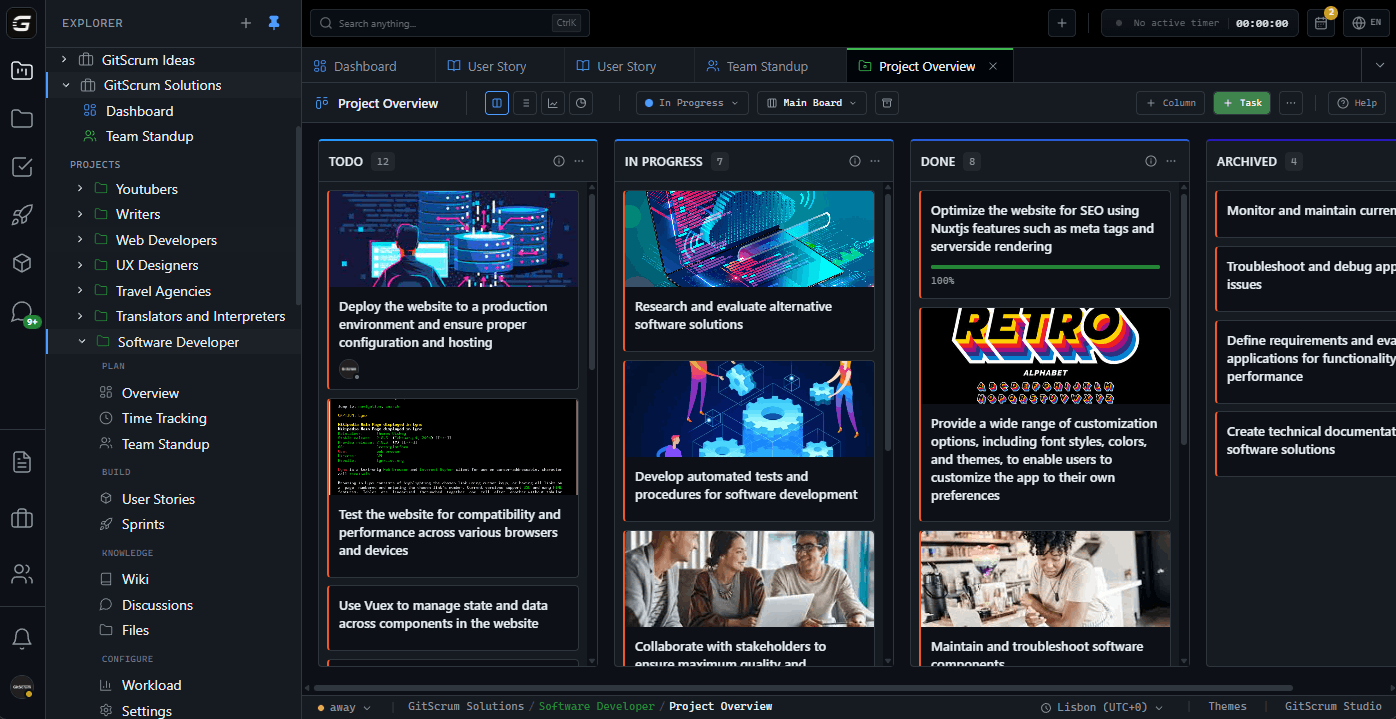
Adds capability. Trello: Board → Lists → Cards GitScrum: Board → Columns → Tasks (with Git superpowers) Same mental model.
More power under the hood. When Trello Is Fine Keep Trello if: ├─ Not writing code ├─ No Git workflow ├─ No sprint structure ├─ Simple task tracking is enough ├─ Non-technical team └─ Happy with current setup Switch to GitScrum if: ├─ Development team ├─ Use GitHub or GitLab ├─ Need Git-connected tasks ├─ Want sprint management ├─ Need velocity tracking ├─ Tired of power-up juggling ├─ Want more for same/less money Real Story 'We started with Trello because it's simple.
Then we added GitHub power-up for PR links. Then story points plugin.
Then reports plugin. Suddenly we're managing 4 different tools duct-taped together.
Switched to GitScrum - it's just as simple as Trello but everything we need is built in. One tool, not four.' - Lead Developer, startup Vs Other Alternatives Jira: - The 'upgrade' from Trello - Massive complexity increase - 10x learning curve - Often overkill Asana: - Not Kanban-native - No Git integration - Marketing/ops focused Linear: - Developer-focused - Fast and modern - $8/user, no free tier - Less feature-complete GitScrum: - Trello simplicity kept - Dev features added - Git-native - $8.90/user (2 free) Pricing 2 users: $0/month (free forever, full features) 5 users: $26.70/month 10 users: $71.20/month 25 users: $178/month All features included.
No power-ups to buy. No feature tiers.
Try Free 1. Sign up (30 seconds) 2.
Import from Trello (optional) 3. Connect GitHub/GitLab 4.
Create sprint 5. Experience Git automation 6.
Keep the simplicity, add the power $8.90/user/month. 2 users free forever.
Trello alternative that understands developers.
The GitScrum Advantage
One unified platform to eliminate context switching and recover productive hours.