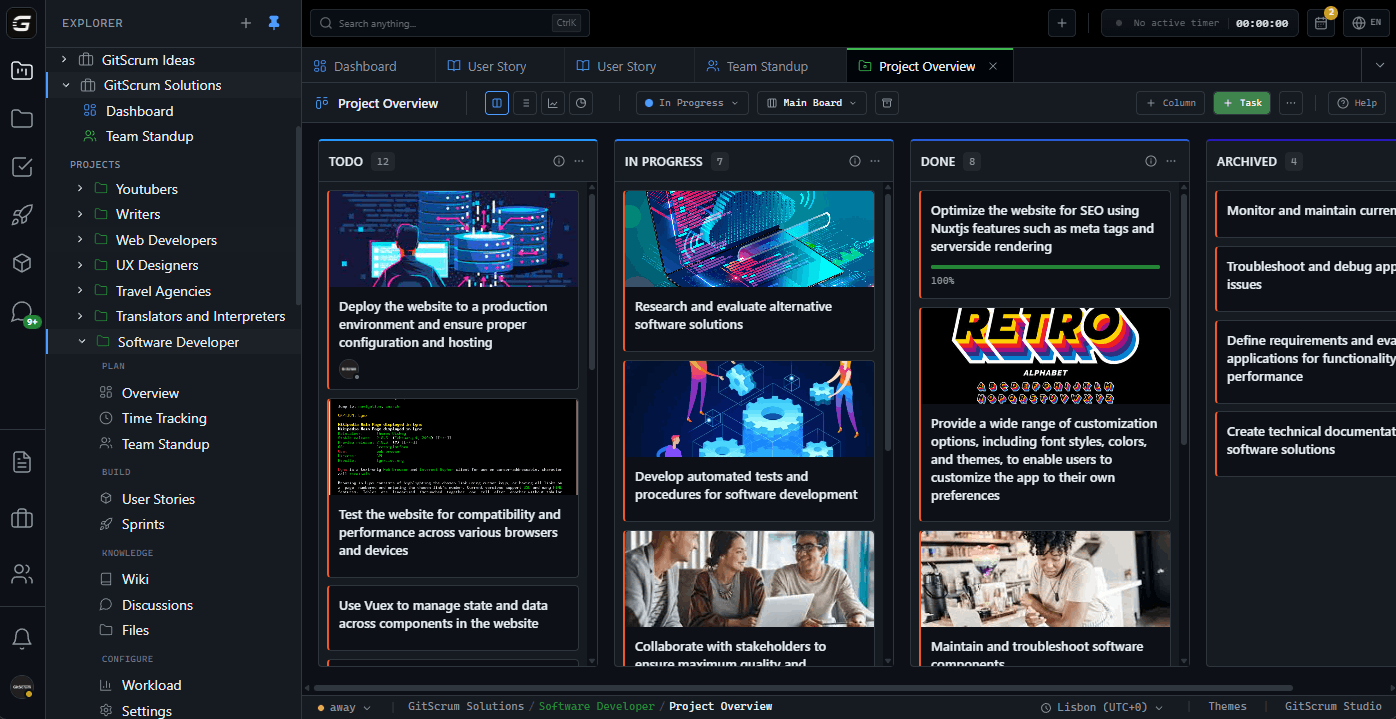
The Agile Washing Problem Every PM tool claims to be 'agile': - 'Agile-ready' - 'Agile-friendly' - 'Supports agile methodologies' - 'Built for agile teams' But most deliver: - Kanban board (just columns and cards) - Maybe sprints (time boxes, nothing more) - That's it.
Real agile requires: - User stories with acceptance criteria - Story point estimation - Sprint planning ceremonies - Velocity tracking over time - Burndown visualization - Retrospective support - Continuous improvement metrics - Working software focus (Git integration) Most 'agile' tools: 2/8 GitScrum: 8/8 What Agile Actually Means in Practice The Agile Manifesto (simplified): 1. Individuals and interactions over processes and tools 2.
Working software over comprehensive documentation 3. Customer collaboration over contract negotiation 4.
Responding to change over following a plan How this translates to tooling: 'Working Software Over Documentation' - Git integration essential - Code progress = project progress - Commit history tells the story - No separate 'reporting' needed GitScrum approach: - Commits link to tasks automatically - PR status visible on boards - Working code is the metric 'Responding to Change' - Easy backlog reprioritization - Mid-sprint scope visible - Quick task creation - Flexible workflows GitScrum approach: - Drag-drop prioritization - Sprint scope change tracking - Create task in seconds - Custom workflows Scrum Implementation in GitScrum The Scrum Framework: Roles: - Product Owner (manages backlog) - Scrum Master (facilitates) - Development Team (executes) All can work in GitScrum with appropriate permissions. Artifacts: 1.
Product Backlog - GitScrum: Backlog view with priority ordering - User stories with acceptance criteria - Epics for grouping - Ready indicators 2. Sprint Backlog - GitScrum: Sprint view with committed items - Story point capacity planning - Clear sprint goal - Daily progress visible 3.
Increment - GitScrum: Done items with linked commits - Working software tracked via Git - Definition of Done checklist Events: 1. Sprint Planning - Select from backlog - Estimate story points - Commit to sprint - Set sprint goal GitScrum: Native sprint creation with capacity checking 2.
Daily Scrum - What did I do? (commit history) - What will I do?
(assigned tasks) - Blockers? (flagged items) GitScrum: Board view shows all, Git shows actual work 3.
Sprint Review - Demo working software - Review completed items - Gather feedback GitScrum: Filter by completed, see linked commits/PRs 4. Sprint Retrospective - What went well?
- What to improve? - Action items GitScrum: Velocity comparison, metrics for discussion Kanban Implementation in GitScrum Kanban Principles: 1.
Visualize Work - GitScrum: Kanban board with customizable columns - Card details visible at glance - Color coding by type/priority 2. Limit WIP (Work in Progress) - GitScrum: Column WIP limits - Visual warning when exceeded - Forces finishing over starting 3.
Manage Flow - GitScrum: Cycle time tracking - Lead time metrics - Bottleneck identification 4. Make Policies Explicit - GitScrum: Column descriptions - Definition of Done visible - Clear workflow rules 5.
Continuous Improvement - GitScrum: Historical metrics - Cumulative flow diagrams - Trend analysis Kanban Board Setup: Default columns: - Backlog (no WIP limit) - Ready (WIP: 10) - In Progress (WIP: 5) - Review (WIP: 3) - Testing (WIP: 3) - Done (no WIP limit) Customize per team needs. Scrumban: Best of Both Some teams need hybrid: - Sprint time boxes (Scrum) - WIP limits (Kanban) - Continuous flow (Kanban) - Sprint planning (Scrum) - No rigid ceremonies GitScrum supports: - Sprints with WIP-limited boards - Continuous backlog grooming - Velocity + flow metrics - Flexible ceremony adoption Story Points in GitScrum Fibonacci sequence: 1, 2, 3, 5, 8, 13, 21...
Estimation features: - Point field on every task - Planning poker support - Historical comparison - Velocity calculation Velocity tracking: - Points completed per sprint - Rolling average - Trend visualization - Capacity planning input Estimation accuracy: - Estimated vs actual time - Point inflation detection - Team calibration data Burndown Charts Ideal burndown: - Linear decrease from sprint start - Zero remaining at sprint end GitScrum burndown: - Real-time updates - Scope change visualization - Remaining vs completed - Trend line projection What burndown reveals: - Scope creep (line goes up) - Blocked progress (line flat) - Ahead of schedule (below ideal) - At risk (above ideal) Velocity Tracking Velocity = points completed per sprint GitScrum tracks: - Per-sprint velocity - Rolling average (3-sprint, 5-sprint) - Trend direction - Team capacity estimate Using velocity: - Sprint planning: Don't commit more than average - Release planning: Remaining points / velocity = sprints needed - Team health: Declining velocity signals problems Comparison: Agile Features Feature GitScrum Jira Linear Trello Monday ------- -------- ---- ------ ------ ------ Sprint planning Native Native Native Plugin No Story points Yes Yes Yes Plugin No Velocity tracking Yes Yes Yes No No Burndown charts Yes Yes Yes No No WIP limits Yes Yes Yes Plugin No Backlog grooming Yes Yes Yes Manual Manual Retrospective data Yes Yes Yes No No Git integration Native Plugin Native Plugin Plugin Price/user $8.90 $17.50+ $8 $5+ $12+ GitScrum: Full agile stack at competitive price. Agile Metrics Dashboard GitScrum provides: Sprint Metrics: - Velocity trend - Burndown status - Scope changes - Completion rate Flow Metrics: - Cycle time (start to done) - Lead time (created to done) - Throughput (items per week) - WIP trends Team Metrics: - Individual capacity - Task distribution - Blocker frequency - Collaboration patterns Code Metrics (via Git): - Commit frequency - PR throughput - Task linkage rate - Code review time For Scrum Masters Your toolkit in GitScrum: - Sprint planning facilitation (capacity view) - Daily standup data (board + Git activity) - Impediment tracking (blocker flags) - Velocity monitoring (trend alerts) - Retrospective data (metrics export) - Process improvement (historical analysis) For Product Owners Your toolkit in GitScrum: - Backlog management (drag-drop priority) - Story writing (acceptance criteria templates) - Sprint goal setting (goal field per sprint) - Stakeholder visibility (read-only views) - Release planning (velocity-based projection) - Feature tracking (epic progress) For Developers Your toolkit in GitScrum: - Task pickup (claim from ready column) - Progress tracking (Git commits = updates) - Code linkage (automatic via commit message) - Time tracking (start/stop timer) - Sprint visibility (what's committed, what's done) - Minimal overhead (code speaks for itself) Agile Adoption Path Week 1: Setup - Create account (free, 2 users) - Connect Git repository - Create first project - Set up board columns Week 2: Backlog - Write user stories - Add acceptance criteria - Estimate story points - Prioritize backlog Week 3: First Sprint - Plan sprint (select stories) - Set sprint goal - Execute (commit, update) - Track burndown Week 4: Review & Retro - Review completed work - Calculate velocity - Discuss improvements - Plan next sprint Ongoing: Continuous Improvement - Track velocity trends - Refine estimation - Optimize workflow - Adapt process Common Agile Anti-Patterns (And How GitScrum Helps) 'Zombie Scrum' - Going through motions - Solution: Git integration shows real work, not ceremony theater 'Velocity Obsession' - Gaming points - Solution: Code correlation, time tracking for calibration 'Scope Creep Sprint' - Constant additions - Solution: Scope change tracking, visual alerts 'Meeting-Heavy Agile' - More meetings than work - Solution: Async updates via Git, reduce standup time 'Agile in Name Only' - Waterfall with boards - Solution: Full ceremony support, metrics for real agile Pricing for Agile Teams 2 users: $0/month (free forever) 3 users: $8.90/month 5 users: $26.70/month 10 users: $71.20/month All agile features included: - Sprints - Story points - Velocity - Burndown - WIP limits - Retrospective data - Git integration No 'Advanced Agile' tier.
No 'Enterprise Scrum' package. All features for everyone.
Start Agile Today 1. Sign up free (30 seconds) 2.
Create project with Scrum template 3. Write first user story 4.
Estimate with story points 5. Start your first sprint No agile certification required.
No Scrum Master certification required. Just start building.
$8.90/user/month. 2 users free forever.
Real agile, not agile theater.
The GitScrum Advantage
One unified platform to eliminate context switching and recover productive hours.