VS Code

GitScrum for VS Code, Google Antigravity, Cursor and Windsurf!

GitScrum logo
Solution

Attention Fragmentation Tools 2026 | Unified Priority View

How do teams lose priorities across 6+ scattered tools? GitScrum's unified dashboard surfaces critical tasks instantly. 40% faster deadline hits with single-priority view. Free trial.

Attention Fragmentation Tools 2026 | Unified Priority View

Attention fragmentation creates a priority blindness that is particularly dangerous for development teams.

When a developer's focus is constantly split between Jira for tasks, Slack for communications, email for external stakeholders, GitHub for code, Confluence for documentation, and additional tools for time tracking and reporting, their mental model of 'what is most important right now' becomes unreliable. High-priority items in one tool are not visible when working in another.

A critical production bug might be flagged in Jira while the developer is responding to Slack messages. An urgent customer request might arrive via email while they are reviewing GitHub pull requests.

The scattered attention model means priorities compete across multiple interfaces with no unified view. The result: developers often work on lower-priority items simply because those items are in their current field of view.

Truly important work gets delayed because it requires switching to a different tool to even see it. Deadlines slip not because developers are slow, but because fragmented attention makes priority management nearly impossible.

GitScrum consolidates priority visibility. When tasks, communications, and deadlines exist in one interface, developers maintain a coherent view of what matters most.

Priority indicators work across the entire work context, not just within individual tool silos. The result: attention flows to genuinely important work instead of whatever happens to be most visible at the moment.

The GitScrum Advantage

One unified platform to eliminate context switching and recover productive hours.

01

problem.identify()

The Problem

Critical priorities get lost when attention is scattered across multiple tools

High-priority tasks in one tool not visible when working in another

Developers work on lower-priority items simply because they are more visible

Deadlines slip due to priority blindness across tool silos

No unified view of what matters most across work context

Urgent items compete for attention across 6+ separate interfaces

02

solution.implement()

The Solution

Consolidate priority visibility into unified interface

Single view of what matters most across all work context

Priority indicators work across entire platform not just tool silos

Attention flows to genuinely important work

Deadlines and urgency visible regardless of current view

End priority blindness from scattered tool attention

03

How It Works

1

Unified Priority View

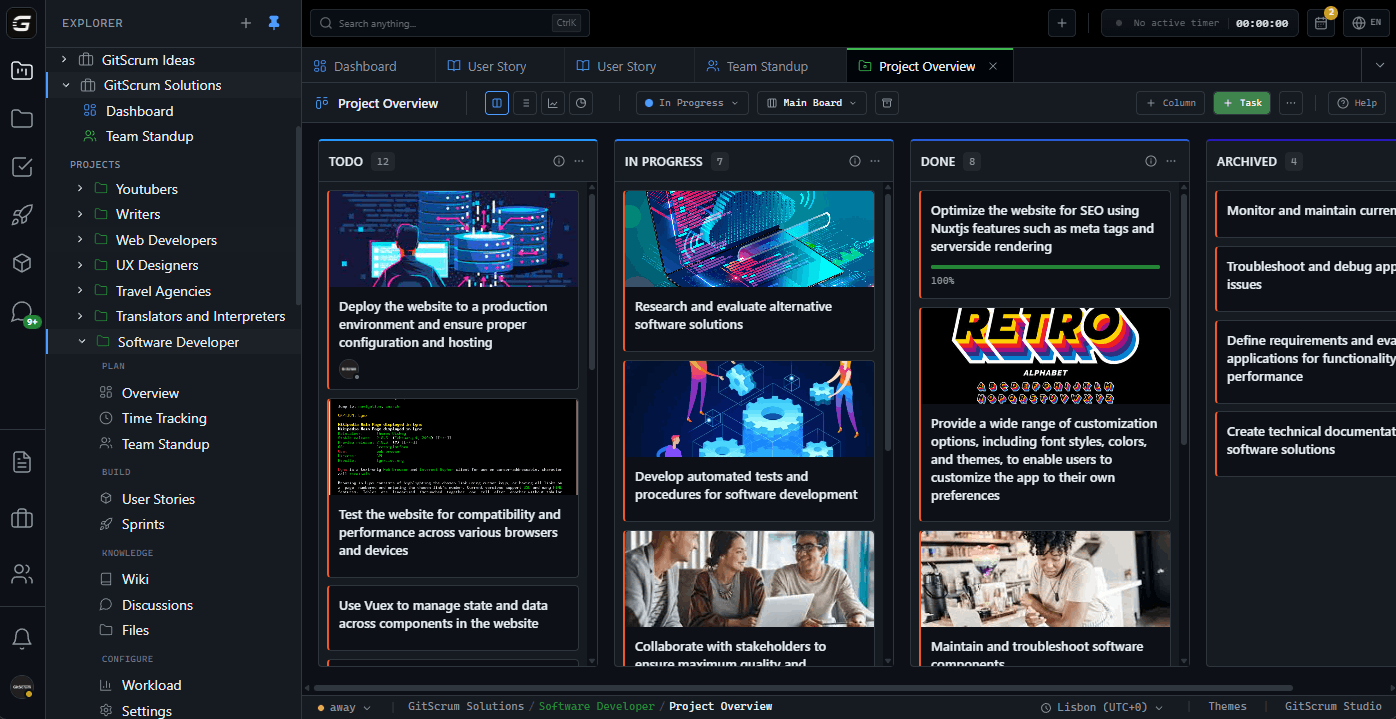
All tasks, deadlines, and urgent items visible in single dashboard regardless of their origin or category

2

Cross-Context Priority Indicators

Priority levels and due dates visible across task boards, discussions, and notifications—not siloed by tool

3

Attention Guidance

Platform surfaces highest-priority items first, guiding attention to what genuinely matters most

4

Priority-Based Notifications

Notification urgency tied to task priority, ensuring critical items break through while low-priority batches quietly

04

Why GitScrum

GitScrum addresses Attention Fragmentation from Scattered Tools Causing Missed Priorities through Kanban boards with WIP limits, sprint planning, and workflow visualization

Problem resolution based on Kanban Method (David Anderson) for flow optimization and Scrum Guide (Schwaber and Sutherland) for iterative improvement

Capabilities

  • Kanban boards with WIP limits to prevent overload
  • Sprint planning with burndown charts for predictable delivery
  • Workload views for capacity management
  • Wiki for process documentation
  • Discussions for async collaboration
  • Reports for bottleneck identification

Industry Practices

Kanban MethodScrum FrameworkFlow OptimizationContinuous Improvement

Frequently Asked Questions

Still have questions? Contact us at customer.service@gitscrum.com

How does attention fragmentation cause missed priorities?

When attention is split across multiple tools, each tool shows its own subset of work. A critical task in Jira is not visible when you are in Slack. An urgent email is hidden when you are reviewing code in GitHub. Without a unified view, developers work on whatever is in their current field of view—which is often not the highest priority item across all their responsibilities.

Why do developers work on lower-priority items?

It is not intentional. In fragmented environments, developers naturally gravitate toward visible work. If they are in Slack responding to messages, they will handle the Slack items in front of them rather than switching to Jira to check if something more important is waiting. Visibility drives attention, not priority level.

How does tool consolidation restore priority visibility?

When tasks, communications, and deadlines exist in one interface, priority comparisons become possible. A developer can see that Task A is priority 1 while the Slack-style discussion is priority 3. The unified view allows attention to flow to genuinely important work based on actual priority, not just what happens to be most visible.

Ready to solve this?

Start free, no credit card required. Cancel anytime.

Works with your favorite tools

Connect GitScrum with the tools your team already uses. Native integrations with Git providers and communication platforms.

GitHubGitHub
GitLabGitLab
BitbucketBitbucket
SlackSlack
Microsoft TeamsTeams
DiscordDiscord
ZapierZapier
PabblyPabbly

Connect with 3,000+ apps via Zapier & Pabbly