Azure DevOps: The Microsoft Everything Platform Azure DevOps includes: ├─ Azure Boards (work tracking) ├─ Azure Repos (Git repositories) ├─ Azure Pipelines (CI/CD) ├─ Azure Test Plans (testing) ├─ Azure Artifacts (package management) └─ All integrated into Microsoft ecosystem For enterprise teams with 100+ developers?
Azure DevOps makes sense. For your 5-person startup?
You're using 10% of the tool and fighting the other 90%. The Small Team Azure DevOps Experience Week 1: 'Let's use Azure DevOps, it has everything!' Week 2: 'Which project template should we use?' Week 3: 'Why are there so many configuration options?' Week 4: 'Where's the simple Kanban view?' Week 5: 'The queries system is confusing' Week 6: 'We need to set up area paths and iterations' Week 7: 'Work item types - Bug vs Issue vs Task?' Week 8: 'Process customization is complicated' Week 9: 'We're spending more time on admin than coding' Week 10: 'Do we really need all this?' Azure DevOps is built for enterprises.
Small teams don't need enterprise complexity. The Configuration Tax Azure DevOps setup for small team: 1.
Choose process template - Basic, Agile, Scrum, or CMMI? - What's the difference again?
- Can we change later? (sort of) 2.
Configure work items - Epic → Feature → User Story → Task - Or Epic → Feature → Product Backlog Item → Task - Custom fields? - States and transitions?
3. Set up area paths - Team structure - Component breakdown - Reporting hierarchy 4.
Configure iterations - Sprint structure - Release cadence - Capacity planning 5. Define queries - My work queries - Team queries - Shared queries 6.
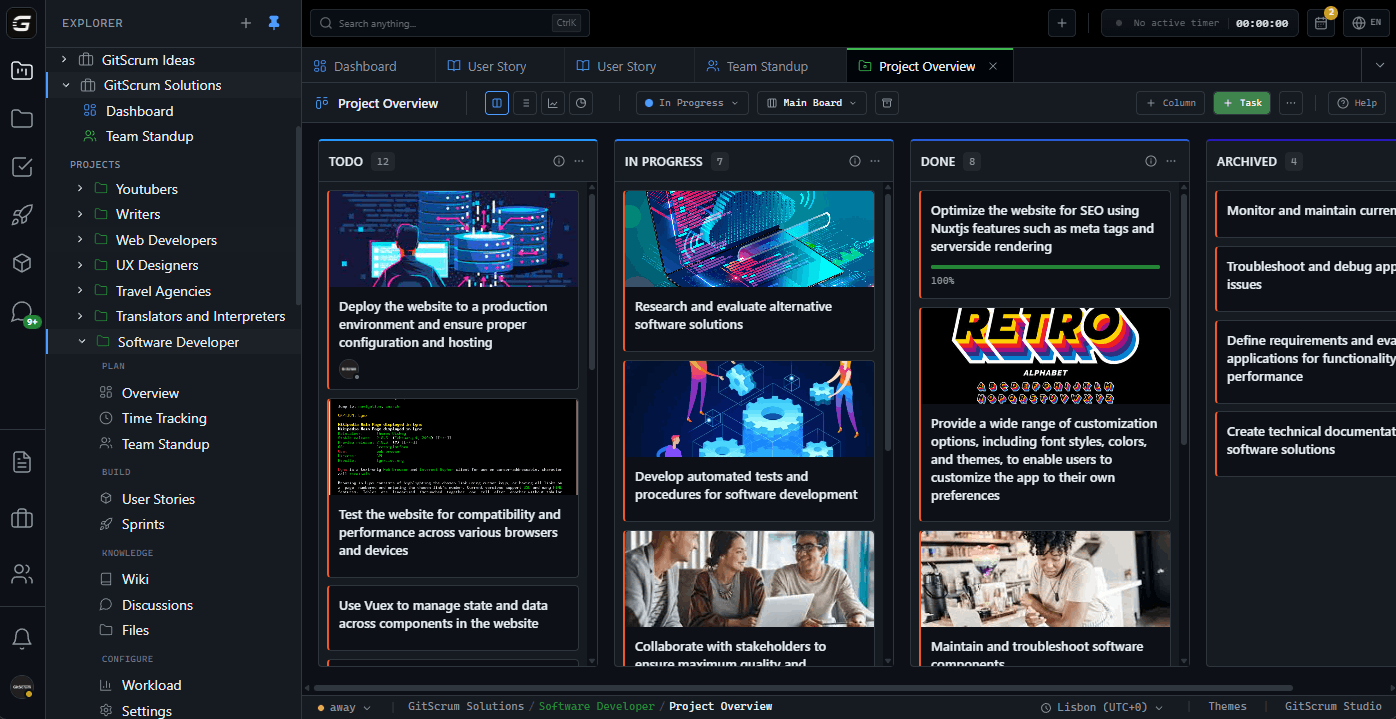
Set up dashboards - Widgets configuration - Chart setup - Team visibility Time spent: Days to weeks For a 5-person team: Overkill GitScrum setup: 1. Sign up 2.
Connect Git 3. Create sprint 4.
Add tasks 5. Start working Time spent: 30 minutes Why Small Teams Don't Need Azure DevOps 1.
You Probably Already Use GitHub Most small teams use GitHub. Azure Repos duplicates what GitHub does.
Now you have two Git systems. GitScrum connects TO your GitHub.
One source of truth for code. 2.
You Don't Need CI/CD in Your PM Tool Azure Pipelines is powerful. But GitHub Actions exists.
GitLab CI exists. CircleCI exists.
CI/CD is a solved problem outside Azure. Your PM tool doesn't need to do CI/CD.
3. You Don't Need Test Plans Enterprise QA teams use Azure Test Plans.
Small teams? Usually test in code.
Jest, Pytest, RSpec, etc. You don't need a separate test management system.
4. Artifact Management is Usually Separate npm, PyPI, Maven Central, Docker Hub.
Most teams use existing package managers. Azure Artifacts solves a problem you don't have.
Pricing Reality Check Azure DevOps Pricing: ├─ Basic: Free (first 5 users, limited features) ├─ Basic: $6/user/month (after first 5) ├─ Basic + Test Plans: $52/user/month └─ Note: Azure infrastructure costs are separate The 'free' reality: - First 5 users on Basic are free - Limited to Basic features - No Test Plans - 1 free parallel job (CI/CD) - Limited free pipeline minutes GitScrum Pricing: ├─ Free Forever: 2 users, ALL features ├─ All users: $8.90/user/month ├─ All features included └─ No hidden limits For 10 developers (after free tiers): ├─ Azure DevOps Basic: $30/month (5 paid) ├─ GitScrum: $71.20/month (8 paid) └─ Azure cheaper at user count only BUT: - Azure: Limited features at Basic tier - Azure: You probably also pay for GitHub - Azure: Time spent on configuration - GitScrum: All features, one tool, works with GitHub Feature Comparison (What Small Teams Actually Use) | Feature | Azure DevOps | GitScrum | |----------------------|---------------|------------------| | Task management | ✓ | ✓ | | Sprint planning | ✓ | ✓ | | Kanban boards | ✓ | ✓ | | Backlog management | ✓ | ✓ | | Git hosting | ✓ | Use GitHub | | GitHub integration | Limited | Native | | Auto status from Git | Partial | Full | | CI/CD | ✓ | Use GH Actions | | Test management | ✓ (paid) | ✗ | | Setup complexity | High | Low | | Configuration needed | Lots | Minimal | | Time tracking | Third-party | Built-in | | Story points | ✓ | ✓ | | Velocity tracking | ✓ | ✓ | | Burndown charts | ✓ | ✓ | When Azure DevOps Makes Sense Stay with Azure DevOps if: ├─ Enterprise organization (100+ developers) ├─ Already invested in Microsoft ecosystem ├─ Need Azure Repos specifically ├─ Need Azure Pipelines specifically ├─ Need Azure Test Plans ├─ Compliance requires Microsoft ├─ IT department mandates it └─ Configuration is already done Switch to GitScrum if: ├─ Small team (under 30 people) ├─ Using GitHub or GitLab for code ├─ Using GitHub Actions or other CI/CD ├─ Want simpler setup ├─ Don't need enterprise features ├─ Value speed over configurability ├─ Want native GitHub integration └─ Time tracking matters The Microsoft Ecosystem Question 'But we use Office 365 and Teams...' Microsoft ecosystem is great. But Azure DevOps integration with Teams?
It's notifications and tab embeds. You can integrate GitScrum with Teams too.
Or Slack. Or whatever you use.
Don't choose your dev PM tool based on email provider. Migration Path From Azure DevOps to GitScrum: 1.
Export work items (CSV or Excel) 2. Clean up data 3.
Sign up GitScrum free 4. Import tasks 5.
Connect GitHub/GitLab 6. Set up sprints 7.
Redirect team Time: 1-2 days for clean migration. Keep Azure DevOps for: - Historical reference - CI/CD if using Azure Pipelines - Repos if not moving to GitHub Real Team Story 'We started with Azure DevOps because it seemed like the 'professional' choice.
But we're a 7-person team using GitHub for code and GitHub Actions for CI. Azure Boards was overkill - we spent more time configuring it than using it.
The queries, work item types, area paths... too much.
Switched to GitScrum, connected our GitHub repos, and had everything working in an afternoon. Now we manage tasks instead of managing our task management tool.' - CTO, B2B SaaS Startup Vs Other Alternatives Jira: - Similar enterprise complexity - Atlassian ecosystem - Expensive GitHub Projects: - Free with GitHub - Limited features - No sprints or velocity Linear: - Developer-focused - Clean UI - No free tier GitScrum: - Developer-focused - GitHub-native - Simpler than Azure DevOps - $8.90/user (2 free) Pricing Summary 2 users: $0/month (free forever, all features) 5 users: $26.70/month 10 users: $71.20/month 20 users: $160.20/month No enterprise configuration.
No process templates to choose. No area paths to define.
Just project management that works. Try Free 1.
Sign up (2 users free forever) 2. Connect GitHub or GitLab 3.
Create sprint 4. Import or create tasks 5.
Experience simplicity $8.90/user/month. 2 users free forever.
The Azure DevOps alternative sized for small teams.
The GitScrum Advantage
One unified platform to eliminate context switching and recover productive hours.