
Basecamp: The Anti-Feature Philosophy Basecamp's philosophy: 'The answer to any feature request is almost always no.
For software development teams, it's limiting. What Basecamp Does Well To-dos: Simple task lists Message boards: Team discussions Campfires: Real-time chat Schedule: Calendar view Docs: File storage Automatic check-ins: 'What did you work on?' Hill Charts: Progress visualization Designed for: Marketing teams, creative agencies, general business.
Designed by: A company that mostly writes blog posts and occasional software. What Software Development Needs That Basecamp doesn't provide: 1.
Git Integration Basecamp: None Reality: Code is the work. Tool should know about code.
2. Sprint Planning Basecamp: 6-week cycles (their Shape Up methodology) Reality: Many teams need 1-2 week sprints, traditional agile 3.
Story Points Basecamp: Just to-dos with due dates Reality: Estimation is crucial for planning capacity 4. Velocity Tracking Basecamp: Hill Charts only (subjective progress) Reality: Need data-driven sprint metrics 5.
Burndown Charts Basecamp: Not available Reality: Standard agile tool for sprint health 6. Backlog Management Basecamp: To-do lists Reality: Need prioritized backlog with grooming workflow 7.
Code-Driven Status Basecamp: Manual updates Reality: Status should update from Git activity The Shape Up vs Scrum Question Basecamp promotes 'Shape Up': ├─ 6-week cycles ├─ No sprints ├─ No daily standups ├─ No story points ├─ Bet on shaped work ├─ Full autonomy for teams └─ Works for Basecamp But most dev teams use: ├─ Scrum or Kanban ├─ 1-2 week sprints ├─ Daily coordination ├─ Story point estimation ├─ Sprint planning meetings ├─ Velocity tracking └─ Industry standard If Shape Up works for you, great. If you need traditional agile, Basecamp fights you.
Pricing Comparison Basecamp Pricing: ├─ Basecamp: $15/user/month (min 10 users) ├─ Or $299/month flat (unlimited users) └─ Note: Flat rate sounds good, needs scale The $299/month flat rate: ├─ 10 users: $29.90/user ├─ 20 users: $14.95/user ├─ 50 users: $5.98/user ├─ 100 users: $2.99/user └─ Only makes sense for 30+ users GitScrum Pricing: ├─ Free Forever: 2 users, all features ├─ All users: $8.90/user/month └─ No minimum team size For 10 developers: ├─ Basecamp: $150/month (or $299 flat) ├─ GitScrum: $71.20/month (2 free) └─ GitScrum saves: $78.80/month For 50 developers: ├─ Basecamp: $299/month (flat better here) ├─ GitScrum: $427.20/month └─ Basecamp cheaper at scale GitScrum wins for teams under 35. Basecamp's flat rate wins at larger scale.
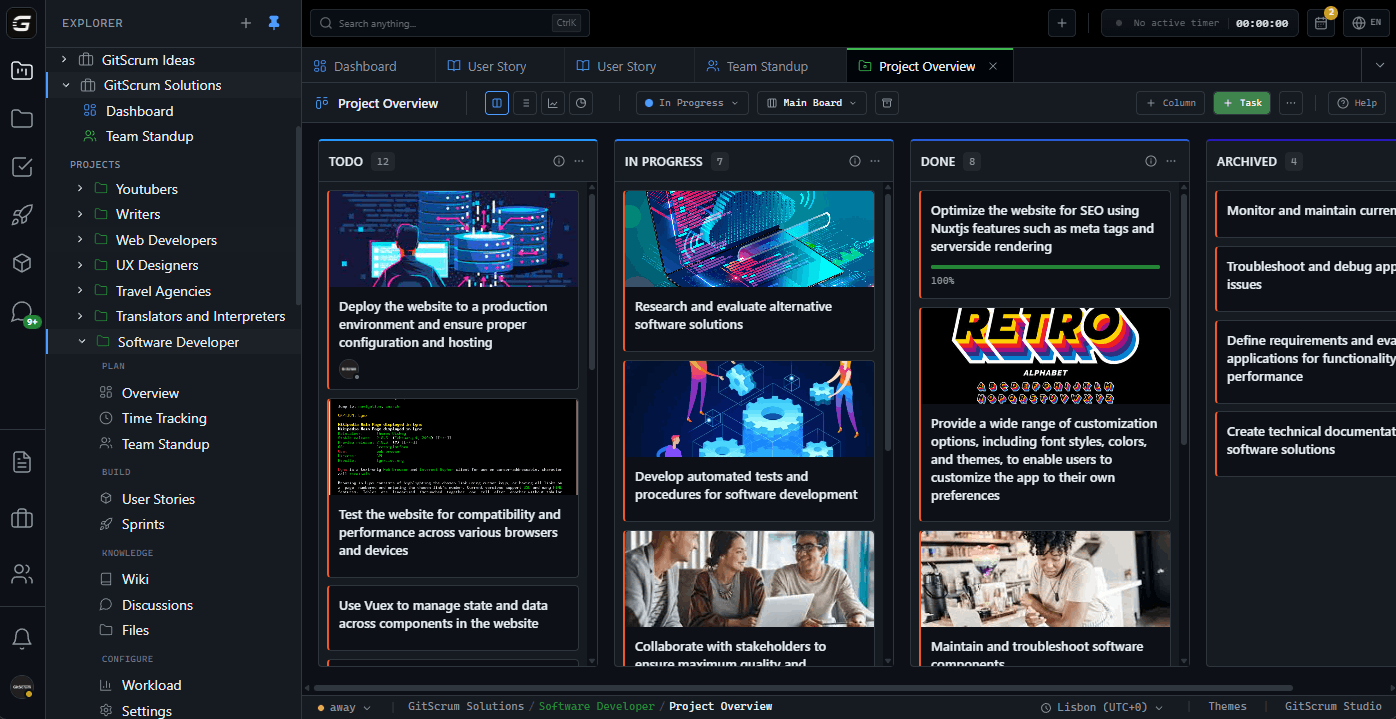
Feature Comparison | Feature | Basecamp | GitScrum | |----------------------|---------------|------------------| | Task management | ✓ (to-dos) | ✓ (full tasks) | | Discussions | ✓ | ✓ | | Calendar | ✓ | ✓ | | Git integration | ✗ | Native | | Sprint planning | ✗ | Built-in | | Story points | ✗ | Built-in | | Velocity tracking | ✗ | Automatic | | Burndown charts | ✗ | Built-in | | Kanban boards | Limited | Full | | Time tracking | ✗ | Built-in + Git | | Auto status updates | ✗ | From Git | | Hill Charts | ✓ | ✗ | | Automatic check-ins | ✓ | ✗ | When Basecamp Is Better Keep Basecamp if: ├─ Team is non-technical or mixed ├─ Shape Up methodology works for you ├─ Don't need Git integration ├─ Don't need sprint planning ├─ 50+ team members (flat rate value) ├─ Simplicity over features priority ├─ Hill Charts valuable for your work └─ Already invested in Basecamp workflow When GitScrum Is Better Switch to GitScrum if: ├─ Software development team ├─ Git-native workflow essential ├─ Traditional agile (Scrum/Kanban) ├─ Need sprint planning ├─ Need story points and velocity ├─ Need burndown charts ├─ Team under 35 people (cost savings) ├─ Time tracking needed └─ Code should drive project status The Developer Perspective Developer using Basecamp: 1. Pick up to-do 2.
Create branch 3. Write code 4.
Create PR 5. Merge code 6.
Manually update to-do in Basecamp 7. Forget sometimes 8.
Board out of sync with reality Developer using GitScrum: 1. Pick up task 2.
Create branch → Task auto-moves to In Progress 3. Write code → Time tracked from commits 4.
Create PR → Task auto-moves to Review 5. Merge code → Task auto-completes 6.
Never update anything manually 7. Board always accurate Migration Path From Basecamp to GitScrum: 1.
Export Basecamp to-dos (not built-in, use API or manual) 2. Sign up GitScrum free (2 users) 3.
Create project structure 4. Import tasks 5.
Connect GitHub/GitLab 6. Set up first sprint 7.
Train team on agile workflow Time: 1-2 days for clean transition. Note: Moving from Shape Up to Sprints is a methodology change, not just a tool change.
Plan for team adjustment. Real Team Story 'Basecamp was fine when we were doing content and marketing.
But when the dev team grew and we needed real sprint planning, Basecamp felt like a general-purpose tool forcing us into their workflow. No Git integration meant our board was always wrong.
Switched to GitScrum for the dev team specifically. Marketing still uses Basecamp - it's great for them.
Dev team needed something built for development.' - Engineering Manager, Growing Startup Vs Other Alternatives Jira: - Enterprise complex - Git integration exists - Expensive at scale - Overkill for many Asana: - Better boards than Basecamp - No Git integration - No sprint concept ClickUp: - Has Git integration - Feature bloated - Performance issues GitScrum: - Developer-focused - Native Git integration - Sprint-first design - $8.90/user (2 free) Pricing Summary 2 users: $0/month (free forever, all features) 5 users: $26.70/month 10 users: $71.20/month 20 users: $160.20/month All dev features included. No Shape Up required.
Git integration native. Try Free 1.
Sign up (2 users free forever) 2. Connect GitHub/GitLab 3.
Create first sprint 4. Add story points to tasks 5.
Experience developer-focused PM $8.90/user/month. 2 users free forever.
The Basecamp alternative built for developers.
The GitScrum Advantage
One unified platform to eliminate context switching and recover productive hours.