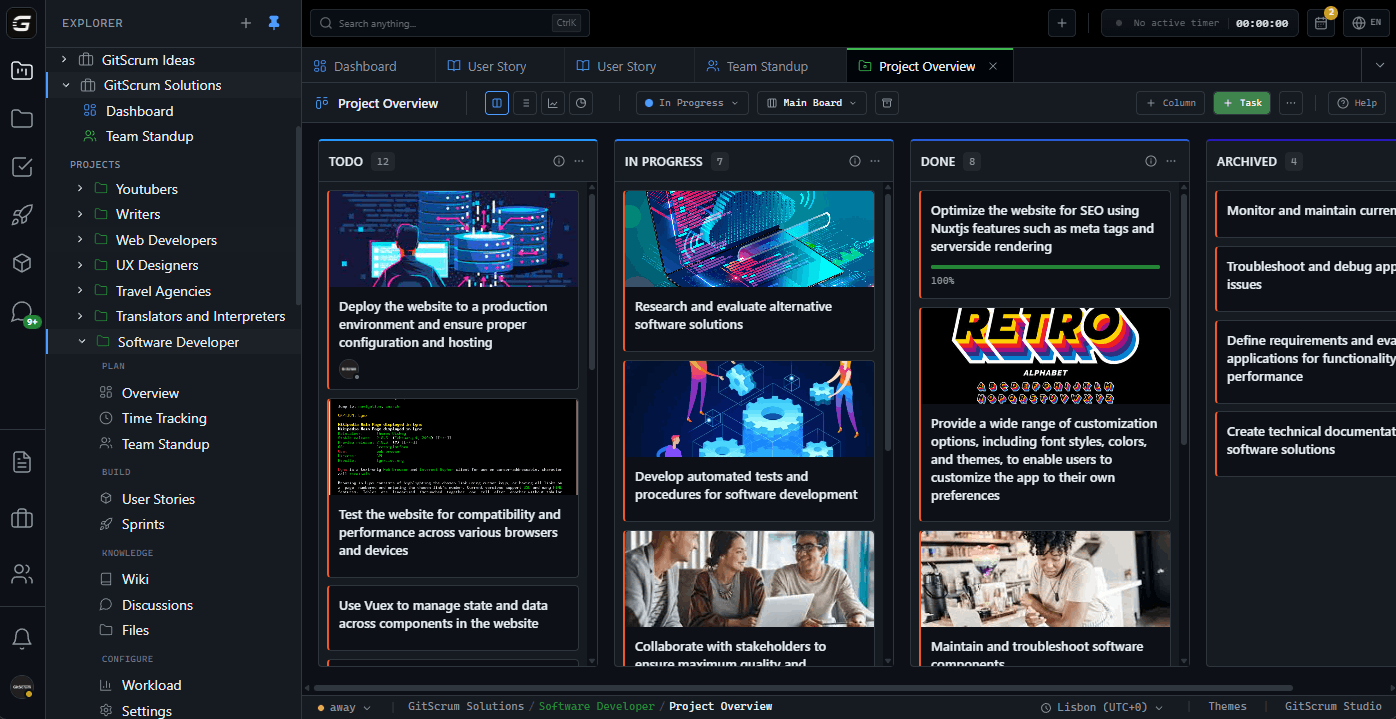
The Code-PM Gap Current reality for developers: Two separate worlds: World 1: Code - Git repository - Branches - Commits - Pull requests - CI/CD pipelines - Code reviews World 2: PM Tool - Task boards - User stories - Sprint backlogs - Status updates - Comments - Reports The gap between them: - Manual syncing - Copy-paste task IDs - Remember to update status - Context switching - Information in two places This gap costs time daily.
Why PM Tools Ignore Code Historical reason: 1. PM tools built for all industries - Construction projects - Marketing campaigns - Event planning - Software is just one use case 2.
Non-technical founders - Business background - Management training - Don't understand Git - Don't use Git 3. Enterprise focus - Large organizations - IT separate from dev - Integration is IT's problem - Developers adapt Result: PM tools that don't understand what developers actually do.
GitScrum: Code-First Philosophy Code is the work: - Tasks represent code changes - Progress is measured in commits - Completion is a merged PR - Status comes from Git, not clicks Not: update task when you remember But: task updates when you code Git Integration Architecture 1. Branch-Task Connection Create branch with task ID: gs-{taskID}-{description} Example: gs-142-add-user-auth GitScrum sees the branch.
Task shows 'In Progress'. No manual update needed.
2. Commit Visibility Commits appear in task: - Commit message - Timestamp - Author - Files changed Progress visible without leaving PM.
3. PR-Task Linking Pull request created: - Link to task automatic - Reviews visible - Merge closes task (optional) Full workflow visibility.
4. CI/CD Status Build status in task: - Passing - Failing - In progress Know if code is deployable.
The Code-Focused Workflow Traditional workflow: 1. Open PM tool 2.
Find task 3. Read requirements 4.
Switch to IDE 5. Create branch (remember task ID) 6.
Write code 7. Commit (remember task ID) 8.
Push 9. Create PR 10.
Switch to PM tool 11. Update task status 12.
Add PR link 13. Back to code Code-focused workflow: 1.
See task in GitScrum 2. Click 'Create branch' in task 3.
Branch created with correct naming 4. Code in IDE 5.
Commit with task ID 6. Push 7.
Create PR 8. Task auto-updates throughout 9.
PR merge completes task Less context switching. Automatic updates.
Code-driven progress. Task-to-Code Context In traditional PM: - Task: 'Fix login bug' - Description: vague - No code context - Hunt for relevant files In GitScrum: - Task: 'Fix login bug' - Branch: gs-203-fix-login-bug - Commits: 3 commits shown - Files: auth.js, login.vue modified - PR: 847 ready for review Full code context in task.
Code-to-Task Context In Git (traditional): - Commit: 'Fix auth' - No task link - No requirements visible - Why was this done? In Git (with GitScrum): - Commit: 'Fix auth gs-203' - Click link: opens task - See requirements - See discussion - Full context Traceability both directions.
Progress Metrics from Code Traditional metrics: - Story points (estimated) - Task completion (manual) - Velocity (calculated from manual input) Code-focused metrics: - Commits per sprint - PRs merged - Code velocity (actual) - Deployment frequency Real metrics from real code. Not estimates and manual updates.
Supported Platforms GitHub: - Full branch integration - Commit tracking - PR linking - Actions visibility GitLab: - Branch integration - MR tracking - CI/CD status Bitbucket: - Branch integration - PR tracking - Pipeline status Connect your existing repos. No migration needed.
Free Code Focus GitScrum pricing: - 2 users FREE forever - Full Git integration - GitHub, GitLab, Bitbucket - Unlimited repositories - Branch-task linking - $8.90/user/month beyond 2 PM that understands code. Because developers built it.
The GitScrum Advantage
One unified platform to eliminate context switching and recover productive hours.