
The Review Bottleneck PR queue reality: - 47 PRs waiting for review - Average wait time: 3.
Not because of quality. Because of process.
The Context Problem Workflow today: 1. Complete work in Jira ticket 2.
Create PR in GitHub 3. Copy PR link to Jira comment 4.
Update Jira status to 'In Review' 5. Message reviewer in Slack 6.
Wait 7. Check GitHub for comments 8.
Update Jira when merged 8 steps. 3 tools.
Manual sync. Context lost at every boundary.
Reviewer opens PR: 'What does this relate to?' Clicks link to Jira. Reads ticket.
Back to GitHub. Reviews code without full context.
Why Reviews Are Slow Reviewer psychology: - Large PR: 'I'll do this when I have time' (never) - Small PR: 'Quick, I'll do now' - No PR summary: 'What am I looking at?' - Complex diff: 'This needs concentration' (procrastinate) Organizational causes: - Review not in sprint commitment - Reviewer not held accountable for wait time - No visibility into queue - Wrong reviewer assigned Result: Feature complete Monday. Deployed Thursday.
3 days of pure wait. Small PRs, Fast Reviews PR size impact: - <100 lines: reviewed in hours - 100-400 lines: reviewed in a day - 400+ lines: reviewed in days (or rubber-stamped) The math: - 500-line PR: 3 days wait, 1 hour review, 2 bugs missed - 5x 100-line PRs: 5x 2 hours wait, 5x 15 min review, 0 bugs missed Smaller = faster + better.
Stacked PRs approach: - PR1: API endpoint (50 lines) - PR2: Service layer (80 lines) - depends on PR1 - PR3: UI integration (60 lines) - depends on PR2 Each reviewed independently. Merged in sequence.
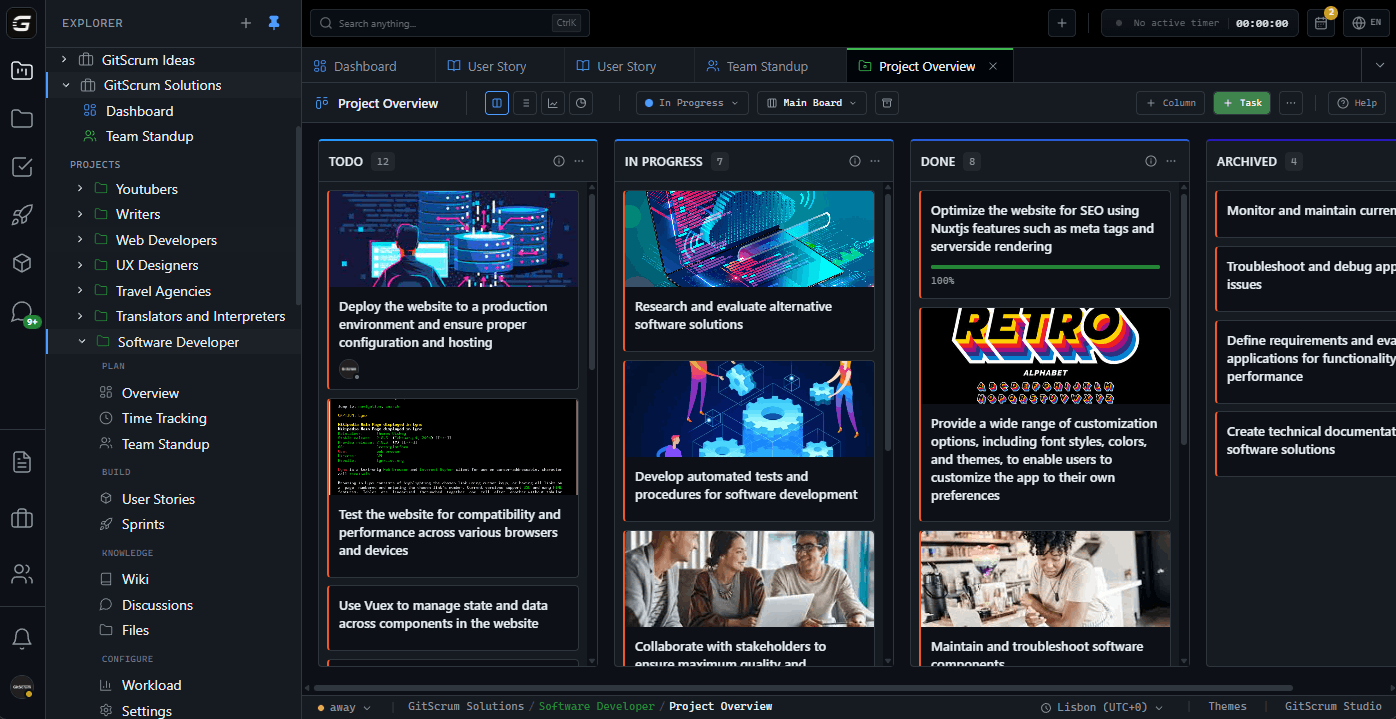
Total time: shorter. Auto-Linked PRs GitScrum integration: - Branch: gs-123-user-authentication - PR created: auto-links to task 123 - Task shows PR status - PR shows task context Reviewer sees: - Feature description - Acceptance criteria - Design decisions - Related tasks No tab switching.
Full context in review. Review Wait Time Visibility Dashboard shows: - PRs waiting for review - Wait time (color coded) - Who's blocking whom - Review load per person Alert triggers: - PR waiting > 24 hours: Yellow alert - PR waiting > 48 hours: Red alert - Team member blocked: Notify blocker Visibility creates accountability.
Reviewer Assignment Smart assignment: - Round-robin for distribution - Code owner for critical paths - Expertise matching for complex PRs - Load balancing when queue grows Avoid: - Always same reviewer - Author picks reviewer (bias) - No reviewer assigned (limbo) Rotation builds team knowledge. Balance prevents bottleneck.
Review SLA Service Level Agreement: - Small PR (<100 lines): 4 hours - Medium PR (100-400 lines): 24 hours - Large PR (400+ lines): 48 hours Track SLA hit rate: - >90%: Healthy - 70-90%: Needs attention - <70%: Process broken Make SLA visible. Team owns it collectively.
Async Review Culture Code review is async work: - Don't interrupt developer mid-flow - Batch review sessions (1-2x daily) - Use PR comments, not Slack - Resolve conversations in PR Review blocks: - Morning: 30 min review time - After lunch: 30 min review time - Builds habit - Predictable Sync only for: - Complex architecture discussions - Repeated misunderstanding - Teaching moments PR Description Template Good PR description: What [One sentence summary] Why [Link to task, business context] How [Technical approach taken] Testing [How to verify this works] Screenshots [If UI changes] Good description = fast review. Reviewer understands without asking.
Review Comments Comment types: - Blocker: Must fix before merge - Suggestion: Consider this improvement - Question: Need clarification - Praise: Good approach (positive reinforcement) Labeling matters: - 'nit: rename variable' vs 'Must rename variable' - Clear priority = fast iteration Constructive tone: - 'Why this approach?' vs 'This is wrong' - Curiosity over judgment - Alternative suggestion with explanation Self-Review First Before requesting review: - Review own PR first - Check diff yourself - Catch obvious issues - Add comments explaining decisions Self-review catches: - Debug statements left behind - TODO comments - Formatting issues - Incomplete changes 5 minutes self-review saves reviewer 20 minutes. Review Checklist Consistent review standards: - [ ] Code works (tests pass) - [ ] Code is readable - [ ] No obvious bugs - [ ] Security considered - [ ] Performance adequate - [ ] Documentation updated Checklist prevents: - Different standards per reviewer - Inconsistent quality - Missed issues Not every PR needs deep review.
Checklist defines minimum bar. Task Status Integration Automatic status updates: - PR created: Task to 'In Review' - PR approved: Task to 'Ready to Merge' - PR merged: Task to 'Done' No manual updates.
Status always accurate. Project view reflects reality.
Metrics Review metrics: - Wait time (PR created to first review) - Review cycle time (first review to approval) - Review iterations (back-and-forth count) - Review load distribution Healthy metrics: - Wait time < 24 hours - Cycle time < 2 days - Iterations < 3 - Even distribution Track trends. Catch problems early.
Review Pairing For complex PRs: - Schedule 30-min sync - Author walks through code - Reviewer asks questions live - Faster than async for complexity When to pair: - Architecture changes - New patterns introduced - Onboarding new reviewer - After 2+ review iterations Pairing is investment. Use selectively.
Blocked Developers When blocked on review: - Start next task (if independent) - Offer to review others (build karma) - Escalate if critical path - Don't just wait When blocking others: - Review before starting new work - Communicate delays - Hand off if unavailable - Ownership of queue Block visibility: - Dashboard shows who blocks whom - Alert when blocking critical path - Team sees impact Getting Started 1. Connect GitHub to GitScrum 2.
Use branch naming: gs-[task-id]-description 3. PRs auto-link to tasks 4.
Monitor review dashboard 5. Set wait time alerts (24h, 48h) 6.
Track review metrics weekly 7. Adjust process based on data Code review that flows.
Quality without bottleneck. $8.90/user/month.
The GitScrum Advantage
One unified platform to eliminate context switching and recover productive hours.