The Big Three Comparison: Jira vs Monday vs Asana Every team comparing PM tools ends up looking at these three.
Here's what they actually are: Jira: Enterprise-Grade Complexity Built by Atlassian for large engineering organizations with: - Complex workflow requirements - Multiple teams needing coordination - Compliance and audit requirements - Dedicated admin resources Strengths: - Powerful customization - Deep integration ecosystem - Comprehensive for large orgs - Strong enterprise features Weaknesses: - Steep learning curve - Requires dedicated admin - Configuration-heavy - Slow for small teams - Expensive for what small teams need Best for: Large engineering orgs with dedicated tool administrators Not for: Small-medium dev teams wanting to ship code Monday.com: Marketing-First Visual Built as a visual work management tool for: - Marketing teams - Creative agencies - Non-technical project management - Visual-heavy workflows Strengths: - Beautiful visual interface - Easy for non-technical users - Good marketing features - Lots of templates Weaknesses: - Weak GitHub integration - Not built for development workflows - Limited sprint functionality - Premium pricing for dev features - Minimum seat requirements Best for: Marketing teams, creative agencies Not for: Development teams working with GitHub Asana: General Purpose Middle Ground Built for general team collaboration: - Cross-functional teams - Goal tracking - Multiple work styles - Project portfolio management Strengths: - Flexible for various use cases - Good task management - Portfolio features - Decent reporting Weaknesses: - GitHub integration is basic - Sprint features limited - Time tracking requires add-ons - Enterprise features at premium pricing - Feature bloat for simple needs Best for: Cross-functional teams, non-technical work Not for: Dev-first teams needing code integration Head-to-Head Comparison: | Feature | Jira | Monday | Asana | GitScrum | |---------|------|--------|-------|----------| | Target User | Enterprise Eng | Marketing | General Teams | Dev Teams | | GitHub Integration | Good (complex) | Basic | Basic | Native | | Sprint Planning | Full | Basic | Limited | Full | | Time Tracking | Add-on | Add-on | Add-on | Included | | Complexity | High | Medium | Medium | Low | | Setup Time | Days-Weeks | Hours | Hours | Minutes | | Admin Required | Yes | Partially | Partially | No | Pricing Comparison (10-person team): | Tool | Monthly Cost | Annual Commitment | Hidden Costs | |------|--------------|-------------------|---------------| | Jira | $100-150 | Often required | Admin time, training | | Monday | $150-300 | Required for discount | Minimum seats, integrations | | Asana | $150-280 | Required for discount | Feature tiers, add-ons | | GitScrum | $71.20 | Never required | None | GitScrum: 8 paid users x $8.90 = $71.20/month (2 free) For Development Teams Specifically: What dev teams need: 1. GitHub/GitLab integration that actually works 2.
Sprint planning that doesn't require training 3. Time tracking without separate tools 4.
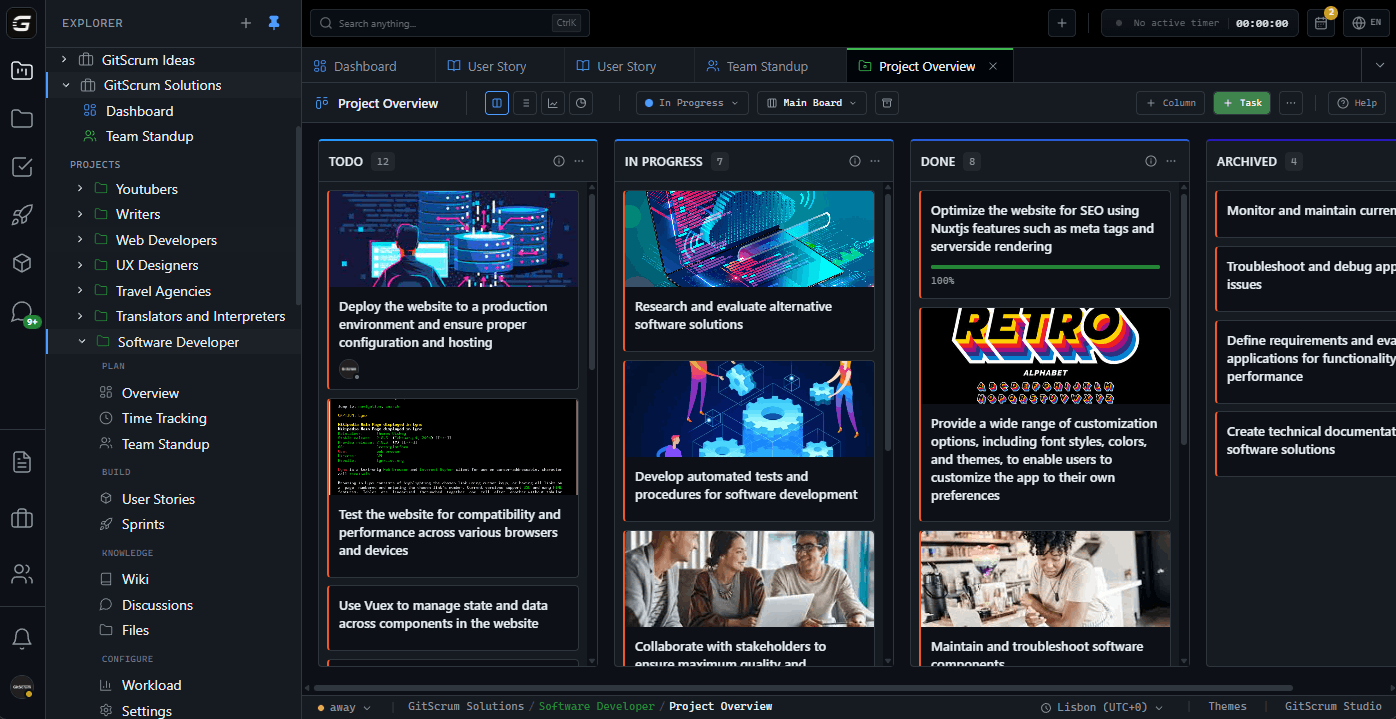
Simple boards for kanban workflows 5. Affordable pricing that scales How each tool delivers: | Need | Jira | Monday | Asana | GitScrum | |------|------|--------|-------|----------| | GitHub Integration | Complex but deep | Surface-level | Basic webhooks | Native bi-directional | | Sprint Planning | Overkill | Minimal | Limited | Right-sized | | Time Tracking | Tempo (extra) | Extra tier | Integration | Built-in | | Board Simplicity | Configurable chaos | Pretty but shallow | General purpose | Dev-focused | | Pricing (10 users) | $100-150/mo | $150-300/mo | $150-280/mo | $71.20/mo | Why Teams Switch from Each: From Jira: - "Too complex for our 8-person team" - "Spent more time configuring than coding" - "Needed a full-time admin we couldn't afford" - "Developers avoided using it" From Monday: - "GitHub integration was superficial" - "Built for marketers, not developers" - "Sprints felt bolted on" - "Couldn't justify the cost for dev features" From Asana: - "Time tracking required separate tool" - "Sprint features were an afterthought" - "Code visibility was non-existent" - "Paying for features we never used" The Fourth Option: Built for Developers Instead of choosing between tools built for other audiences: GitScrum was built specifically for development teams: - GitHub-first architecture - Sprint planning designed for dev workflows - Time tracking built-in - Simple boards that devs actually use - Pricing that respects small team budgets Migration Paths: From Jira to GitScrum: - Week 1: Set up GitScrum, import basic structure - Week 2: Connect GitHub, configure boards - Week 3: Migrate active projects - Week 4: Full transition Complexity reduction: 90% Cost reduction: 30-50% From Monday to GitScrum: - Week 1: Set up GitScrum, connect GitHub - Week 2: Recreate project structure - Week 3: Migrate active work - Week 4: Full transition GitHub integration improvement: 10x Cost reduction: 50-70% From Asana to GitScrum: - Week 1: Set up GitScrum - Week 2: Import projects and tasks - Week 3: Configure sprints and time tracking - Week 4: Full transition Dev feature improvement: Significant Cost reduction: 50-75% Bottom Line: Jira: Enterprise tool for enterprise teams with enterprise budgets Monday: Marketing tool marketed as everything Asana: General tool trying to be everything GitScrum: Developer tool built for developers $8.90/user/month.
2 users free forever. GitHub-native.
Skip the comparison and use the tool built for how you work.
The GitScrum Advantage
One unified platform to eliminate context switching and recover productive hours.