VS Code

GitScrum for VS Code, Google Antigravity, Cursor and Windsurf!

GitScrum logo
Solution

Data Silos Delay Delivery 2026 | Tool-Trapped Info

Spec approved 3 days ago—engineering never saw. Blocker in GitHub—PM checking Jira doesn't know. Critical info trapped in wrong tools delays delivery. Free trial.

Data Silos Delay Delivery 2026 | Tool-Trapped Info

Data silos become delivery blockers when information needed for the next step is trapped in a tool that the next person doesn't check.

Approvals languish unseen. Blockers go unaddressed.

Dependencies complete without downstream notification. Each tool boundary creates a communication gap where project progress falls through.

The aggregate effect: weeks of delays across a project from dozens of small silo-created gaps.

The GitScrum Advantage

One unified platform to eliminate context switching and recover productive hours.

01

problem.identify()

The Problem

Approvals trapped in tools others don't check

Blockers flagged where decision-makers don't look

Dependencies completed without downstream notice

Tool boundaries create communication gaps

Small silo gaps aggregate to major delays

02

solution.implement()

The Solution

Critical updates surface everywhere needed

Blockers visible to all stakeholders

Dependencies trigger automatic notifications

No tool boundary creates communication gap

Delivery timeline protected from silo delays

03

How It Works

1

Blocker Surfacing

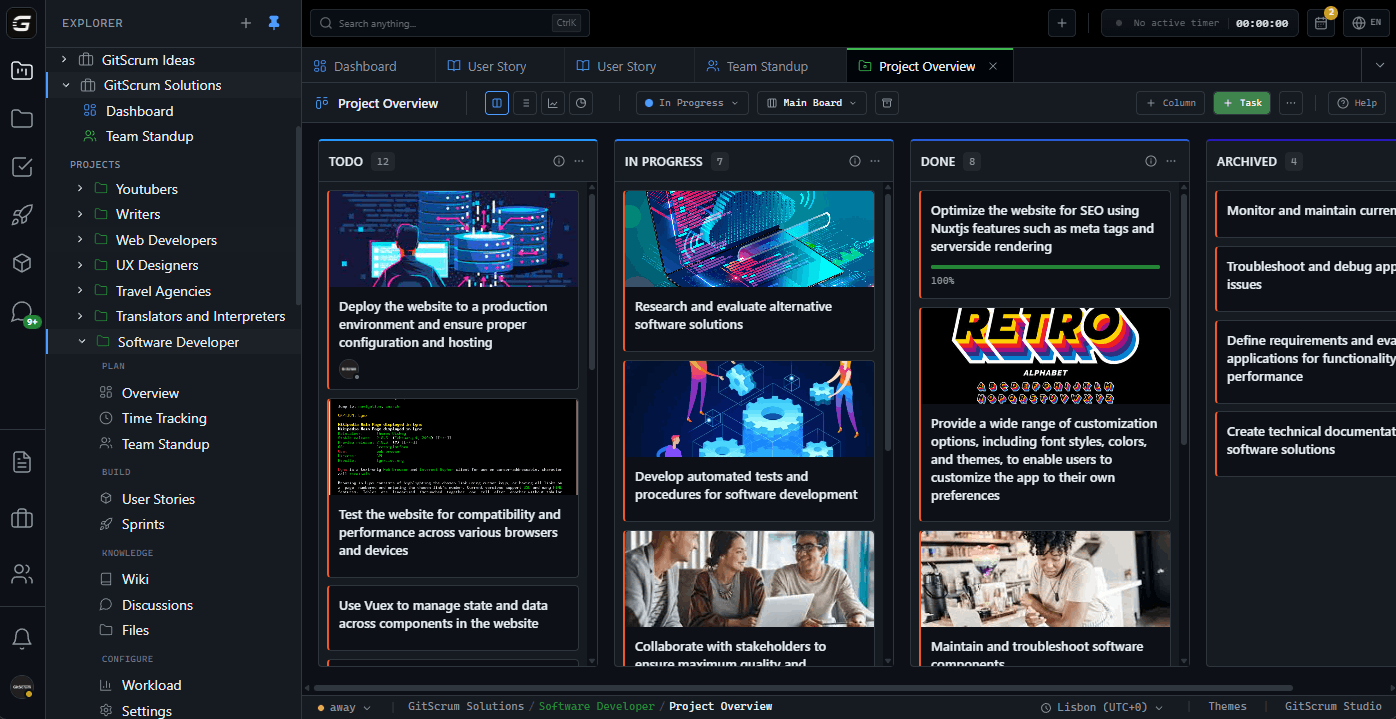
Blockers can't hide: 'Mark a task blocked in GitScrum → immediately visible on: Project dashboard (Blocked count increases). Sprint board (task shows blocked status). Team notifications (configurable alert). Manager views (risk indicators update). The blocker doesn't stay in one place—it surfaces everywhere stakeholders look.'

2

Dependency Notifications

Downstream teams know instantly: 'Task A completes → Task B (dependent) automatically notifies assigned team member: 'Your blocker is resolved, ready to continue.' No waiting for someone to remember to tell you. No checking multiple tools for dependency status. The system handles the hand-off.'

3

Approval Workflows

Approvals route to the right people: 'Design ready for review? GitScrum notifies reviewer, creates approval task, sets deadline. Three days waiting? Escalation notification. Approval granted? Engineering automatically notified, task unblocked, work continues. The approval process has no gaps where requests get lost.'

4

Delivery Timeline Impact

Show how silos affect delivery: 'When a blocker sits too long, GitScrum shows timeline impact: 'AUTH-45 blocked 3 days: Milestone X now at risk, delivery may slip 2 days.' Visible consequences motivate action. Data silos that would quietly delay delivery become urgent, visible priorities.'

04

Why GitScrum

GitScrum addresses Data Silos Causing Delayed Project Delivery through Kanban boards with WIP limits, sprint planning, and workflow visualization

Problem resolution based on Kanban Method (David Anderson) for flow optimization and Scrum Guide (Schwaber and Sutherland) for iterative improvement

Capabilities

  • Kanban boards with WIP limits to prevent overload
  • Sprint planning with burndown charts for predictable delivery
  • Workload views for capacity management
  • Wiki for process documentation
  • Discussions for async collaboration
  • Reports for bottleneck identification

Industry Practices

Kanban MethodScrum FrameworkFlow OptimizationContinuous Improvement

Frequently Asked Questions

Still have questions? Contact us at customer.service@gitscrum.com

How do you measure delivery delay caused by data silos?

GitScrum tracks: Time-to-awareness (how long until the right person knew about a state change). Time-to-action (how long from awareness to response). Aggregate these across tool boundaries vs within-platform. The difference quantifies silo-caused delay. Before/after metrics show impact of consolidation.

What if stakeholders still prefer their own tools?

GitScrum pushes critical information to them. PM stays in Monday.com? Critical blockers still notify them via configured integration. The goal is eliminating delivery-impacting gaps, not forcing tool abandonment. Over time, central visibility often motivates voluntary consolidation.

How do you prevent notification fatigue from over-surfacing?

Intelligent escalation. Day 1 blocker: Team notification. Day 3: Manager notification. Day 5: Executive escalation. Routine status changes don't spam everyone—only delivery-impacting events surface broadly. Configuration controls thresholds and audiences.

Can you show historical silo impact for justifying tool consolidation?

Yes. GitScrum reports: 'Q3 had 47 blocker delays averaging 2.3 days each, caused by information trapped in external tools. Estimated impact: 108 developer-days, 3 milestone slips.' Data for making the case to leadership for tool consolidation.

Ready to solve this?

Start free, no credit card required. Cancel anytime.

Works with your favorite tools

Connect GitScrum with the tools your team already uses. Native integrations with Git providers and communication platforms.

GitHubGitHub
GitLabGitLab
BitbucketBitbucket
SlackSlack
Microsoft TeamsTeams
DiscordDiscord
ZapierZapier
PabblyPabbly

Connect with 3,000+ apps via Zapier & Pabbly