What Dev Teams Actually Need vs.
What PM Tools Sell Generic PM tools are built for everyone—which means they're optimized for no one. Development teams end up paying for: - Marketing campaign management (never used) - Creative asset approval workflows (never used) - CRM integrations (never used) - HR onboarding modules (never used) - Sales pipeline features (never used) - Document proofing tools (never used) Meanwhile, what dev teams actually need often comes as premium add-ons: - GitHub/GitLab integration (sometimes extra) - Time tracking at task level (often premium) - Sprint velocity tracking (sometimes limited) - API access for automation (typically enterprise tier) Pricing Breakdown: What Dev Teams Pay For a typical 8-person development team: | Tool | Monthly Cost | Dev-Specific Features | Hidden Costs | |------|--------------|----------------------|---------------| | Jira | $64-100 | Strong (but complex) | Admin overhead | | Monday | $96-120 | Weak (marketing focus) | Integrations extra | | Asana | $88-132 | Medium | GitHub integration limited | | ClickUp | $48-96 | Medium | Feature overload | | Azure DevOps | $48+ | Strong | Microsoft ecosystem lock-in | | GitScrum | $53.40 | Built for this | None | GitScrum calculation: 6 paid users x $8.90 = $53.40/month (2 free) Annual Cost Comparison: - Jira: $768-1,200/year - Monday: $1,152-1,440/year - Asana: $1,056-1,584/year - ClickUp: $576-1,152/year - GitScrum: $640.80/year GitScrum saves $128-$943/year vs alternatives.
What Development Teams Actually Need: 1. Task Management That Connects to Code - Link tasks to branches - Link tasks to pull requests - Link tasks to commits - Auto-update task status from GitHub activity - See code context without leaving PM tool 2.
Sprint Planning - Create sprints with start/end dates - Add tasks to sprints - Track committed vs. completed work - Simple velocity metrics - Retrospective data when needed 3.
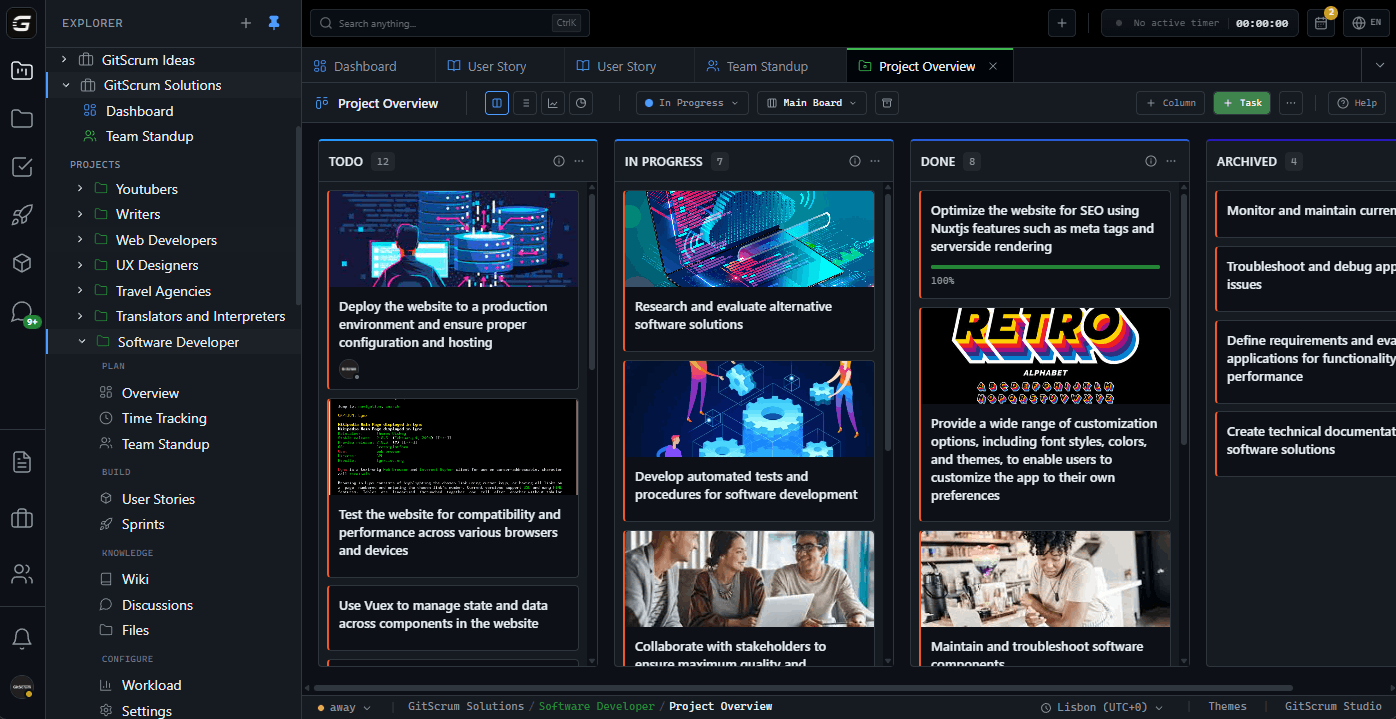
Time Tracking (For Billing or Analysis) - Track time at task level - Aggregate by project, sprint, or user - Export for client invoices - No separate time tracking tool needed 4. Simple Boards - Kanban view of work in progress - Customizable columns (To Do, In Progress, Review, Done) - WIP limits to prevent bottlenecks - Quick task creation and movement 5.
Team Collaboration - Discussions on tasks - mentions for notifications - File attachments when needed - No complex comment threading or proofing 6. Basic Reporting - What's done this sprint - Who's working on what - Blocked items - Time spent (if tracking) What Development Teams DON'T Need (But Pay For): - Gantt charts (waterfall methodology) - Resource planning across departments - Creative asset versioning - Marketing calendar views - CRM sync - Document approval workflows - Sales forecasting integration - HR onboarding checklists - Portfolio management dashboards - Custom branding and white-labeling These features increase tool complexity and price.
Dev teams subsidize them for other departments. Pricing Models Explained: Per-User Monthly: - Jira: $8-10/user (varies by tier) - Monday: $12-20/user (minimum 3 users) - Asana: $11-27.99/user - ClickUp: $7-12/user - GitScrum: $8.90/user (2 free) Hidden Costs: 1.
Minimum Seat Requirements - Monday.com requires minimum 3 seats - Some tools have 5-seat minimums - GitScrum: No minimum (start with 2 free) 2. Feature Tier Jumps - Basic features at low tier - GitHub integration requires mid-tier - Time tracking requires higher tier - API access requires enterprise - GitScrum: All features included, single price 3.
Integration Costs - GitHub integration: Sometimes extra - Slack integration: Sometimes extra - API calls: Sometimes metered - GitScrum: All integrations included 4. Admin Overhead - Complex tools need administrators - Administrator time = cost - Training time for new team members - GitScrum: Self-explanatory interface, minimal admin True Cost Calculation: For an 8-person dev team over 1 year: | Category | Jira | Monday | GitScrum | |----------|------|--------|----------| | License | $960 | $1,152 | $640.80 | | Admin time (hours) | 50 | 30 | 5 | | Training time (hours) | 40 | 20 | 4 | | Integration setup | 20 | 15 | 2 | | @ $50/hour | $5,500 | $3,250 | $550 | | TRUE COST | $6,460 | $4,402 | $1,190.80 | GitScrum true cost is 18-27% of alternatives.
Scaling Costs: As your team grows: | Team Size | GitScrum Monthly | Jira Monthly | Monday Monthly | |-----------|------------------|--------------|----------------| | 5 | $26.70 | $40-50 | $60-100 | | 10 | $71.20 | $80-100 | $120-200 | | 20 | $160.20 | $160-200 | $240-400 | | 50 | $427.20 | $400-500 | $600-1,000 | GitScrum linear pricing: No tier jumps, no enterprise negotiations. The Value Equation: Development teams should pay for: - GitHub integration (critical) - Task management (essential) - Sprint planning (methodology) - Time tracking (billing/analysis) - Team collaboration (coordination) Development teams shouldn't pay for: - Features for other departments - Enterprise compliance they don't need - Custom branding they won't use - Portfolio management they won't implement GitScrum pricing reflects dev team reality: $8.90/user/month for exactly what you need.
2 users free forever. No bundled features you won't use.
The GitScrum Advantage
One unified platform to eliminate context switching and recover productive hours.