
Frontend Work Is Different Frontend development reality: ├─ Design handoff from Figma ├─ Component states (hover, focus, error, loading) ├─ Responsive breakpoints (mobile, tablet, desktop) ├─ Animation specifications ├─ Accessibility requirements ├─ Cross-browser testing ├─ Design feedback loops ├─ Then: Design changes One 'simple' component = many subtasks.
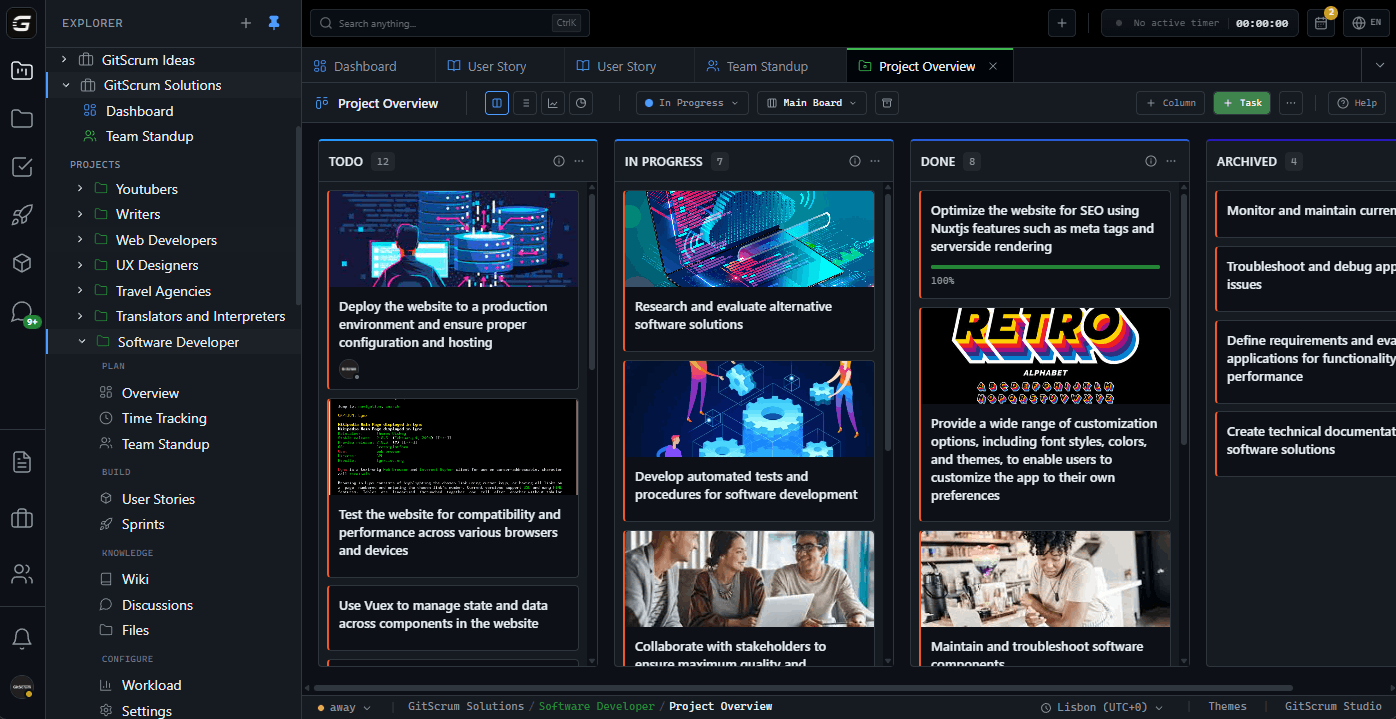
Why Generic PM Fails Frontend Jira for frontend: ├─ One ticket = 'Build button component' ├─ But button has: │ ├─ 5 visual states │ ├─ 3 breakpoints │ ├─ Loading animation │ ├─ A11y requirements │ └─ Storybook documentation ├─ All invisible in ticket ├─ 'Done' means nothing Result: Frontend always 'almost done' but actually 60% complete. GitScrum for Frontend Teams Component-based tracking: ├─ Task per component ├─ Checklist for states/breakpoints ├─ Figma link attached ├─ Git commits show progress ├─ Design changes = task update ├─ Storybook link when done Actual progress visible.
Design-to-Code Workflow Typical flow: ├─ Designer: 'Here's the Figma link' ├─ Developer: Creates component task ├─ Subtasks: states, breakpoints, a11y ├─ Code commits link to task ├─ Designer reviews in Storybook ├─ Feedback goes in task comments ├─ Iterate until approved ├─ Done = merged + documented GitScrum tracks this flow: ├─ Figma link in task ├─ Git commits auto-link ├─ Comments for feedback ├─ Checklist for completion criteria ├─ No separate design tool needed Component State Tracking Button component states: ├─ Default ├─ Hover ├─ Focus ├─ Active/Pressed ├─ Disabled ├─ Loading ├─ Error (if applicable) In GitScrum: ├─ Checklist in task description ├─ [x] Default state ├─ [x] Hover state ├─ [ ] Focus state (in progress) ├─ [ ] Loading state ├─ Clear completion visibility 'How done is the button?' '4 of 7 states done.' Responsive Breakpoints Breakpoint tracking: ├─ Mobile (< 640px) ├─ Tablet (640-1024px) ├─ Desktop (> 1024px) ├─ Optional: Large desktop, Watch In GitScrum: ├─ Checklist per breakpoint ├─ Screenshots attached per breakpoint ├─ Designer reviews each ├─ One task, all breakpoints visible No more 'looks good on desktop' but broken on mobile. Design Change Management Design change mid-sprint: ├─ Figma updated ├─ Task updated with change note ├─ Subtasks added/modified ├─ Time estimate adjusted ├─ Stakeholder notified via comment ├─ Sprint scope visible Transparent impact: ├─ 'This design change adds 2 days' ├─ Visible in task history ├─ Sprint burndown reflects reality ├─ No surprise delays Accessibility Tracking A11y requirements: ├─ Keyboard navigation ├─ Screen reader support ├─ Color contrast (WCAG AA/AAA) ├─ Focus indicators ├─ ARIA labels ├─ Reduced motion support In GitScrum: ├─ A11y checklist per component ├─ Links to a11y specs in wiki ├─ QA task for a11y testing ├─ Not an afterthought Accessibility built in, not bolted on.
Design System Components Design system tracking: ├─ Button (primary, secondary, tertiary) ├─ Input (text, email, password, error) ├─ Modal (small, medium, large) ├─ Card (basic, featured, interactive) ├─ ... (50+ components) GitScrum approach: ├─ One task per component ├─ Labels for component type ├─ Sprint per design system release ├─ Storybook link = done ├─ Wiki documents patterns Design system progress visible.
Figma Integration Workflow Figma + GitScrum: ├─ Figma link in task description ├─ Comments reference specific frames ├─ Design changes noted in task ├─ No Figma plugin needed ├─ Links work for anyone Simple workflow: ├─ Designer: Posts Figma link in task ├─ Developer: Builds from spec ├─ Reviewer: Compares Figma to Storybook ├─ Feedback: Task comments ├─ Done: Links to both in task Cross-Browser Testing Browser support: ├─ Chrome (latest 2) ├─ Firefox (latest 2) ├─ Safari (latest 2) ├─ Edge (latest 2) ├─ Maybe: IE11 😱 Tracking approach: ├─ Browser checklist in task ├─ QA tasks for browser testing ├─ Bug tasks linked to component ├─ 'Done' means tested everywhere Component Library Progress Storybook-driven development: ├─ Component documented in Storybook ├─ All states visible ├─ All breakpoints viewable ├─ A11y tests passing ├─ = Component 'Done' GitScrum links: ├─ Task → Storybook URL ├─ Storybook = source of truth ├─ QA reviews in Storybook ├─ Design signs off in Storybook Frontend + Backend Coordination Frontend waiting on API: ├─ Component ready for integration ├─ API not done yet ├─ Blocked dependency visible ├─ Both teams see same board GitScrum approach: ├─ Frontend task: 'Build UserCard' ├─ Backend task: 'GET /users API' ├─ Dependency linked ├─ Blocker visible on board ├─ No surprise when integrating Pricing for Frontend Teams Solo frontend dev: $0 (free) 2-person team: $0 (free) 5-person team: $26.70/month 8-person team: $53.40/month 15-person team: $115.70/month $8.90/user/month. 2 users free forever.
All features included: ├─ Git integration ├─ Checklists (states/breakpoints) ├─ Attachments (Figma links) ├─ Wiki (design system docs) Compared to Design Tools Figma project tracking: ├─ Great for design, not for code ├─ No Git integration ├─ Not built for dev workflow Zeplin: ├─ Handoff tool, not PM ├─ No task tracking ├─ Another tool to maintain Jira: ├─ Generic, not component-aware ├─ Heavy for frontend teams ├─ Visual work invisible GitScrum: ├─ Git-native (code-first) ├─ Component checklists ├─ Figma links supported ├─ Lightweight for velocity Real Frontend Experience 'Every PM tool we tried ignored frontend reality. Components have states.
Responsive has breakpoints. Design changes mid-sprint.
GitScrum lets us track component completion properly - with checklists for every state and breakpoint. When someone asks "how done is the modal?", I can say "6 of 8 states, mobile done, tablet in progress".
That precision changed everything.' - Lead Frontend Engineer Daily Workflow Morning: ├─ Check board: What's in progress? ├─ Any design updates in tasks?
├─ Blockers on backend? ├─ 5 minutes, start coding During work: ├─ Commit updates task ├─ Check off completed states ├─ Add screenshots for review ├─ Note questions in comments Code review: ├─ PR links to task ├─ Reviewer sees component scope ├─ Storybook URL in task ├─ Design sign-off tracked Sprint Planning for Frontend Estimating components: ├─ Simple component (2-3 states): Small ├─ Medium component (5+ states): Medium ├─ Complex component (many states, animations): Large ├─ + Responsive multiplier ├─ + A11y multiplier GitScrum sprint: ├─ Points based on component complexity ├─ Velocity includes design change buffer ├─ Burndown reflects frontend reality ├─ Not forced into backend sprint model Start Free Today 1.
Sign up (30 seconds) 2. Connect frontend repo 3.
Create component tasks with checklists 4. Ship components, not status updates Frontend-aware project management.
The GitScrum Advantage
One unified platform to eliminate context switching and recover productive hours.