The Issue Tracking Problem Most issue tracking focuses on: - Creating the issue - Assigning it - Marking it resolved But this misses the most important part: HOW was it fixed?
Typical issue tracking workflow: 1. Issue Created 'Login button not working on mobile' Assigned to: Sarah Status: Open 2.
Issue Updated Status: In Progress (no details on what's being done) 3. Issue Resolved Status: Closed Comment: 'Fixed' What's missing: - What code was changed?
- Which commit? - Which files?
- Was it tested? - Can we roll it back?
- Who approved the fix? This is the traceability gap.
Why Traceability Matters Scenario 1: Issue Reappears Bug was 'fixed' 3 months ago. Now it's back.
With disconnected tracking: - Find old issue - Read 'Fixed' comment - No idea what was changed - Developer who fixed it left - Start from scratch With GitScrum: - Find old issue - See linked commits - See exactly what files changed - See the code diff - Understand the original fix - Debug from there Time saved: hours or days. Scenario 2: Audit/Compliance 'Show me every change made for this security issue.' With disconnected tracking: - Issue says 'Fixed' - No link to code - Search Git history manually - Hope commit messages are descriptive - Hope you find everything With GitScrum: - Open issue - See all linked commits - See all linked PRs - See who approved - See when merged - Export complete audit trail Compliance satisfied.
Scenario 3: Root Cause Analysis 'Why did the production outage happen?' With disconnected tracking: - Find issue created during outage - 'Database timeout' - What change caused it? - Check deployment logs - Check Git history - Try to correlate timestamps - Maybe find the cause With GitScrum: - Find issue - See linked commits - One commit from yesterday - 'Add new database query for reports' - Found the culprit Time to root cause: minutes instead of hours.
GitScrum Issue Tracking Core Principle: Every issue connects to code. Issue Lifecycle with Git: 1.
Issue Created - Title: 'Login button not working on mobile' - Type: Bug - Priority: High - Reported by: Customer Success - Environment: iOS Safari 2. Issue Assigned - Assigned to: Sarah - Sprint: Sprint 23 - Story Points: 2 3.
Branch Created - Sarah creates branch: fix/456-mobile-login - GitScrum auto-links branch to issue - Issue status: In Progress (auto) 4. Work Happens - Commit: 'Fix touch event handler 456' - Commit: 'Add mobile viewport check 456' - Each commit auto-links to issue - Visible on issue activity timeline 5.
PR Opened - PR: 'Fix mobile login button (456)' - GitScrum links PR to issue - Issue status: In Review (auto) 6. PR Reviewed - Reviewer approves - Comments visible - Approval recorded 7.
PR Merged - Code merged to main - Issue status: Done (auto) - Full trail recorded 8. Future Reference - Issue shows: - 2 commits linked - 1 PR linked - Files changed: login.vue, touch-handler.js - Merged by: Mike - Approved by: Lisa - Complete history Issue Types GitScrum supports structured issue types: Bug - Reproduction steps - Expected behavior - Actual behavior - Environment - Severity Feature Request - User story format - Acceptance criteria - Business value Task - Description - Subtasks - Dependencies Tech Debt - Current state - Desired state - Risk if not addressed Spike (Research) - Question to answer - Timebox - Outcome Each type has appropriate fields.
No one-size-fits-all. Issue Fields Core fields: - Title - Description (rich text) - Type - Priority (Critical, High, Medium, Low) - Status (configurable) - Assignee - Reporter - Sprint - Story Points - Due Date - Labels Bug-specific: - Reproduction Steps - Environment - Severity vs Priority - Affected Version - Fix Version Custom fields: - Create your own - Text, number, date, dropdown - Apply to specific types Issue Workflow Default workflow: Backlog → Ready → In Progress → In Review → QA → Done Customizable: - Add/remove states - Set transitions - Add conditions - Different per project Auto-transitions (Git-triggered): - Branch created → In Progress - PR opened → In Review - PR approved → Ready to Merge - PR merged → Done (or QA if needed) Manual option always available.
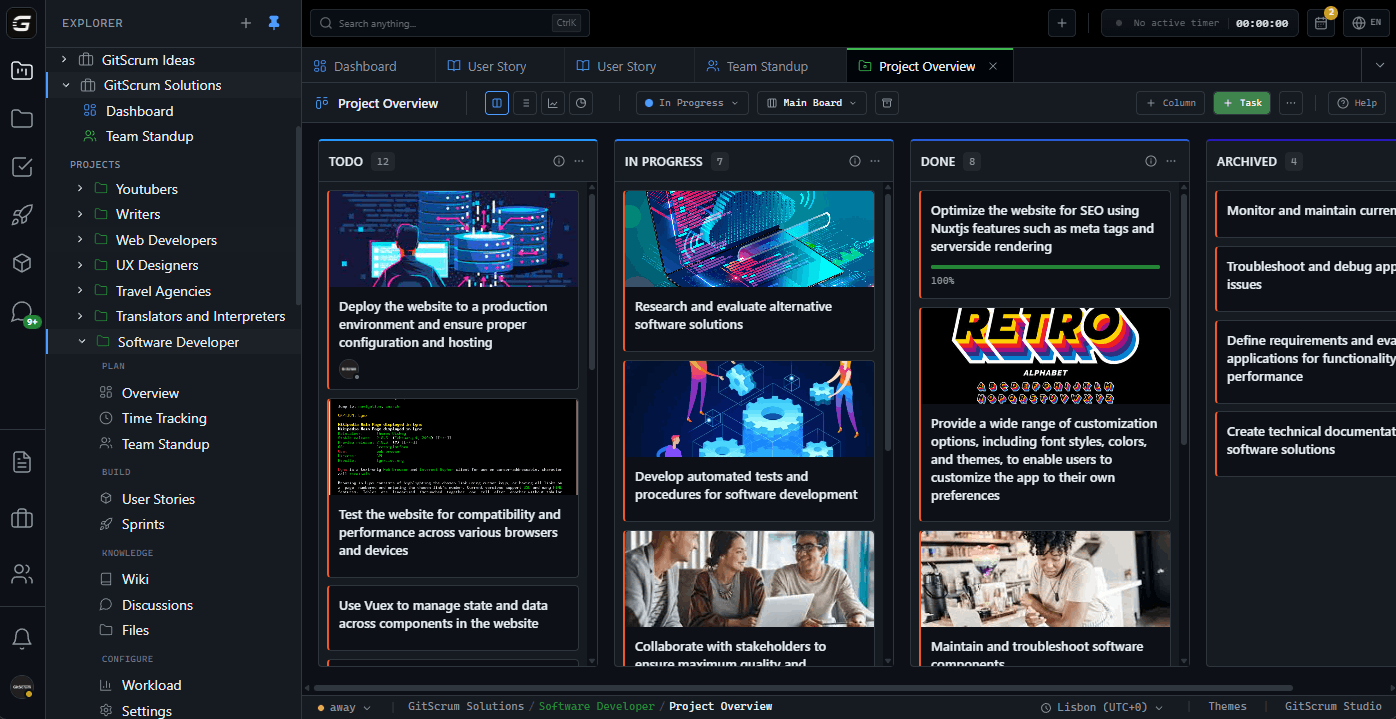
Issue Board Kanban-style board: - Columns = workflow states - Cards = issues - Drag to change status - Quick filters (type, assignee, sprint) - Swimlanes (by epic, assignee, or none) Card shows: - Title - Type icon - Priority indicator - Assignee avatar - Story points - Git activity indicator - Due date (if set) Click to expand: - Full description - Comments - Git activity - Time logged Issue Search and Filter Find issues fast: - Full-text search - Filter by any field - Save filter as view - Combine filters (AND/OR) Example filters: - 'My open bugs' - 'Critical issues this sprint' - 'Issues without commits' - 'Issues fixed last week' - 'Issues by customer report' Query builder for advanced filtering. Issue Reports Built-in reports: 1.
Issue Age Report - How long are issues open? - Which are stuck?
2. Resolution Time - Average time to close - By type, priority, assignee 3.
Created vs Resolved - Are we keeping up? - Trend over time 4.
Issue Distribution - By type, priority, assignee - Identify patterns 5. Sprint Report - Committed vs completed - Carryover issues Export to CSV for custom analysis.
Git Integration Details Linking Methods: 1. Task ID in commit message: 'Fix mobile login 456' 'Closes 456' 'Fixes GS-456' 2.
Task ID in branch name: 'fix/456-mobile-login' 'feature/GS-123-new-dashboard' 3. Task ID in PR title/body: 'Fix mobile login (456)' 4.
Manual link: - Copy commit SHA - Paste in issue All methods create bidirectional links. What Gets Captured: - Commit SHA - Commit message - Author - Timestamp - Files changed - PR number - PR status - PR reviewers - Merge status Click through to GitHub/GitLab for full diff.
Notifications Stay informed: - Issue assigned to me - Issue I'm watching updated - Mentioned in comment - Issue I reported resolved - Git activity on my issues Channels: - In-app notifications - Email (configurable) - Slack integration No spam. Only relevant updates.
Mobile Access Triage issues on the go: - View issue list - Update status - Add comments - See Git activity - Get notifications iOS and Android apps. Vs Jira Jira: ✓ Comprehensive issue tracking ✓ Highly customizable ✗ Complex configuration ✗ Slow interface ✗ Git integration requires plugins ✗ Expensive with needed add-ons GitScrum: ✓ Complete issue tracking ✓ Configurable workflows ✓ Simple setup ✓ Fast interface ✓ Native Git integration ✓ $8.90/user all-inclusive Vs GitHub Issues GitHub Issues: ✓ Close to code ✓ Free for public repos ✗ Basic project management ✗ No sprint support ✗ Limited reporting ✗ Single repo focus GitScrum: ✓ Connected to code ✓ Full project management ✓ Sprint support ✓ Comprehensive reports ✓ Multi-repo support ✓ $8.90/user (2 free) Vs Linear Linear: ✓ Fast, modern interface ✓ Developer-focused ✗ $10/user ✗ Limited Git integration ✗ GitHub only (for Git features) GitScrum: ✓ Fast interface ✓ Developer-focused ✓ $8.90/user ✓ Deep Git integration ✓ GitHub, GitLab, Bitbucket Vs Bugzilla/Mantis Bugzilla/Mantis: ✓ Free/open source ✓ Bug-focused ✗ Dated interface ✗ No Git integration ✗ Self-hosted burden GitScrum: ✓ Modern interface ✓ Multiple issue types ✓ Native Git integration ✓ Cloud hosted ✓ $8.90/user (2 free) Pricing 2 users: $0/month (free forever) 5 users: $26.70/month 10 users: $71.20/month 25 users: $178/month Includes: - All issue types - Custom workflows - Git integration - Reports - Mobile apps - API access - Unlimited issues - Unlimited projects No per-issue pricing.
No feature limits. Migration Coming from: Jira: - Import via CSV - Field mapping - Preserves history GitHub Issues: - Direct import - Maintains issue numbers CSV: - Standard import - Custom field mapping Most imports complete in minutes.
Getting Started 1. Sign up (30 seconds) 2.
Create project 3. Configure issue types (or use defaults) 4.
Connect Git repository 5. Create first issue 6.
Reference issue in commits 7. Watch the trail build $8.90/user/month.
2 users free forever. Issue tracking with complete code traceability.
The GitScrum Advantage
One unified platform to eliminate context switching and recover productive hours.