VS Code

GitScrum for VS Code, Google Antigravity, Cursor and Windsurf!

GitScrum logo
Solution

Tool Switching Cost 2026 | Mental Recovery Time Hidden

Devs switching 9-12 tools daily lose 2-3 hours to mental recalibration. Unified platforms eliminate cognitive overhead between activities. Free trial.

Tool Switching Cost 2026 | Mental Recovery Time Hidden

Mental recovery time is the hidden cost of fragmented tool environments.

Each time a developer switches from one tool to another, their brain must: recognize the new interface, recall the workflow patterns for that tool, adjust to different visual layouts and interaction models, and re-establish context for what they were doing in that tool. This mental recalibration takes time and energy, even for tools developers use daily.

The cognitive load compounds when tools have different UI conventions, keyboard shortcuts, navigation patterns, and mental models. Switching from Jira's project-centric view to Slack's conversation-centric view to VS Code's file-centric view requires three different mental orientations in quick succession.

For developers using 9-12 tools daily and switching between them dozens of times, the accumulated mental recovery time consumes 2-3 hours per day—time that is neither productive work nor genuine rest. GitScrum consolidates multiple work functions into a unified interface with consistent patterns.

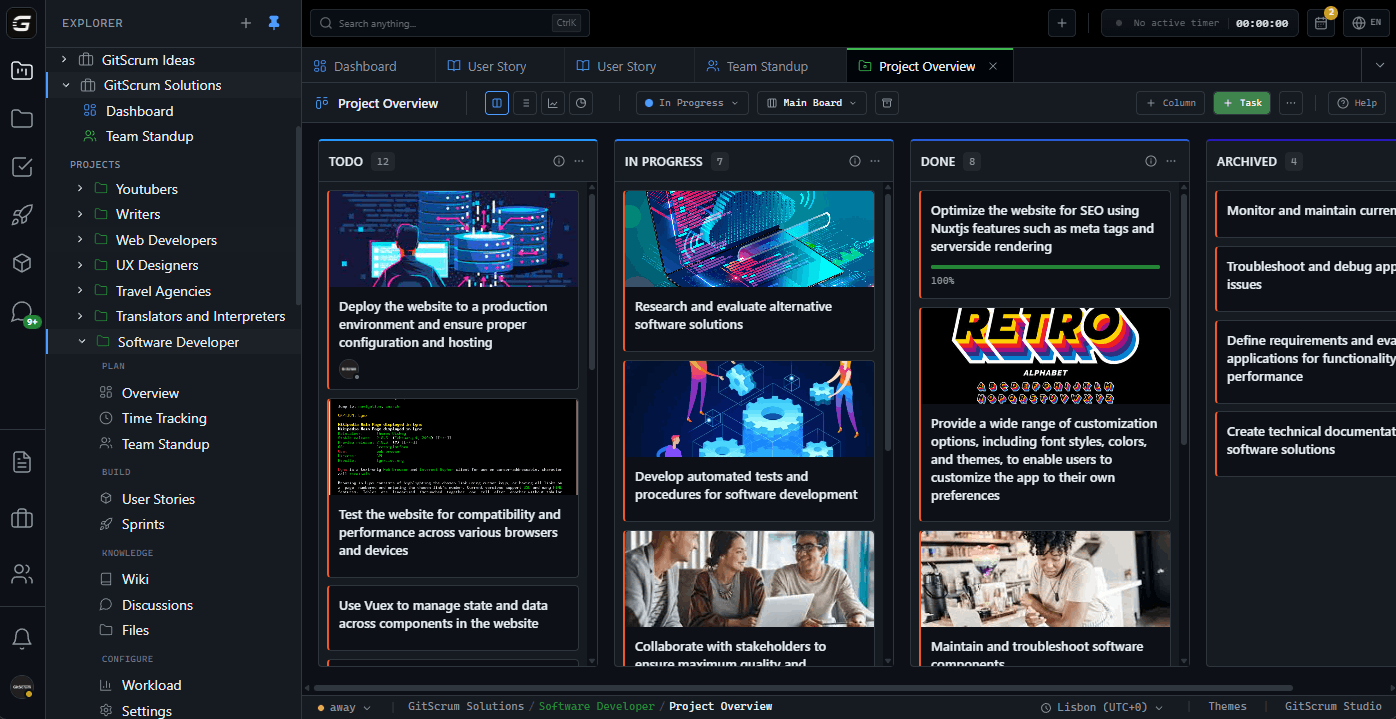
Task management, time tracking, discussions, and project visibility all use the same navigation, shortcuts, and visual language. This consistency dramatically reduces the mental recalibration required between activities, preserving cognitive energy for actual development work.

The GitScrum Advantage

One unified platform to eliminate context switching and recover productive hours.

01

problem.identify()

The Problem

Each tool switch requires mental recalibration to new interface and context

Different UI conventions, shortcuts, and navigation patterns across tools

2-3 hours daily consumed by accumulated mental recovery overhead

Cognitive energy drained by constant tool transitions

Time lost is neither productive work nor genuine rest

9-12 tools with different mental models create constant friction

02

solution.implement()

The Solution

Consolidate work functions into unified interface with consistent patterns

Reduce tools from 9-12 to minimal set with shared conventions

Consistent navigation, shortcuts, and visual language across activities

Eliminate mental recalibration between task, time, and discussion views

Preserve cognitive energy for actual development work

Single mental model for multiple work functions

03

How It Works

1

Unified Design System

All GitScrum modules share consistent visual patterns, navigation structure, and interaction models—learn once, apply everywhere

2

Consistent Keyboard Shortcuts

Same shortcuts work across task boards, time tracking, discussions, and dashboards. No need to remember different commands for each function

3

Seamless Context Flow

Moving between tasks, time logs, and discussions feels like navigating within one application, not switching between separate tools

4

Reduced Tool Count

Replace 4-6 specialized tools with one unified platform, dramatically cutting the number of interfaces your brain must track

04

Why GitScrum

GitScrum addresses Mental Recovery Time Lost to Constant Tool Switching through Kanban boards with WIP limits, sprint planning, and workflow visualization

Problem resolution based on Kanban Method (David Anderson) for flow optimization and Scrum Guide (Schwaber and Sutherland) for iterative improvement

Capabilities

  • Kanban boards with WIP limits to prevent overload
  • Sprint planning with burndown charts for predictable delivery
  • Workload views for capacity management
  • Wiki for process documentation
  • Discussions for async collaboration
  • Reports for bottleneck identification

Industry Practices

Kanban MethodScrum FrameworkFlow OptimizationContinuous Improvement

Frequently Asked Questions

Still have questions? Contact us at customer.service@gitscrum.com

What exactly is mental recovery time?

Mental recovery time is the cognitive overhead required when switching between tools. Each switch requires your brain to recognize the new interface, recall that tool's conventions and workflows, adjust to different visual layouts, and re-establish what you were doing in that context. This recalibration takes time and energy even for familiar tools.

How does tool consolidation reduce mental recovery time?

When multiple functions share a unified interface with consistent patterns, your brain does not need to recalibrate between them. Moving from task management to time tracking to discussions within a single platform feels like navigating one application, not switching between separate tools with different mental models.

Is mental recovery time the same as context switching cost?

They are related but distinct. Context switching cost includes the full 23-minute recovery time after an interruption, including rebuilding task-specific mental context. Mental recovery time specifically refers to the cognitive overhead of adapting to a different tool's interface and conventions. Both add up throughout the workday.

Ready to solve this?

Start free, no credit card required. Cancel anytime.

Works with your favorite tools

Connect GitScrum with the tools your team already uses. Native integrations with Git providers and communication platforms.

GitHubGitHub
GitLabGitLab
BitbucketBitbucket
SlackSlack
Microsoft TeamsTeams
DiscordDiscord
ZapierZapier
PabblyPabbly

Connect with 3,000+ apps via Zapier & Pabbly