The Mobile Development Challenge Mobile is unique: ├─ Two platforms (iOS + Android) ├─ Two app stores (different timelines) ├─ Review delays (1-7 days unpredictable) ├─ Version coordination (feature parity) ├─ Backend dependencies (API availability) ├─ Device fragmentation (Android) ├─ OS version support (both) Generic PM tools treat mobile like web.
It's not. The Multi-Platform Problem Scenario: Login redesign feature iOS team: ├─ Started: Monday ├─ Completed: Thursday ├─ Submitted: Friday ├─ Approved: Monday (3-day review) ├─ Released: Tuesday Android team: ├─ Started: Monday ├─ Blocked: Tuesday (API not ready) ├─ Unblocked: Wednesday ├─ Completed: Friday ├─ Submitted: Friday ├─ Approved: Saturday (1-day review) ├─ Released: Sunday In generic PM tool: ├─ One task: 'Login redesign' ├─ Status: ???
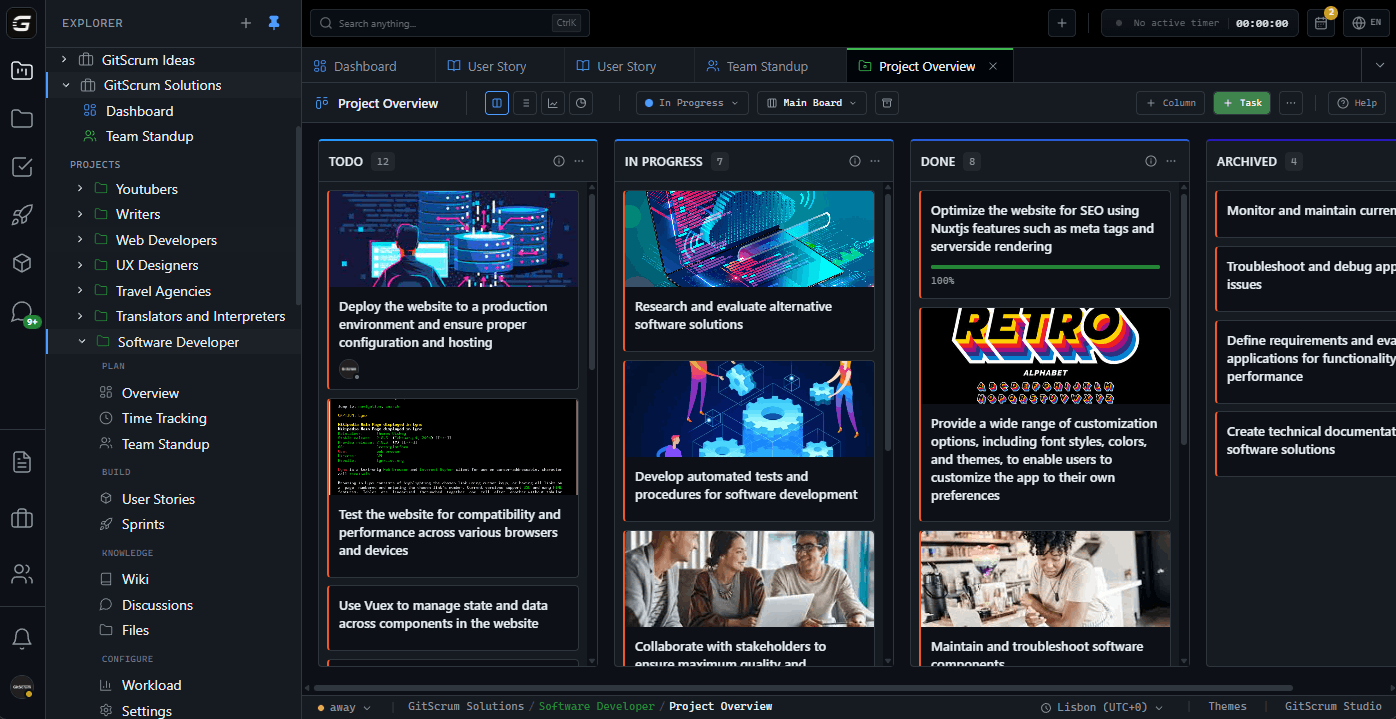
(done on one, not other) ├─ Progress: Unclear ├─ Blocking: Hidden In GitScrum: ├─ Task: 'Login redesign - iOS' ├─ Task: 'Login redesign - Android' ├─ Both linked (see relationship) ├─ Different status (accurate) ├─ Blocking visible (API dependency) ├─ Git activity shows exact progress App Store Review Workflow The unpredictable part: ├─ iOS review: 1-7 days (usually 1-2) ├─ Google review: 1-3 days (usually hours) ├─ Rejection: Back to development ├─ Resubmit: Timer resets GitScrum supports: ├─ 'In Review' status (waiting) ├─ 'Rejected' status (action needed) ├─ 'Approved' status (ready) ├─ 'Released' status (in store) Visibility without process overhead: Board shows what's waiting, what's rejected, what's live. No status meetings needed.
Release Train Coordination Mobile release trains: ├─ Weekly? Bi-weekly?
Monthly? ├─ Both platforms same day?
├─ Or staggered for safety? ├─ Marketing coordination?
├─ Support team readiness? GitScrum sprint planning: ├─ Sprint = Release train ├─ Features planned for both platforms ├─ Dependencies visible ├─ 'Done' = Both platforms released ├─ Carry-over visible Version Parity Tracking Common problem: 'iOS has feature X, Android doesn't yet.' 'When will Android catch up?' GitScrum approach: ├─ Label tasks by platform: iOS, Android ├─ Filter by platform: See gaps ├─ Parity tracking: What's missing?
├─ Priority: Backend by parity debt Not a complex system. Just labels and filters.
Backend Dependency Management Mobile reality: ├─ Feature needs backend API ├─ Backend team has different sprint ├─ API delayed = Mobile blocked ├─ No visibility = Frustration GitScrum approach: ├─ Backend API task created ├─ Mobile tasks blocked by it ├─ Status visible in board ├─ When API done → Mobile unblocks ├─ No hidden dependencies Git Integration for Mobile GitScrum works with: ├─ Swift/Objective-C (Xcode + GitHub/GitLab) ├─ Kotlin/Java (Android Studio + GitHub/GitLab) ├─ Flutter (Dart, single repo or split) ├─ React Native (JS/TS, usually single repo) ├─ Xamarin (C, single or split) Commit patterns GitScrum tracks: ├─ feature/login-ios → iOS task ├─ feature/login-android → Android task ├─ feature/login → Cross-platform task ├─ PRs linked to tasks automatically ├─ Merge = Done Cross-Platform Frameworks Flutter/React Native reality: ├─ Single codebase (mostly) ├─ Platform-specific code (sometimes) ├─ Platform-specific bugs (always) ├─ Build and deploy separately GitScrum approach: ├─ Task: 'Login feature' (shared code) ├─ Sub-task: 'iOS-specific fix' ├─ Sub-task: 'Android-specific fix' ├─ Or separate tasks if significant Flexibility: Structure it your way. QA and Testing Workflow Mobile QA is complex: ├─ Develop ├─ Unit tests (automated) ├─ Internal testing (TestFlight/Internal Track) ├─ Beta testing (external testers) ├─ QA sign-off ├─ Store submission ├─ Review ├─ Release GitScrum custom statuses: ├─ Development ├─ Internal Testing ├─ Beta Testing ├─ QA Approved ├─ In Review ├─ Released Your workflow, not ours.
Pricing for Mobile Teams Indie developer (1 person): ├─ 1 user: FREE ├─ Full features ├─ Both platforms tracked Small mobile team (4 developers): ├─ 2 free + 2 × $8.90 = $17.80/month ├─ iOS lead, Android lead, 2 devs Mobile studio (10 developers): ├─ 2 free + 8 × $8.90 = $71.20/month ├─ Multiple apps ├─ QA included Vs alternatives: ├─ Jira + Mobile plugins: $100+/month ├─ Azure DevOps: Free but complex ├─ GitScrum: Simple, $71.20/month Features Mobile Teams Need | Need | GitScrum | |------------------------|---------------------------| | Multi-platform tracking | Labels + filters | | App store workflow | Custom statuses | | Git integration | Swift, Kotlin, RN, etc. | | Dependency tracking | Task relationships | | Release planning | Sprint = Release train | | Review status | Board visibility | Real Mobile Team Experience 'We're a 6-person mobile team doing iOS and Android native.
Before GitScrum, we had one Jira task for 'feature X' that was perpetually 'in progress' because one platform was always behind the other. Switched to separate tasks per platform linked to actual repos.
Now we see: iOS is in review, Android is blocked waiting for API, backend is finishing API today. Clear.
No standup needed.' - Mobile Tech Lead Migrating from Other Tools Common pattern: ├─ Using Jira with mobile plugins ├─ Complexity overwhelming small team ├─ Or using nothing (GitHub Issues only) ├─ Need something in between Migration path: ├─ Export from Jira (if applicable) ├─ Import to GitScrum ├─ Connect repos (iOS, Android, Backend) ├─ Set up labels: iOS, Android, Backend ├─ Configure custom statuses for review workflow ├─ Running in 30 minutes Pricing Summary 1 developer: $0/month (FREE) 4 developers: $17.80/month 6 developers: $35.60/month 10 developers: $71.20/month $8.90/user/month. 2 users free forever.
Start Free Today 1. Sign up (30 seconds) 2.
Connect iOS and Android repos 3. Create platform-specific tasks 4.
Track both platforms, one board Mobile PM without mobile complexity.
The GitScrum Advantage
One unified platform to eliminate context switching and recover productive hours.