
The Startup Tool Trap You raise seed money.
You have 18 months runway. You need to build, ship, iterate.
'We should use Jira.' Two weeks later: - 3 hours configuring workflows - 2 people arguing about process - Zero code shipped - $1,000/month tool bill The tool designed for 10,000 person companies. You have 4.
The Velocity vs Control Trade-off Startups face a choice: Chaos Mode: - No tool - Slack threads as task tracking - Things get done (maybe) - Can't report to investors - Don't know what shipped when Enterprise Mode: - 47 workflow configurations - 3 approval levels - Process overhead - Ship once a quarter - Die before product-market fit Neither works. The Budget Reality Pre-seed/Seed budget: - Every dollar matters - $50/user/month × 5 people = $250/month = $3,000/year - That's runway burned - That's 2-3 features not built Free tools?
- Missing features - Export ransom (pay to get your data) - 'Free until we raise, then 10x price' The Communication Hell Small team, but: - Slack for chat - Email for clients - Google Docs for specs - Spreadsheet for tasks - GitHub for code Context everywhere. Context nowhere.
'Where's the spec for that feature?' 'Check Slack... no wait, Google Docs...
or was it Notion?' GitScrum: Built for Startup Speed Not enterprise-tool-made-simple. Built from ground up for small, fast teams.
Pricing That Respects Runway $8.90/user/month. 2 users free forever.
5 person startup: - 2 free + 3 paid = $26.70/month - $320/year (not $3,000) - Annual runway impact: Negligible No 'contact sales.' No enterprise-only features. All features.
Fair price. Setup in Minutes, Not Weeks Startup onboarding: 1.
Sign up (2 min) 2. Create project (1 min) 3.
Invite team (2 min) 4. Start working (immediate) No consultants.
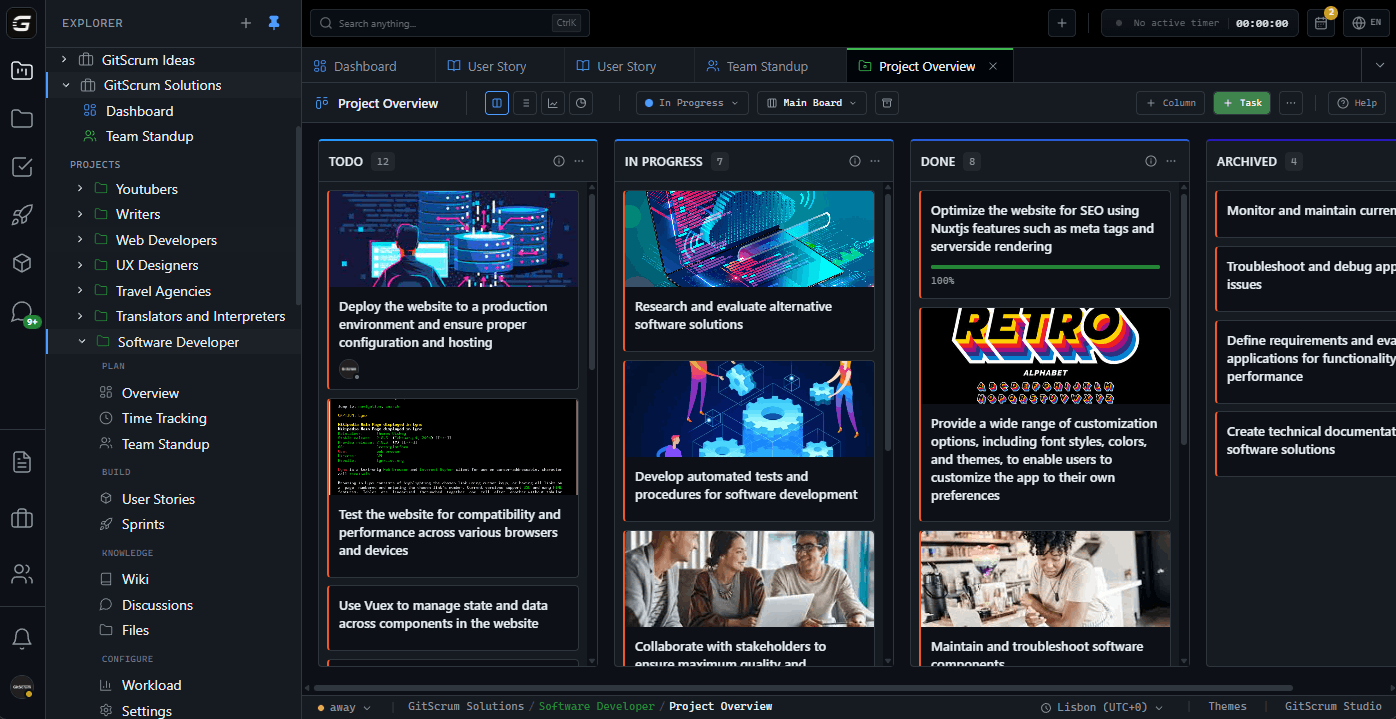
No configuration specialists. No 'implementation project.' Flexible Without Chaos Structure when you need it: - Boards for visual workflow - Sprints if you want iterations - Simple lists if you don't Not imposed.
Adapt to how you work. Git-Native Startup teams use Git.
Project management should too. - Commits linked to tasks - PRs show on board - Merges move cards Development and project management unified.
One less context switch. Investor-Ready Reporting 'What did you ship this month?' One-click answer: - Features completed - Velocity trend - Sprint burndown - Progress visualization For board meetings.
For investor updates. Without manual report building.
Client Collaboration (Free) External stakeholders: - Investors viewing progress - Advisors giving input - Early customers testing In GitScrum: Clients are free. Not 'viewer seats at $5.' Free.
Share progress without budget impact. Pivot-Ready Startups pivot.
Project management should handle it. - Archive old project in seconds - Start new project immediately - History preserved if you pivot back - No data loss Pivot is rename + new board.
Not 'migrate to new tool.' Remote-First Most startups are remote or hybrid. GitScrum works: - Async updates (not real-time-only) - Clear ownership (who's doing what) - Notifications without spam - Works across timezones No 'everyone needs to be online.' Scale When You Scale Seed → Series A → Series B: - Same tool - More users - More projects - Same workflow No 'migrate to enterprise plan.' No reimplementation.
Just add seats. The Startup Stack Typical startup: - Code: GitHub/GitLab - Chat: Slack/Discord - Docs: Notion/Google Docs - Project: ???
GitScrum fits: - Native Git integration - Discussion on tasks (less Slack noise) - Wiki for documentation - Project management as center Velocity Over Process Enterprise tools add friction. 'Add workflow step.' 'Require approval.' 'Enforce field completion.' GitScrum philosophy: - Minimal required fields - No mandatory workflows - Ship first, process later - Iterate on process as team grows Process serves shipping.
Not the other way around. The Pre-PMF Reality Before product-market fit: - Everything is experiment - Features may get killed - Roadmap changes weekly - 'Plan' is a suggestion GitScrum handles this: - Archive tasks easily - Reprioritize with drag-drop - No 'workflow violation' when plans change - Flexibility is feature, not bug Founder Mode Founders do everything: - Code - Sell - Support - Manage Dashboard shows what matters: - What's blocked - What's shipping today - What needs attention No 'log in and get lost.' Clear priorities.
Fast decisions. Vs The Alternatives Jira: - Great for 500 people - Overkill for 5 - Setup takes weeks - $$$ Trello: - Simple - Too simple - No sprints, no Git, no reporting - Scales badly Asana: - Marketing-team friendly - Not dev-native - No Git integration - Price climbs fast Linear: - Clean, fast - But $10/user, no free tier - Limited to product/eng GitScrum: - Dev-native - Startup-priced ($8.90, 2 free) - Git integration - Scales with you - Ships fast The Startup Checklist ✓ Can I start in < 10 minutes?
→ Yes ✓ Can we afford it? → 2 free, then $8.90 ✓ Does it connect to our code?
→ Native Git ✓ Can we share with investors? → Free clients ✓ Will it scale to 20 people?
→ Same tool ✓ Can we move fast? → Built for velocity GitScrum: Built for startups.
Because enterprise tools kill startups.
The GitScrum Advantage
One unified platform to eliminate context switching and recover productive hours.