GitScrum PRO Annual — 2,500+ SaaS apps via MCP

GitScrum logo
Solution

Simplify Dev Team Workflow Single Tool 2026 | Git Native

50+ daily tool switches. 1-2h lost. GitScrum: tasks, time, docs unified. Commits auto-update status. Under 10 switches. Reclaim hours for coding. $8.90/user. Free trial.

Simplify Dev Team Workflow Single Tool 2026 | Git Native

The fractured developer workflow: A typical developer day: Morning standup prep (15 min): - Open Jira to see assigned tasks - Check Slack for overni...

The GitScrum Advantage

One unified platform to eliminate context switching and recover productive hours.

01

problem.identify()

The Problem

50+ context switches daily between tools

1-2 hours lost to tool overhead

Manual status updates in multiple places

Information scattered across platforms

Developers frustrated by process, not coding

New hires take weeks to learn toolchain

GitHub and PM tool are disconnected

Time tracking requires separate app

02

solution.implement()

The Solution

Under 10 context switches with unified platform

Reclaim 1-2 hours daily for actual coding

Git commits auto-update task status

All project info in single interface

Developers focus on code, not process

New hires productive in hours

Native GitHub integration syncs everything

Time tracking built into task workflow

03

How It Works

1

Connect GitHub

One OAuth connection. GitScrum links to your repositories. Commits, PRs, and branches automatically associate with tasks. Setup takes 2 minutes.

2

Reference Tasks in Commits

Include task ID in commit message: 'Fix login bug #TASK-123'. GitScrum links the commit to the task. Task shows commit history. Commit shows task context.

3

Auto-Update on PR Merge

Configure: when PR merges to main, move task to 'Done'. No manual status updates. Code deployment = task completion. Perfect audit trail.

4

View Everything in Context

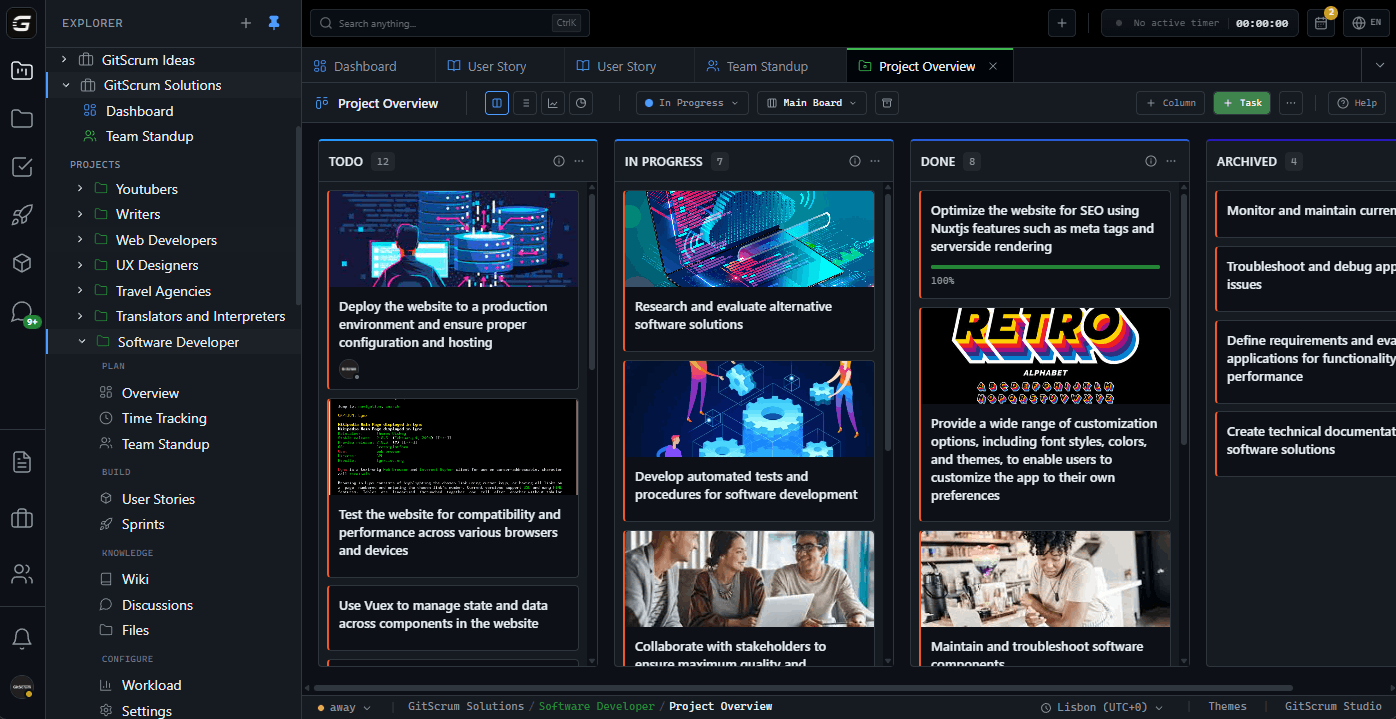
Task card shows: description, time logged, commits linked, PRs associated, comments. Everything visible without leaving GitScrum. GitHub stays for code, GitScrum for project context.

04

Why GitScrum

GitScrum addresses Simplify Development Team Workflow Single Tool through Kanban boards with WIP limits, sprint planning, and workflow visualization

Problem resolution based on Kanban Method (David Anderson) for flow optimization and Scrum Guide (Schwaber and Sutherland) for iterative improvement

Capabilities

  • Kanban boards with WIP limits to prevent overload
  • Sprint planning with burndown charts for predictable delivery
  • Workload views for capacity management
  • Wiki for process documentation
  • Discussions for async collaboration
  • Reports for bottleneck identification

Industry Practices

Kanban MethodScrum FrameworkFlow OptimizationContinuous Improvement

Frequently Asked Questions

Still have questions? Contact us at customer.service@gitscrum.com

Does this replace GitHub?

No. GitHub stays your code home. GitScrum integrates with it for project context. Write code in GitHub, manage projects in GitScrum. They sync automatically.

What if we use GitLab or Bitbucket?

GitScrum supports GitLab and Bitbucket with similar integration capabilities. Same commit-task linking, same auto-updates, same workflow simplification.

How does auto-status update work?

Configure triggers: branch created → 'In Progress', PR opened → 'Code Review', PR merged → 'Done'. Customize to match your workflow. Task status always reflects code state.

Can developers still use their favorite IDE?

Absolutely. GitScrum doesn't touch your coding environment. Code in VS Code, Vim, IntelliJ—whatever you prefer. Integration happens through git, not IDE plugins.

Ready to solve this?

Start free, no credit card required. Cancel anytime.

Works with your favorite tools

Connect GitScrum with the tools your team already uses. Native integrations with Git providers and communication platforms.

GitHubGitHub
GitLabGitLab
BitbucketBitbucket
SlackSlack
Microsoft TeamsTeams
DiscordDiscord
ZapierZapier
PabblyPabbly

Connect with 3,000+ apps via Zapier & Pabbly