GitScrum PRO Annual — 2,500+ SaaS apps via MCP

GitScrum logo
Solution

Sprint Planning Small Teams 2026 | No Ceremony Tax

Enterprise tools: 12h ceremony/sprint. GitScrum: 15-min planning, no story points required, async standups. Built for 3-5 dev teams. $8.90/user. 2 free forever. Free trial.

Sprint Planning Small Teams 2026 | No Ceremony Tax

Small Team Reality Your team: - 3-5 developers - Maybe a part-time PM - No dedicated scrum master - No agile coach - Everyone codes Enterprise sprint tools assume: - 10+ team members - Dedicated roles - Multi-hour ceremonies - Complex velocity tracking - Story point standardization Mismatch.

The Ceremony Tax Enterprise agile ceremony: - Sprint Planning: 4 hours - Daily Standup: 15 min x 10 days = 2.5 hours - Sprint Review: 2 hours - Retrospective: 2 hours - Backlog Grooming: 2 hours Total: 12.5 hours per 2-week sprint Per person: 50+ hours/month in meetings Small team can't afford this. Need to ship, not meet.

Small Team Sprint Planning What actually matters: 1. What's the goal this sprint?

2. What tasks achieve it?

4. What are dependencies?

Time needed: 15-30 minutes Format: Quick sync, not formal ceremony GitScrum approach: - Drag tasks to sprint - Assign owners - Set priorities - Done. Start working.

No Story Points Required Story points theory: - Relative estimation - Velocity tracking - Capacity planning Small team reality: - 'This takes a day' - 'This takes a week' - 'This is huge, break it down' Simple estimation works: - T-shirt sizes (S/M/L/XL) - Day estimates - Or just gut feel GitScrum: Optional estimation. Use if helpful, skip if not.

Flexible Sprint Length Enterprise: 2-week sprints, always. Small teams vary: - 1-week for fast iteration - 2-week for feature development - Monthly for maintenance work - No sprints for some projects GitScrum flexibility: - Set sprint length per project - Change when needed - Or skip sprints entirely Your cadence, your choice.

Backlog Management Backlog essentials: - What's the next thing? - What's blocked?

- What's nice to have? GitScrum backlog: - Stack ranked list - Drag to reorder - Pull into sprint - Simple and visual No: - Complex prioritization frameworks - Weighted scoring systems - Priority committees Top of list = most important.

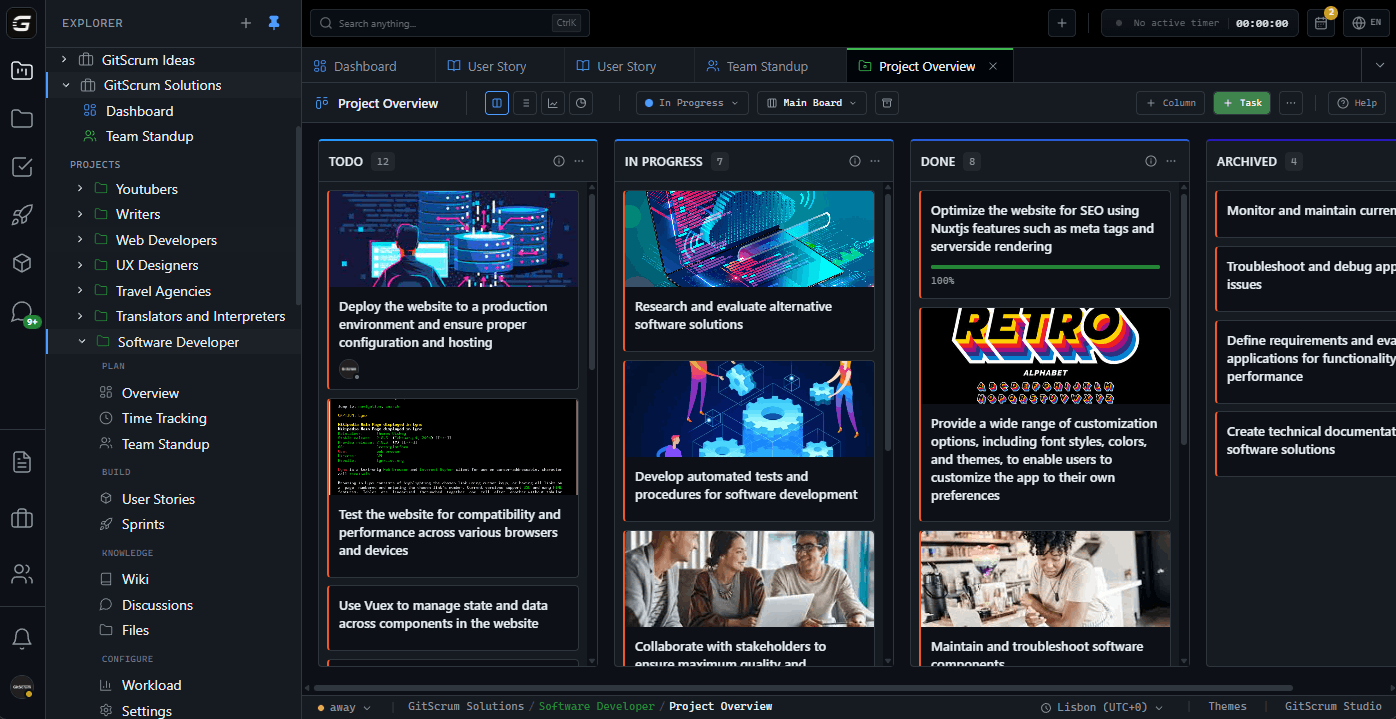
Sprint Board During sprint: - What's todo? - What's in progress?

- What's blocked? - What's done?

GitScrum sprint view: - Kanban within sprint - Clear status visible - Progress obvious - Blockers highlighted Glance and know status. Async Standups 15-minute daily standup: - Good for co-located teams - Hard for remote teams - Timezone problems - Interrupt flow Async alternative: - Update task status in GitScrum - Add blocker notes - Team sees current state - No meeting needed Status from the work itself.

Sprint Velocity (Optional) If you want to track: - Tasks completed per sprint - Points completed (if using) - Trend over time GitScrum provides: - Basic velocity chart - Sprint comparison - Completion rate Not required. There if useful.

Git Integration in Sprints Sprint task: 'Add user auth' Git workflow: - Create branch gs-123-user-auth - Develop on branch - PR references task - Merge updates status Sprint view shows: - Code progress on tasks - PRs pending review - What's actually shipping Code and sprint unified. Sprint Retrospective (Light) Enterprise retro: - 2-hour facilitated session - Post-its everywhere - Voting on items - Action item tracking Small team retro: - 15-minute chat - 'What worked?' - 'What didn't?' - 'What to change?' GitScrum: - Note section per sprint - Capture key learnings - Reference later - No complex process Release Coordination Small team shipping: - 'What's in this release?' - 'Is it all tested?' - 'Ready to deploy?' Sprint as release unit: - Sprint = what ships - Sprint complete = release ready - Clear boundary GitScrum: - Sprint tasks = release contents - Easy to see what's shipping - Deploy with confidence Scaling When Needed Team grows from 3 to 7: - Same tool works - Add more process if needed - Sprints still work - No migration GitScrum grows with you: - Start simple - Add complexity when ready - Never forced Start free.

Stay affordable. Why Small Teams Choose GitScrum Right-sized agile: - Sprint planning in 15 minutes - No mandatory story points - Flexible sprint length - Async standup option Developer-friendly: - Git integration native - Dark mode default - Keyboard shortcuts - Fast interface Small team pricing: - 2 users FREE forever - $8.90/user/month beyond - All features always - No enterprise overhead Sprint planning that fits.

Not enterprise bloat.

The GitScrum Advantage

One unified platform to eliminate context switching and recover productive hours.

01

problem.identify()

The Problem

Enterprise ceremony tax - 12+ hours per sprint in meetings. Story point debates. Multi-hour planning. Small teams can't afford this.

Mandatory complexity - Story points required. Velocity charts required. Burndown required. Overkill for 3-5 person team.

Rigid sprint structure - 2-week sprints always. No flexibility. Doesn't fit all project types or team rhythms.

Scrum master assumption - Tools assume dedicated role for process. Small teams don't have that luxury.

Co-located bias - Daily standups assume same timezone, same office. Remote small teams struggle.

Process over progress - More time tracking velocity than actually coding. Meetings about meetings.

02

solution.implement()

The Solution

15-minute planning - Drag tasks to sprint. Assign owners. Set priority. Done. No 4-hour sessions.

Optional story points - Use them if helpful. Skip if not. Simple estimation works too. Your choice.

Flexible sprint length - 1 week, 2 weeks, monthly, or no sprints. Per project. Change when needed.

No dedicated role needed - Any team member runs planning. Tool is self-explanatory. No scrum master required.

Async standup built-in - Task updates show status. Board reflects progress. No mandatory meetings.

Progress over process - Minimal ceremony. Maximum shipping. Track what matters, skip what doesn't.

03

How It Works

1

Create Sprint with Goal

Name your sprint. Set dates. Define the goal in one sentence. What are we shipping this cycle? Clear target for team.

2

Pull Tasks from Backlog

Drag tasks from backlog to sprint. Realistic amount. Assign owners. Set priorities. 15 minutes max.

3

Track Progress on Board

During sprint, tasks flow through Kanban: Todo, In Progress, Review, Done. Status always visible. Git updates automatically.

4

Close Sprint and Review

Sprint ends. See what shipped. Quick retro note. Remaining tasks move to next sprint or backlog. Ready for next cycle.

04

Why GitScrum

GitScrum addresses Sprint Planning Tool for Small Dev Teams - Agile Without the Ceremony Tax through Kanban boards with WIP limits, sprint planning, and workflow visualization

Problem resolution based on Kanban Method (David Anderson) for flow optimization and Scrum Guide (Schwaber and Sutherland) for iterative improvement

Capabilities

  • Kanban boards with WIP limits to prevent overload
  • Sprint planning with burndown charts for predictable delivery
  • Workload views for capacity management
  • Wiki for process documentation
  • Discussions for async collaboration
  • Reports for bottleneck identification

Industry Practices

Kanban MethodScrum FrameworkFlow OptimizationContinuous Improvement

Frequently Asked Questions

Still have questions? Contact us at customer.service@gitscrum.com

Do we have to use story points?

No. Story points are completely optional. Many small teams use simple estimation: Small/Medium/Large, or day estimates, or no estimation at all. Use what works for your team. GitScrum doesn't force any estimation method.

Can we change sprint length per project?

Yes. Each project can have different sprint length. Main product: 2-week sprints. Maintenance project: weekly. Experimental project: no sprints, just kanban. Mix and match as needed.

Do we need a scrum master?

No. GitScrum is designed for teams without dedicated process roles. Any team member can create sprints, run planning, facilitate retros. The tool is self-explanatory. Process simplicity means no specialist needed.

What's the pricing for small teams?

2 users FREE forever - all features including sprints. Teams of 3-5: $8.90/user/month. So 5-person team: $44.50/month total. No enterprise pricing. No minimum seats. Perfect for small team budgets.

Ready to solve this?

Start free, no credit card required. Cancel anytime.

Works with your favorite tools

Connect GitScrum with the tools your team already uses. Native integrations with Git providers and communication platforms.

GitHubGitHub
GitLabGitLab
BitbucketBitbucket
SlackSlack
Microsoft TeamsTeams
DiscordDiscord
ZapierZapier
PabblyPabbly

Connect with 3,000+ apps via Zapier & Pabbly