The Monday.
Marketing/ops chose it first - Beautiful demos sold leadership - Easy to set up for non-technical teams - 'One tool for the whole company' dream 2. Dev team got added later - 'Just put your sprints in Monday' - 'We already pay for it, use it' - 'How hard can it be?' 3.
Reality sets in - GitHub integration doesn't really work - Developer workflows don't fit the model - Speed is frustrating - Pricing escalates with features needed Why Monday.com Fails Development Teams 1. Built for Visual Thinkers, Not Developers Monday's design philosophy: - Everything is colorful and visual - Drag-and-drop is the primary interaction - Complexity hidden behind automations - Optimized for demo impressions Developer needs: - Keyboard shortcuts for speed - Information density - Git-native integration - Fast, not pretty Result: Developers feel like they're using a toy, not a tool.
2. GitHub Integration Is Marketing, Not Engineering Monday GitHub 'integration': - Connect GitHub account - Create 'GitHub' column - Manual linking of PRs - Webhook notifications - No automatic status updates What developers need: - Commits auto-link to tasks - PRs auto-update status - Branch creation from tasks - Repository visibility in PM tool - Code-driven project status Result: Two tools maintained separately.
Duplication of effort. 3.
Performance Is Unacceptable Monday loading times: - Initial board load: 3-5 seconds - Switching views: 1-2 seconds - Search: Noticeable delay - Everything feels sluggish Developer context: - IDE loads in <1 second - Terminal is instant - GitHub is fast - Then you open Monday... Result: Developers avoid the tool.
Updates become sporadic. 4.
Pricing Becomes a Problem Monday pricing reality: - Per-user costs escalate quickly - Basic tier lacks needed features - Standard/Pro tiers expensive - Minimum seat requirements - Feature gatekeeping aggressive Comparison: Feature Monday Pro GitScrum ------- ---------- -------- Price/user/month $16 $8.90 Time tracking $$$ Included GitHub integration Basic Deep Free tier 3 users (limited) 2 users (full) Minimum seats 3 None Result: Paying premium for features you don't need, lacking ones you do. 5.
Workflow Mismatch Monday model: - Generic 'work management' - One-size-fits-all approach - Customization through complexity - Marketing/ops workflows assumed Development reality: - Sprint planning specific needs - Code review workflows - Release management - Technical debt tracking - Developer-specific terminology Result: Forcing development workflow into marketing tool shape. The Switch Trigger Points Teams switch from Monday when: 1.
GitHub integration frustration peaks - 'Why doesn't this just sync automatically?' - Manual updates become unacceptable - Time wasted on duplicate entry 2. Speed becomes blocker - Developers waiting for board to load - Finding information takes too long - 'I'll just check Slack instead' 3.
Price increase arrives - Annual renewal shock - New pricing tier required - 'We're paying HOW much for this?' 4. New developer joins - Fresh eyes see the problems - 'Why aren't we using Linear/GitScrum?' - Comparison to modern tools 5.
Sprint velocity drops - Correlation with tool frustration - Time spent on PM overhead - Team morale around tooling Choosing Your Monday.com Replacement For development teams specifically: 1. GitScrum (Recommended) Why: GitHub-native, complete feature set, fair pricing Best for: Teams wanting everything in one tool Bonus: Time tracking included, client portals Price: 2 free users, $8.90/user after 2.
Linear Why: Fastest PM tool available Best for: Teams prioritizing speed above all Trade-off: No time tracking, no free tier Price: $8/user/month minimum 3. Shortcut Why: Good balance, API-first Best for: Teams building heavy automations Trade-off: Not as fast, less polished Price: Free tier + $8.50/user 4.
Jira Why: Industry standard, enterprise compliance Warning: You'll trade Monday problems for Jira problems Best for: Only if you have Atlassian mandate Recommendation: GitScrum for most dev teams. Free trial lets you validate before committing.
Monday to GitScrum Migration Guide Week 1: Preparation Day 1-2: Audit current state - List active boards in Monday - Identify which boards are dev-related - Document custom automations - Note integration dependencies Day 3-4: Export data - Export boards as CSV - Screenshot key configurations - Document workflow states - List team members and permissions Day 5-7: Set up GitScrum - Create GitScrum account (free) - Connect GitHub immediately - Configure basic project structure - Test with sample data Week 2: Migration Day 8-9: Data migration - Import active items to GitScrum - Don't import old/closed items - Configure sprint structure - Set up board columns Day 10-11: Team transition - Quick training session (30 min) - Distribute quick-start guide - Set Monday to read-only - All new work in GitScrum Day 12-14: Stabilization - Monitor for issues - Answer questions - Adjust configurations - Collect feedback Week 3-4: Optimization - Remove unused features - Fine-tune workflows - Measure velocity - Document learnings Common Monday to GitScrum Mappings Monday Concept GitScrum Equivalent -------------- ------------------- Board Project / Board Group Sprint / Milestone Item Task / User Story Subitems Subtasks Status column Board columns Person column Assignee Timeline Sprint dates Automations Git-driven automation Dashboards Sprint reports GitHub column Git integration (real) Key difference: GitScrum's Git integration is native, not a column. What You'll Gain from Switching 1.
Real GitHub Integration - Commits auto-link to tasks - PRs update status automatically - No manual maintenance - Code IS your status update 2. Speed - Sub-second page loads - Instant search - No waiting for boards - Developer-acceptable performance 3.
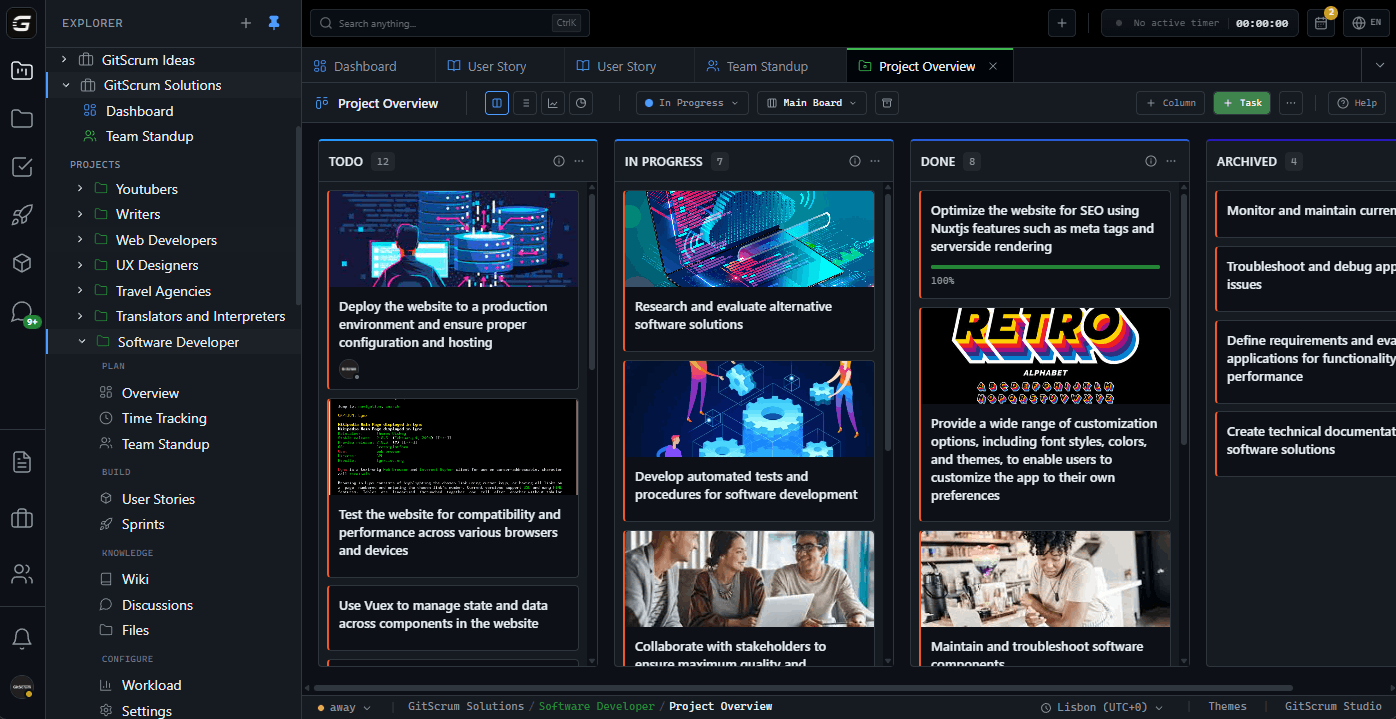
Developer Experience - Keyboard shortcuts - Information density - Dark mode - Built for code workflows 4. Fair Pricing - 2 users free forever - $8.90/user (vs $16+ on Monday) - All features included - No feature gatekeeping 5.
Time Tracking Included - Built-in, not addon - Per-task tracking - Team visibility - Client billing ready 6. Client Portals (Bonus) - If you do agency work - Share progress with clients - No Monday 'guest' complexity Handling the Transition For the dev team: - Show them speed difference immediately - Demo GitHub integration working - Emphasize keyboard shortcuts - 'Try it for one sprint' For leadership: - Show cost comparison - Highlight GitHub integration gap - Developer satisfaction metrics - Sprint velocity correlation For marketing/ops (if they stay on Monday): - Separate tools is okay - Dev teams have different needs - Can integrate via API if needed - No need to force one-size-fits-all Post-Switch Reality Check Week 2: - Expected: Some adjustment questions - Measure: GitHub auto-linking working - Watch: Speed perception improvement Week 4: - Expected: Workflow stabilized - Measure: Sprint velocity - Watch: Monday usage (should be zero) Week 8: - Expected: Full adoption - Measure: Team satisfaction - Watch: Any requests to return (rare) Most common feedback: 'Why didn't we switch sooner?' The One-Tool Dream vs Reality Monday promise: One tool for entire company Reality: Not every team works the same Development teams: - Need Git integration - Need speed - Need developer workflows Marketing teams: - Need visual presentations - Need campaign tracking - Need stakeholder sharing Forcing one tool creates: - Frustration for specialists - Compromised workflows - Lowest common denominator Better approach: - Right tool for each team - Integrate where needed - Accept specialized needs GitScrum is the right tool for development teams.
Ready to Leave Monday? GitScrum for development teams: - GitHub-native integration (real, not cosmetic) - Developer-grade speed - Keyboard-first design - Time tracking included - 2 users free forever - $8.90/user/month (no gatekeeping) Most teams complete migration in 1-2 weeks.
Velocity typically improves from day one. No more 'pretty but useless' PM tool.
Try GitScrum: What Monday.com should have been for developers.
The GitScrum Advantage
One unified platform to eliminate context switching and recover productive hours.