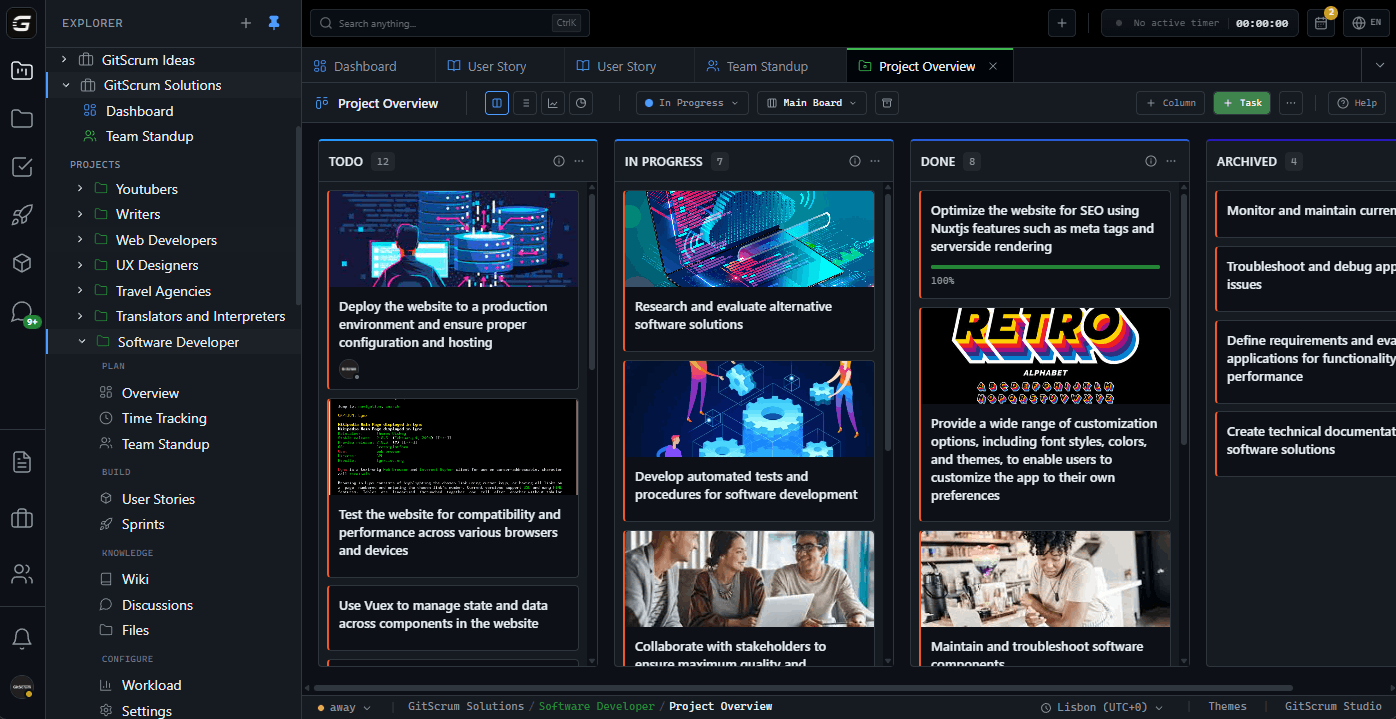
The Task Management Mismatch Most task management software was built for: - Marketing campaigns - Event planning - Content calendars - HR onboarding - General office work Developer tasks are fundamentally different: Generic Task: - 'Write blog post' - Due date: Friday - Assignee: Marketing - Status: Done/Not Done Developer Task: - 'Implement user authentication' - Sprint: Sprint 14 - Story Points: 5 - Linked: feature/user-auth branch - Commits: 12 - PR: 456 - Code Review: Approved - Time: 8h 23m tracked - Blocked by: Backend API spec - Dependencies: User model, JWT library Using Asana for dev tasks is like using Excel for source control.
It works until it doesn't. Why Dev Tasks Need Different Software 1.
Tasks Live With Code Non-dev: Task is done when someone says it's done. Dev: Task is done when code is merged and deployed.
Generic tools have no concept of: - Branches - Commits - Pull requests - Code review - Deployment status GitScrum: Task links to Git. PR merged = Done.
Tasks Need Estimation Non-dev: 'This will take about a day' Dev: Story points, t-shirt sizing, complexity vs effort Generic tools: - Time estimates (hours) - Usually ignored - No velocity tracking GitScrum: - Story point fields - Velocity calculation - Sprint capacity planning - Historical accuracy tracking 3. Tasks Need Context Non-dev: Task description is enough.
Dev: Task needs specs, acceptance criteria, technical notes, subtasks, linked issues, related PRs. Generic tools: - Title + description - Maybe subtasks - Limited metadata GitScrum: - Full user story format - Acceptance criteria checklist - Technical notes section - Linked commits, branches, PRs - Subtasks with estimates - Blocked/blocking relationships - Time tracking per task 4.
Tasks Need Workflow States Non-dev: To Do → Doing → Done Dev: Backlog → Ready → In Progress → Review → QA → Staging → Done Generic tools: - 3-4 columns - Custom columns possible but awkward - No automation GitScrum: - Customizable workflow states - Git-triggered automations - PR opened → Review column - PR merged → Done column - Deployment → Deployed state 5. Tasks Need Sprints Non-dev: Tasks have due dates.
Dev: Tasks belong to iterations/sprints with team capacity. Generic tools: - Due dates and milestones - No sprint concept - No velocity - No burndown GitScrum: - Sprint planning views - Drag tasks to sprints - Velocity tracking - Burndown charts - Sprint retrospectives The Real Cost of Generic Task Tools Context Switching: - Check Asana for task - Switch to GitHub for code - Back to Asana to update - Slack for communication - Back to GitHub for PR - Back to Asana for status Time wasted: 30+ minutes daily per developer.
Data Fragmentation: - Task says 'In Progress' - Code has been merged for 2 days - Nobody updated the task - PM thinks work is ongoing - Reality is disconnected Reporting Gaps: - 'How much work did we complete?' - Task tool: 47 tasks marked done - Reality: 12 were marked done late, 8 were never updated - No correlation with actual code shipped GitScrum Task Anatomy A GitScrum task includes: ┌─────────────────────────────────────────────────────┐ │ [GS-123] Implement User Authentication │ │ Type: User Story Points: 5 Sprint: Sprint 14 │ ├─────────────────────────────────────────────────────┤ │ Assignee: @developer Status: In Review │ │ Time: 8h 23m Due: Sprint end (3 days) │ ├─────────────────────────────────────────────────────┤ │ User Story │ │ As a user, I want to log in so I can access... │ │ │ │ Acceptance Criteria │ │ ☑ Email/password login │ │ ☑ Password validation (8+ chars) │ │ ☐ Remember me option │ │ ☐ Forgot password flow │ ├─────────────────────────────────────────────────────┤ │ Technical Notes │ │ Use JWT tokens.
See RFC in wiki. │ ├─────────────────────────────────────────────────────┤ │ Subtasks │ │ ☑ Create login form (2h) │ │ ☑ Backend auth endpoint (3h) │ │ ☐ Remember me cookie (1h) │ │ ☐ Forgot password email (2h) │ ├─────────────────────────────────────────────────────┤ │ Git Activity │ │ ● Branch: feature/123-user-auth │ │ ● 12 commits │ │ ● PR 456 (Approved, ready to merge) │ ├─────────────────────────────────────────────────────┤ │ Relationships │ │ Blocks: GS-124 (User profile page) │ │ Related: GS-100 (User model) │ └─────────────────────────────────────────────────────┘ Everything in one place.
No context switching. Task Workflows in GitScrum Default Dev Workflow: Backlog → Ready → In Progress → Review → QA → Done With Git Automation: - Task assigned → In Progress - Branch created → In Progress - PR opened → Review - PR approved → Ready to Merge - PR merged → QA (or Done) - Deployed → Done Customizable: - Add stages - Remove stages - Set triggers - Define automations Task Types GitScrum supports: - User Story - Feature from user perspective - Task - Technical work item - Bug - Defect to fix - Spike - Research/exploration - Epic - Large initiative (contains tasks) Each type can have: - Different fields - Different workflows - Different icons - Custom attributes Task Estimation & Planning Story Points: - Fibonacci (1, 2, 3, 5, 8, 13) - T-Shirt (XS, S, M, L, XL) - Custom scales Planning Poker (coming soon): - Team votes - Reveal simultaneously - Discuss differences - Reach consensus Capacity Planning: - Team velocity history - Sprint capacity meter - Overcommitment warning Time Tracking on Tasks Built-in timer: - Start/stop with one click - Auto-pause detection - Manual entry option Task-level tracking: - Time per task - Time vs estimate comparison - Remaining time Reporting: - Time by project - Time by person - Time by sprint - Billable vs non-billable Task Dependencies Relationship types: - Blocks / Blocked by - Related to - Parent / Child (subtasks) - Duplicate of Dependency view: - See blocking chains - Identify bottlenecks - Critical path visibility Alerts: - Blocked task warnings - Circular dependency detection Task Search & Filtering Find tasks by: - Status - Assignee - Sprint - Labels/tags - Story points - Time tracked - Git activity - Custom fields Saved filters: - My tasks - Blocked tasks - This sprint - Unestimated - No assignee Global search: - Search across all projects - Search in descriptions - Search in comments Bulk Task Operations Select multiple tasks: - Move to sprint - Change assignee - Update status - Add labels - Change story points Import/Export: - CSV import - JSON export - API access Mobile Task Access iOS & Android: - View tasks - Update status - Log time - Add comments - Receive notifications On-the-go standup updates.
Vs Asana for Dev Asana: ✓ Beautiful UI ✓ Great for marketing ✓ Timelines ✗ No Git integration ✗ No sprint concept ✗ No story points ✗ No velocity tracking ✗ Limited dev workflow GitScrum: ✓ Dev-focused UI ✓ Git integration ✓ Sprint planning ✓ Story points ✓ Velocity tracking ✓ Dev workflows ✓ $8.90/user vs Asana's $10.99+ Vs Todoist/Things for Dev Todoist/Things: ✓ Clean personal task management ✓ Great for individual productivity ✗ No team features ✗ No Git integration ✗ No sprints ✗ Not for software projects GitScrum: ✓ Team collaboration ✓ Git-connected ✓ Sprint-based ✓ Built for dev teams Vs Jira Jira: ✓ Dev-focused ✓ Full featured ✗ Complex configuration ✗ Slow interface ✗ Expensive ($17.50+/user) ✗ Requires training GitScrum: ✓ Dev-focused ✓ Simple interface ✓ Fast ✓ $8.90/user ✓ No training needed ✓ 2 users free Task Management Pricing 2 users: $0 (free forever) 3 users: $8.90/month 10 users: $71.20/month 25 users: $178/month Includes: - Unlimited tasks - Unlimited projects - Git integration - Sprint planning - Time tracking - All task features Migrating from Other Tools From Asana: - Export CSV - Import to GitScrum - Map fields - Done in minutes From Trello: - Export JSON - Import boards - Cards become tasks From Jira: - Export issues - Import with field mapping - Preserve history Getting Started 1. Sign up (30 seconds) 2.
Create project 3. Add first tasks 4.
Connect GitHub/GitLab 5. Start sprint 6.
Track progress From signup to productive: 5 minutes. $8.90/user/month.
2 users free forever. Task management built for developers.
The GitScrum Advantage
One unified platform to eliminate context switching and recover productive hours.