The Planning Problem Sprint Planning Meeting: PM: 'How much can we commit to this sprint?
8 stories?' Dev 2: 'Maybe 10 if nothing goes wrong.' Dev 3: 'Last sprint we did 6, but that was because of holidays.' PM: 'Let's commit to 9 and see what happens.' Sprint ends with 6 stories completed PM: 'Why did we only finish 6?' Team: '...' This happens because: - No historical data - No objective measurement - Planning based on feelings - Hope replaces math What is Velocity? Velocity = Story Points completed per sprint Story Points: - Relative measure of effort/complexity - Not hours - Team agrees on scale (Fibonacci: 1, 2, 3, 5, 8, 13) - Consistent within team Example: Sprint 10: 24 story points completed Sprint 11: 28 story points completed Sprint 12: 22 story points completed Sprint 13: 26 story points completed Average Velocity: 25 story points/sprint Now you can answer: - 'How much can we commit?' ~25 points - 'When will Feature X be done?' (remaining points / 25) sprints - 'Can we hit the deadline?' Compare required vs capacity Why Velocity Matters 1.
Predictable Commitments Instead of: 'We think we can do 9 stories' Say: 'Our velocity is 25 points. This sprint has 26 points.
It's achievable.' Objective. Defensible.
2. Stakeholder Trust When you consistently deliver what you commit: - Stakeholders trust estimates - Fewer questions about timelines - Less pressure to over-commit - Healthier team 3.
Capacity Planning Project needs 100 story points. Team velocity: 25 points/sprint.
Estimate: 4 sprints (2 months). Add buffer for unknowns: 5 sprints.
Promise: 'Delivered in Q2.' 4. Trend Analysis Velocity over time: Sprint 1-5: ~18 points (forming) Sprint 6-10: ~22 points (norming) Sprint 11-15: ~26 points (performing) Sprint 16+: ~28 points (optimizing) Team is improving.
Or: Sprint 15: 28 points Sprint 16: 24 points Sprint 17: 20 points Team is struggling. Investigate.
5. Scope Negotiation Stakeholder: 'Can you add Feature Y to this release?' PM: 'Feature Y is 40 points.
We have 25 points of capacity left. We'd need to cut 15 points of something else.' Data-driven negotiation.
How GitScrum Tracks Velocity 1. Story Point Assignment During backlog refinement: - Assign story points to each item - Use planning poker or team consensus - Points reflect relative complexity GitScrum provides: - Point field on every task - Fibonacci sequence dropdown - Custom scales if needed 2.
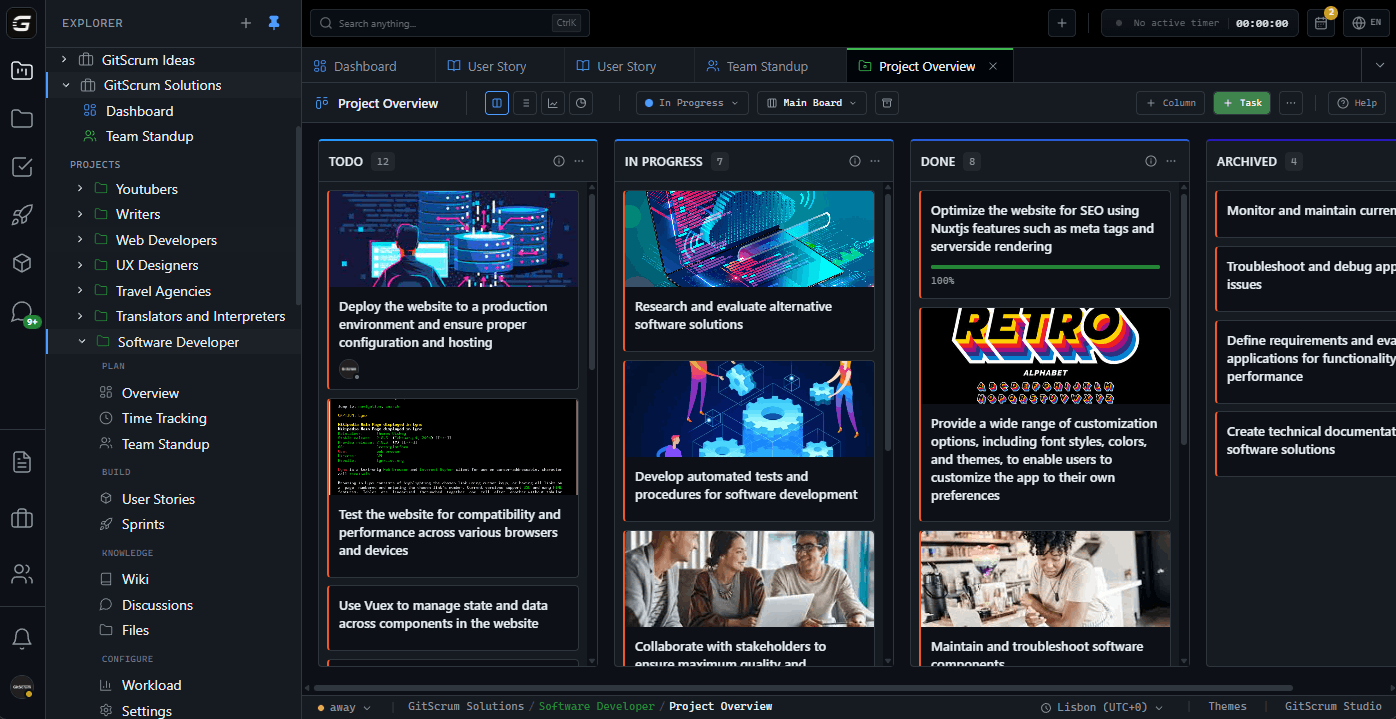
Sprint Tracking During sprint: - Items move across board - Done items tracked - Points accumulate GitScrum shows: - Committed points (start of sprint) - Completed points (current) - Remaining points 3. Sprint Completion At sprint end: - Completed points recorded - Incomplete items handled - Historical velocity updated 4.
Velocity Dashboard Sprint Velocity History ═════════════════════ Sprint | Committed | Completed | Accuracy ──────────|───────────|───────────|────────── Sprint 10 | 28 | 24 | 86% Sprint 11 | 26 | 28 | 108% Sprint 12 | 24 | 22 | 92% Sprint 13 | 26 | 26 | 100% ──────────|───────────|───────────|────────── Average | 26 | 25 | 96% Velocity Chart: 30 ┤ 28 ┤ ● 26 ┤ ● 24 ┤ ● 22 ┤ ● 20 ┤──────────────────────── S10 S11 S12 S13 Avg: 25 points/sprint Trend: Stable Velocity Metrics 1. Rolling Average - Last 4-6 sprints - Smooths out anomalies - More reliable than single sprint 2.
Variance - How consistent is velocity? - High variance = less predictable - Low variance = more confidence 3.
Commitment Accuracy - Committed vs Completed - Target: 80-100% - Over 100% = under-committing - Under 80% = over-committing 4. Trend - Is velocity improving?
- Declining? - Stable?
Using Velocity for Planning Scenario: Product wants a roadmap Backlog: - Feature A: 40 points - Feature B: 30 points - Feature C: 25 points - Feature D: 35 points - Total: 130 points Team velocity: 25 points/sprint Calculation: 130 points / 25 per sprint = 5.2 sprints With buffer: 6 sprints Timeline: - Sprint 1-2: Feature A (40 pts) - Sprint 2-3: Feature B (30 pts) - Sprint 3-4: Feature C (25 pts) - Sprint 4-6: Feature D (35 pts) Not guessing. Math.
Capacity Adjustments Velocity changes when: 1. Team Size Changes - New member joins → velocity drops initially (onboarding) - Member leaves → velocity drops proportionally - Account for ramp-up time 2.
Holidays/PTO - Sprint with holiday → reduce expected velocity - Plan for known absences 3. Tech Debt/Incidents - Planned tech debt sprint → lower feature velocity - Incident response → reduce capacity GitScrum: Track capacity factors per sprint.
Velocity Anti-Patterns What NOT to do: 1. Compare Teams Team A: 30 points Team B: 20 points Team A is NOT 'better'.
Points are relative within team. Different teams, different scales.
2. Pressure to Increase 'Last sprint was 25, this sprint should be 28.' Velocity is not a performance metric.
Increased pressure = corner-cutting. Quality suffers.
3. Ignore Variance Sprints: 30, 15, 40, 10 Average: 24 But highly unreliable.
Investigate causes. 4.
Start Too Early 'What's our velocity?' 'We've done one sprint.' Need 4-6 sprints for reliable velocity. Early sprints are calibration.
Velocity + Git Integration GitScrum adds accuracy: Traditional: - Task marked done manually - Could be premature - Could be forgotten With Git: - PR merged = done - Objective completion - No manual marking needed - Accurate velocity data Velocity-Based Capacity View Sprint Planning: Sprint 14 Planning ══════════════════ Team Velocity: 25 points (avg) Variance: +/- 3 points Capacity this sprint: ├─ Standard: 25 points ├─ Holiday: -2 days → -4 points ├─ New member: +0 (still onboarding) ├─ Adjusted: 21 points Backlog candidates: ├─ Story A: 8 points ├─ Story B: 5 points ├─ Story C: 3 points ├─ Story D: 5 points ├─ Total: 21 points ✓ Recommendation: Commit to 21 points Data-driven sprint planning. Reporting for Stakeholders Velocity Report: Team: Backend Period: Q4 2024 Velocity Trend: ├─ October: 24 pts/sprint (avg) ├─ November: 26 pts/sprint (avg) ├─ December: 25 pts/sprint (avg) ├─ Q4 Total: 25 pts/sprint (avg) Commitment Accuracy: 94% Variance: Low (±3 points) Trend: Stable Projections for Q1: ├─ Expected velocity: 25-27 pts/sprint ├─ Available sprints: 6 ├─ Capacity: 150-162 points └─ Roadmap items: 140 points → ✓ Achievable Vs Jira Velocity Jira: ✓ Has velocity charts ✓ Sprint reports ✗ Requires configuration ✗ Git integration needs plugins ✗ Complex for simple needs GitScrum: ✓ Built-in velocity tracking ✓ Sprint reports ✓ Simple setup ✓ Native Git integration ✓ $8.90/user Vs Spreadsheet Tracking Spreadsheets: ✓ Free ✓ Customizable ✗ Manual entry ✗ Error-prone ✗ No Git connection ✗ Time-consuming GitScrum: ✓ Automatic calculation ✓ Git-connected ✓ Less manual work ✓ More accurate ✓ $8.90/user (2 free) Pricing 2 users: $0/month (free forever) 5 users: $26.70/month 10 users: $71.20/month 25 users: $178/month Includes: - Velocity tracking - Sprint planning tools - Capacity planning - Velocity reports - Git integration - All PM features No analytics tier.
Velocity included for all. Getting Started 1.
Sign up (30 seconds) 2. Create sprints 3.
Assign story points to tasks 4. Complete sprints 5.
After 4-6 sprints, velocity stabilizes 6. Use velocity for planning 7.
Predict with confidence $8.90/user/month. 2 users free forever.
Velocity tracking that enables predictable delivery.
The GitScrum Advantage
One unified platform to eliminate context switching and recover productive hours.