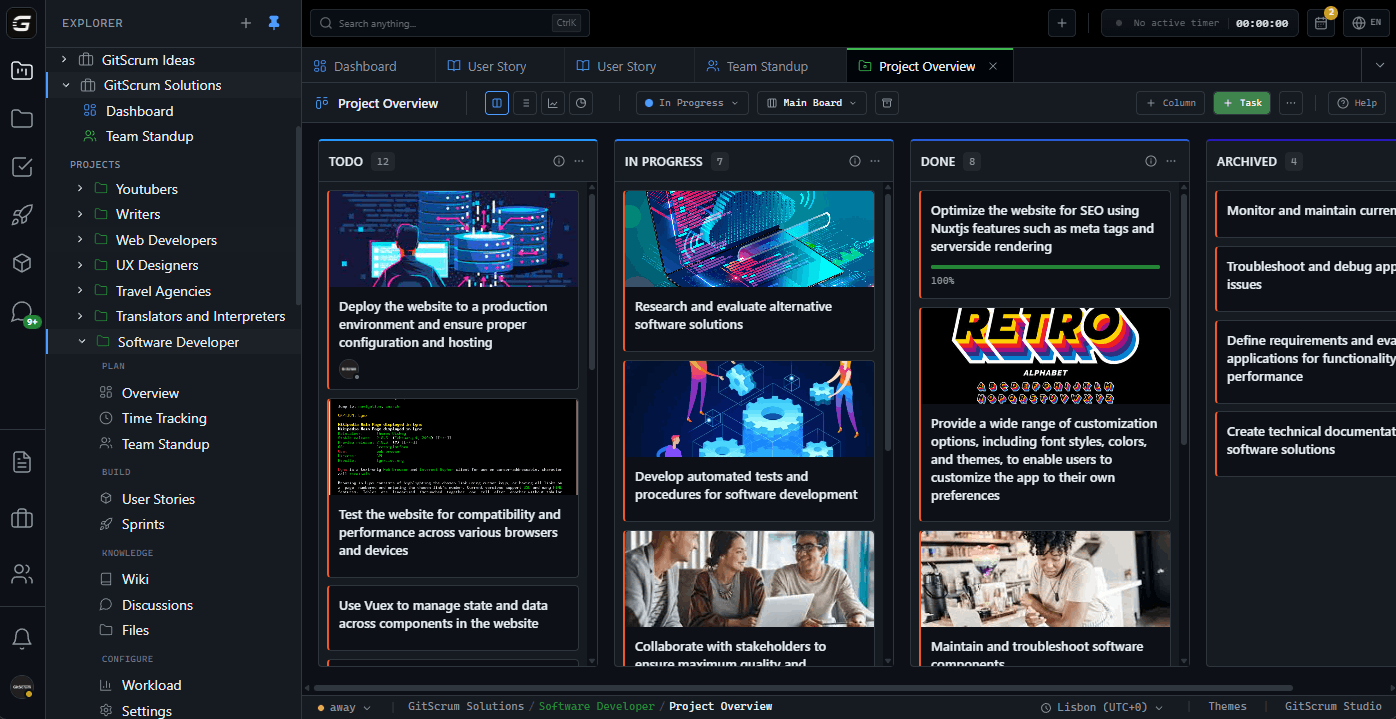
The Time Tracking Problem Friday afternoon.
Timesheet due. Developer stares at screen: 'Monday...
what did I do Monday?' Opens Slack history Opens Git log Opens calendar 'I think I spent 4 hours on AUTH-123... Maybe 2 on that bug fix?
3 in meetings? Lunch was...
did I take lunch?' Result: Best guesses filled in. Nobody actually knows.
Why Developers Hate Time Tracking 1. Context Switches Real developer day: 09:00 - Start AUTH-123 09:12 - Quick Slack question 09:15 - Back to AUTH-123 09:35 - PR review requested 10:05 - Back to AUTH-123 10:15 - Standup 10:30 - Back to AUTH-123 10:45 - Production issue 11:30 - Back to AUTH-123 32 context switches before noon.
How do you track that? 2.
Interruption-Driven Planned: 4 hours on Feature X Actual: - 1.5 hours Feature X - 45 min helping teammate - 30 min incident response - 1 hour meetings - 15 min timesheet entry 'Feature X: 4 hours' → Wrong but submitted anyway. 3.
Mental Load Manual tracking requires: - Remember to start timer - Remember to stop timer - Remember to switch tasks - Remember to categorize - Remember at end of day/week Developers: Have better things to remember. 4.
Inaccuracy Studies show: - Manual time tracking has 40%+ error - Most people overestimate focused time - End-of-day logging loses nuance - Rounding distorts reality Garbage in, garbage out. Why Accurate Time Data Matters 1.
Project Estimation 'How long will Feature X take?' Without data: 'Maybe 2 weeks?' With data: 'Similar features averaged 47 hours. At our velocity, ~3 weeks.' 2.
Client Billing Agency billing client: Inaccurate: 'We think we spent about 80 hours.' Accurate: 'We have 87.5 logged hours with task-level breakdown.' Client trust = accurate invoices. 3.
Capacity Planning How much time do we actually have? Inaccurate: '5 devs × 40 hours = 200 hours' Accurate: '5 devs × 28 available hours (after meetings, admin) = 140 hours' 4.
Cost Analysis What did Feature X actually cost? Inaccurate: '2 sprints = whatever that cost' Accurate: '156 developer hours + 12 PM hours = $16,800' GitScrum Time Tracking Automatic Time from Git Branch Created └─ Timer starts for linked task Commits Made └─ Activity recorded (proof of work) PR Opened └─ Time logged against task PR Merged └─ Timer stops, final time recorded Developer does: Write code GitScrum does: Track time How It Works 1.
Task Assignment Dev picks up AUTH-123 2. Branch Creation $ git checkout -b feature/AUTH-123-oauth GitScrum: ├─ Detects branch creation ├─ Finds linked task AUTH-123 ├─ Starts time tracking └─ Records: 'Work started 10:03 AM' 3.
Development Time Dev works on feature... Commits: - 10:45 AM: 'Initial OAuth setup' - 11:30 AM: 'Add token refresh' - 2:15 PM: 'Fix callback handling' GitScrum: ├─ Records commit timestamps ├─ Calculates active time ├─ Excludes obvious gaps (lunch, meetings) └─ Tracks: '3h 15m active development' 4.
PR and Merge Dev opens PR at 2:30 PM Review at 3:00 PM Merge at 3:45 PM GitScrum: ├─ Records PR creation time ├─ Records merge time └─ Final log: '4h 12m on AUTH-123' Time Entry Created: AUTH-123 - Implement OAuth ────────────────────────── Date: Dec 15, 2024 Duration: 4h 12m Type: Development Source: Git (automatic) Activity: ├─ 10:03 - Branch created ├─ 10:45 - Commit: Initial OAuth setup ├─ 11:30 - Commit: Add token refresh ├─ 14:15 - Commit: Fix callback handling ├─ 14:30 - PR opened └─ 15:45 - PR merged Manual Tracking Option For non-code work: Meetings: - One-click timer start/stop - Or manual entry - Category: Meeting Research: - Manual entry with notes - Category: Research/Investigation Reviews: - PR review triggers time tracking - Category: Code Review Flexibility for all work types. Time Reports Weekly Summary: Week of Dec 9-15 ═══════════════ Developer: Sarah Chen Total: 41h 23m By Category: ├─ Development: 28h 15m (68%) ├─ Code Review: 6h 30m (16%) ├─ Meetings: 4h 45m (11%) └─ Other: 1h 53m (5%) By Project: ├─ Project Alpha: 22h 30m ├─ Project Beta: 15h 20m └─ Internal: 3h 33m By Task (Top 5): ├─ AUTH-123: 8h 15m ├─ AUTH-128: 6h 45m ├─ BUG-456: 4h 30m ├─ API-789: 4h 15m └─ Various: 17h 38m Client Billing View For agencies: Client: Acme Corp Project: Dashboard Rebuild Period: Dec 2024 ════════════════════════════════════════ Task │ Hours │ Rate │ Amount ══════════════╪═══════╪════════╪════════ AUTH-123 │ 8.25 │ $150 │ $1,237 AUTH-128 │ 6.75 │ $150 │ $1,012 BUG-456 │ 4.50 │ $150 │ $675 API-789 │ 4.25 │ $150 │ $637 ──────────────┼───────┼────────┼──────── Total │ 23.75 │ │ $3,561 ════════════════════════════════════════ Export: [PDF] [CSV] [QuickBooks] Accurate, detailed, billable.
Capacity Analysis Team capacity view: Team: Backend (5 devs) Period: Q4 2024 Total Hours: 2,340h logged Breakdown: ├─ Coding: 1,520h (65%) ├─ Code Review: 280h (12%) ├─ Meetings: 350h (15%) ├─ Planning: 120h (5%) └─ Other: 70h (3%) Insights: ├─ 35% of time is non-coding ├─ Average 26h/week actual coding ├─ Meeting load increasing (+12% vs Q3) Data-driven capacity planning. Estimation Improvement With historical time data: New Feature X Request Similar past features: ├─ AUTH-123: 8.25h (OAuth implementation) ├─ AUTH-089: 12.5h (SSO integration) ├─ AUTH-067: 6.75h (Password reset) Estimate for Feature X: ├─ Based on similarity: OAuth type ├─ Suggested estimate: 8-10 hours ├─ Confidence: High (multiple data points) 'About 2 days' → '8-10 hours based on similar work' Vs Toggle/Harvest Dedicated time trackers: ✓ Detailed time tracking ✓ Good reporting ✗ Separate from PM tool ✗ No Git integration ✗ Manual entry required ✗ Additional cost GitScrum: ✓ Integrated with PM ✓ Git-automated tracking ✓ Minimal manual entry ✓ Reports included ✓ $8.90/user (2 free) Vs Jira Time Tracking Jira: ✓ Has time logging ✗ All manual entry ✗ Worklog is tedious ✗ No Git automation ✗ Reports need plugins GitScrum: ✓ Git-automated ✓ Manual option when needed ✓ Built-in reports ✓ $8.90/user Vs No Tracking No time tracking: ✓ Zero overhead ✗ No billing accuracy ✗ No estimation data ✗ No capacity insights ✗ Blind to actual effort GitScrum: ✓ Minimal overhead (Git-automated) ✓ Accurate billing ✓ Estimation improvement ✓ Capacity visibility ✓ $8.90/user (2 free) Privacy and Trust Time tracking concerns: 1.
Not Big Brother GitScrum tracks work time, not: - Keystrokes - Screenshots - Application usage - Webcam Code activity, nothing more. 2.
Developer Owned Developers see their own data. Can adjust/annotate.
Transparent, not surveillance. 3.
Aggregate Reporting Team reports show totals. Not second-by-second tracking.
Focus on outcomes, not monitoring. Pricing 2 users: $0/month (free forever) 5 users: $26.70/month 10 users: $71.20/month 25 users: $178/month Includes: - Git-automated time tracking - Manual time entry - Time reports - Client billing views - Export options - All PM features No time tracking tier.
All plans include full time features. Getting Started 1.
Sign up (30 seconds) 2. Connect GitHub/GitLab 3.
Enable time tracking in settings 4. Work normally - Git activity creates time entries 5.
Review weekly summaries 6. Export for billing/analysis $8.90/user/month.
2 users free forever. Accurate time tracking without the tracking burden.
The GitScrum Advantage
One unified platform to eliminate context switching and recover productive hours.