VS Code

GitScrum for VS Code, Google Antigravity, Cursor and Windsurf!

GitScrum logo
Solution

Agile Task Management 2026 | Async Standups Auto Status

How to manage agile tasks without meetings? GitScrum: async standups, Git-driven status. Developers save 17 hours/sprint on ceremonies alone. Free trial.

Agile Task Management 2026 | Async Standups Auto Status

Agile Lost Its Way The Manifesto said: - Individuals and interactions over processes and tools - Working software over comprehensive documentation - Customer collaboration over contract negotiation - Responding to change over following a plan What it became: - Processes enforced by tools - Documentation for ceremony compliance - Stakeholder management theater - Following the sprint plan religiously Developers wanted to ship faster.

Got meetings instead. The Ceremony Problem Typical 2-week sprint: - Sprint planning: 4 hours - Daily standup: 7.5 hours (30 min x 15 days) - Backlog grooming: 2 hours - Sprint review: 2 hours - Sprint retrospective: 1.5 hours Total: 17 hours Coding hours lost: 17 That's 2+ days per sprint.

4+ days per month. Just in meetings.

Standup Theater What standup should be: - Quick sync (5 minutes) - Blockers surfaced - Help requested - Done What standup became: - Status reporting performance - Waiting for your turn - Listening to unrelated updates - Manager checking attendance - 30-45 minutes daily Result: developers dread it. Context switch every morning.

Deep work interrupted. Agile for Developers (Not Consultants) GitScrum philosophy: - Ship code, not ceremonies - Measure output, not hours in meetings - Adapt process to team, not team to process - Tools support work, don't create it What stays: - Sprints (time-boxing works) - Backlog (prioritization works) - Retrospectives (improvement works) - Velocity (measurement works) What goes: - Ceremony bloat - Story point debates - Daily standups (async option) - Theater for stakeholders Sprint Planning That Works Traditional planning: 1.

Review velocity (30 min) 2. Read all stories (2 hours) 3.

Debate story points (1 hour) 4. Commit to sprint (30 min) 5.

Everyone exhausted GitScrum planning: 1. Backlog already prioritized 2.

Pull what's doable 3. Size by gut (S/M/L) 4.

Start coding 15 minutes, not 4 hours. Planning enables work.

Doesn't replace it. Async Standups Daily sync without daily meeting: - Morning: write update in task comments - Format: Done / Doing / Blocked - Teammates read when convenient - Blockers trigger notification - Conversation in thread if needed Benefits: - No context switch - Written record - Timezone friendly - Respects deep work - Actually useful Still want meetings?

Have them. But not required.

Status From Code Manual status problem: - Developer codes - Forgets to update task - PM asks for status - Developer updates task - Repeat forever GitScrum approach: - Branch created: task started - PR opened: task in review - PR merged: task done - Deploy complete: released Code is truth. Status follows automatically.

No nagging required. Velocity Without Story Point Wars Story point dysfunction: - '3 or 5?' debates - Fibonacci religion - Gaming for commitment - Meaningless precision GitScrum velocity: - Count tasks completed - Track by size (S/M/L) - Historical trend - Capacity planning Velocity serves planning.

Not meeting performance. Retrospectives That Improve Typical retro: - What went well (safe stuff) - What didn't (blame game) - Action items (ignored) - Same problems next sprint Effective retro: - Data-driven observations - Root cause analysis - One improvement chosen - Actually implemented GitScrum provides: - Sprint metrics (cycle time, blockers) - Comparison to previous sprints - Visible improvement tracking - Action items as tasks Burndown That Reflects Reality Burndown fantasy: - Planned ideal line - Actual line never matches - Scope changes hidden - End of sprint panic GitScrum burndown: - Real completion rate - Scope changes visible - Early warning on pace - Historical comparison Transparency, not theater.

Backlog Management Prioritization made simple: - Stack rank (1 is next) - Labels for categories - Estimates optional - Pull when ready No: - Epic/story/task hierarchy for small teams - Mandatory story format - Points required to add - Grooming theater Backlog serves delivery. Not process compliance.

Why Developers Choose GitScrum Agile without the BS: - Sprints: yes - Ceremonies: minimal - Status: automatic - Standups: async option - Dark mode: native - Keyboard: first-class $8.90/user/month 2 users FREE forever Git integration included. All features included.

No enterprise tax. Getting Started First sprint in 10 minutes: 1.

Create project 2. Add backlog items 3.

Connect Git repo 4. Set sprint duration 5.

Pull tasks to sprint 6. Start coding No certification required.

No consultant needed. Just shipping code.

The GitScrum Advantage

One unified platform to eliminate context switching and recover productive hours.

01

problem.identify()

The Problem

Ceremony bloat - 17+ hours per sprint in meetings. Planning, standups, grooming, review, retro. More process than product.

Daily standup theater - 30-45 minutes watching people report status. Context switch every morning. Deep work destroyed.

Story point religion - Hours debating 3 vs 5. Fibonacci worship. Gaming estimates. Meaningless precision that changes nothing.

Manual status lag - Code ships, status stale. PM asks for updates. Developer interrupts work. Repeat daily.

Agile-in-name-only - Fixed scope, fixed timeline, 'agile' label. Waterfall with standups. Process without principles.

One-size-fits-all process - Scrum certified consultants enforcing textbook process. Team adapts to methodology, not reverse.

02

solution.implement()

The Solution

Minimal ceremony - 15-minute planning. Async standups. Data-driven retros. Process that enables shipping, not replaces it.

Async-first sync - Written updates when convenient. Blockers surface immediately. Deep work protected. Timezone-friendly.

Simple sizing - S/M/L by gut feeling. Historical velocity from actual output. Planning without point debates.

Automatic status - Code state = task state. Branch started = in progress. PR merged = done. No manual updates.

Principles over process - Iteration, feedback, adaptation. Apply what works for your team. No textbook enforcement.

Team-adapted methodology - Start simple, add process when needed. Complexity earned, not imposed.

03

How It Works

1

Create Sprint Backlog

Add tasks to prioritized backlog. Stack rank what matters. Size as S/M/L. No story format required.

2

Start Sprint

Pull doable tasks from backlog. Set sprint duration (1-4 weeks). Start coding immediately. 15-minute planning max.

3

Ship with Auto-Tracking

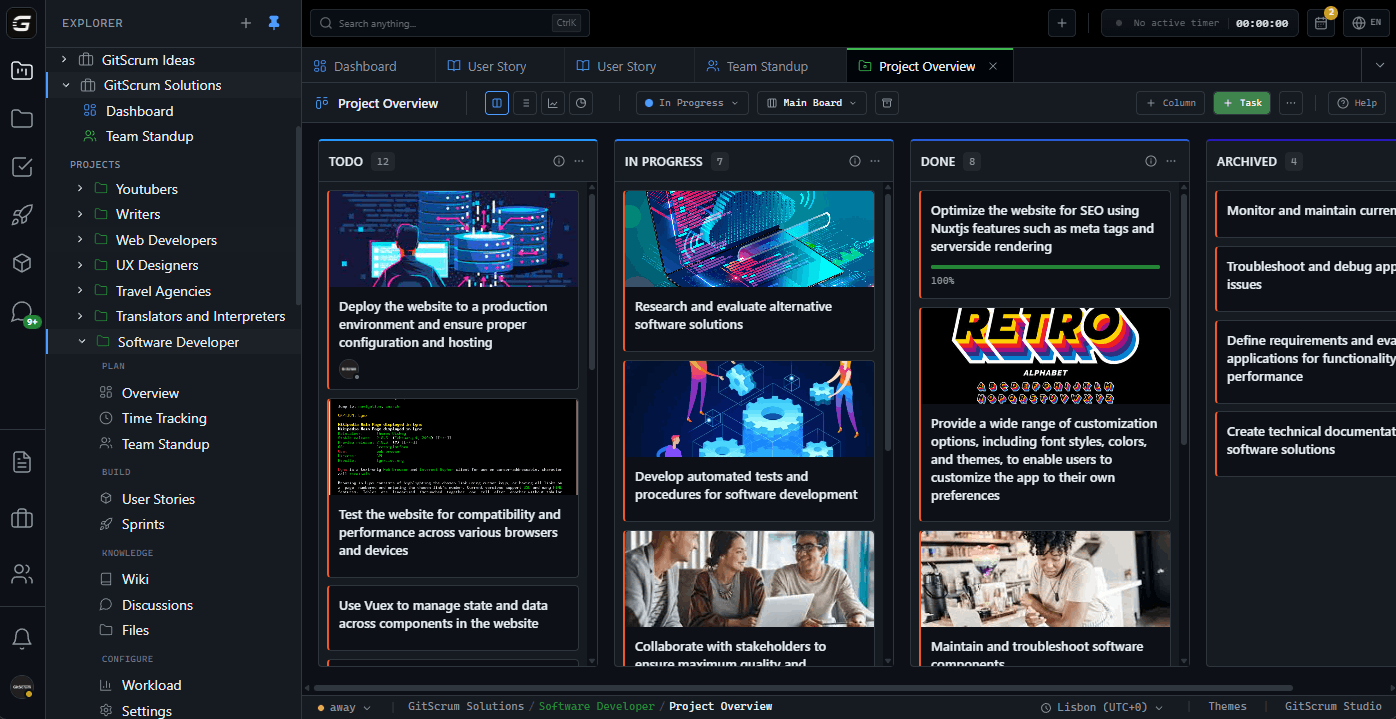
Code in branches. Status updates automatically. Async standups in task comments. Burndown reflects reality.

4

Complete and Improve

Sprint ends, metrics available. Data-driven retro. Pick one improvement. Apply next sprint. Iterate forever.

04

Why GitScrum

GitScrum addresses Agile Task Management for Developers - Ship Fast Without the Ceremony through Kanban boards with WIP limits, sprint planning, and workflow visualization

Problem resolution based on Kanban Method (David Anderson) for flow optimization and Scrum Guide (Schwaber and Sutherland) for iterative improvement

Capabilities

  • Kanban boards with WIP limits to prevent overload
  • Sprint planning with burndown charts for predictable delivery
  • Workload views for capacity management
  • Wiki for process documentation
  • Discussions for async collaboration
  • Reports for bottleneck identification

Industry Practices

Kanban MethodScrum FrameworkFlow OptimizationContinuous Improvement
features.related()

Related Features

View all features

Frequently Asked Questions

Still have questions? Contact us at customer.service@gitscrum.com

How do async standups work?

Team members post daily updates in task comments: Done yesterday, Doing today, Blocked by. Everyone reads when convenient. Blockers trigger immediate notifications. Discussions happen in threads. Same sync value, no 30-minute meeting.

Can I still have regular standups if I want?

Absolutely. GitScrum doesn't force async. If your team prefers daily sync meetings, the board provides perfect context. But async is there when you need it - timezone challenges, deep work days, or just preference.

How does velocity work without story points?

Velocity calculated from tasks completed per sprint, weighted by size (S/M/L). Historical trend shows capacity. No Fibonacci debates. No gaming estimates. Just actual output tracked over time.

Is this still 'real' Agile?

More than most. Agile Manifesto: 'Individuals and interactions over processes and tools.' We prioritize shipping over ceremony, adaptation over textbook compliance. That's the original intent.

Ready to solve this?

Start free, no credit card required. Cancel anytime.

Works with your favorite tools

Connect GitScrum with the tools your team already uses. Native integrations with Git providers and communication platforms.

GitHubGitHub
GitLabGitLab
BitbucketBitbucket
SlackSlack
Microsoft TeamsTeams
DiscordDiscord
ZapierZapier
PabblyPabbly

Connect with 3,000+ apps via Zapier & Pabbly